

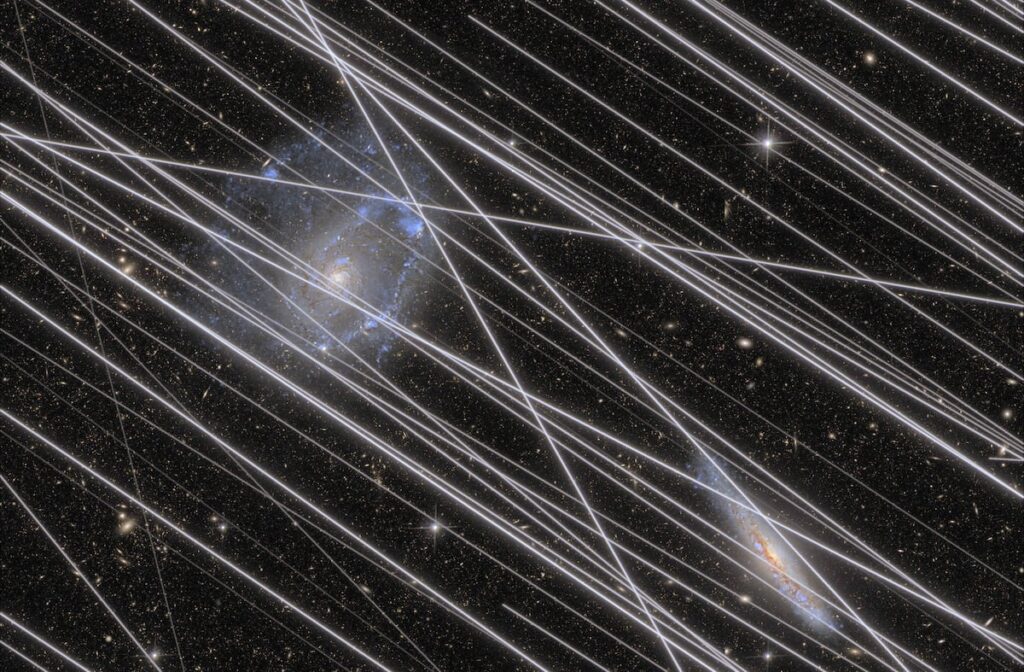
First came the curious lights in the sky after nightfall, which surprised astronomy enthusiasts around the world. The phenomenon, caused by Elon Musk’s Starlink satellite network, initially excited many who encouraged others to witness the luminous trains these satellites created as they ascended. However, the enthusiasm soon turned to concern as astronomers began to protest the interference these lights caused, streaking their telescope images with intense white lines.
This development follows Elon Musk’s promise to minimize the effects of Starlink satellites on astronomical observations—a promise that has yet to be fulfilled. Musk suggested that scientists should not limit themselves to ground-based observatories, implying that the future of astronomy lies in space-based telescopes. However, a new NASA study warns that even space telescopes like the Hubble are not immune to the threat posed by satellite constellations.
Impact on Space Telescopes
The research, led by Spanish astrophysicist Alejandro Serrano Borlaff, highlights that at least one in three Hubble images will be contaminated by satellite light if the planned projects for large constellations like Starlink are completed. These constellations have already sought authorization to launch over 500,000 satellites.
“This is the first scientific study whose main objective is to investigate the effects of light pollution on space telescopes, taking into account these plans announced by the industry,” says Borlaff from NASA’s Ames Research Center in Mountain View, California.
The consequences could be even more severe for the new generation of space telescopes. For instance, the ARRAKIHS mission, the first of the European Space Agency (ESA) to be scientifically led by Spain, could see satellite streaks in 96% of its images, according to Borlaff’s study published in the journal Nature.
Challenges for Hubble and Beyond
The veteran Hubble Space Telescope and the upcoming SPHEREx, set for launch in 2025, are two of NASA’s space telescopes in low Earth orbit. This region is currently home to more than 9,000 Starlink satellites, most orbiting about 340 miles above the Earth’s surface. The study predicts that with 560,000 satellites in orbit, nearly 40% of Hubble’s images will contain at least one satellite streak; for SPHEREx, contamination could reach up to 99%.
Borlaff explains, “The impact of those artificial streaks on images from both NASA telescopes will depend on the scientific objective of each investigation. If the observations can be repeated or combined, it is possible to partially correct the data, though not without some cost.”
He warns that all telescopes would lose some image quality or depth, regardless of the type of observation. “One of the fields that could be most affected is the search for asteroids potentially hazardous to Earth,” he adds.
Discrepancies and Concerns
ARRAKIHS, designed to explore dark matter, is expected to face fewer issues. Rafael Guzmán, leader of the ARRAKIHS team, challenges Borlaff’s findings, stating that the satellite’s orientation will reduce interference. “Since it will be looking towards the Earth’s zenith, the number of satellites passing through its field of view will be much smaller than he estimates,” Guzmán notes.
Carlos Corral, head of the ARRAKIHS project at the ESA, agrees with Guzmán, expressing surprise at Borlaff’s calculations. Corral emphasizes the mission’s robustness, stating, “ARRAKIHS is prepared to deal with natural interference, such as cosmic rays, which is indeed of the magnitude that this new research attributes to satellites.”
“Our previous estimates indicate a much smaller impact, on the order of 1% of the images,” Corral says. “If a satellite, or a cosmic ray, happens to cross an area of interest in those images and invalidates them, we simply take more images.”
Looking Ahead
While ARRAKIHS may escape significant impact, the broader implications of satellite proliferation remain concerning. Corral underscores the increasing challenges posed by space debris and potential collisions, noting, “Filling the sky with tens of thousands of satellites is not a good idea. It’s a problem especially for ground-based telescopes, but you can’t escape that problem even by going into space.”
As the debate continues, the astronomical community faces the pressing need to balance technological advancement with the preservation of our ability to explore the cosmos. The conversation around satellite constellations and their impact on space exploration is likely to intensify as more satellites are launched and as new space telescopes begin their missions.