


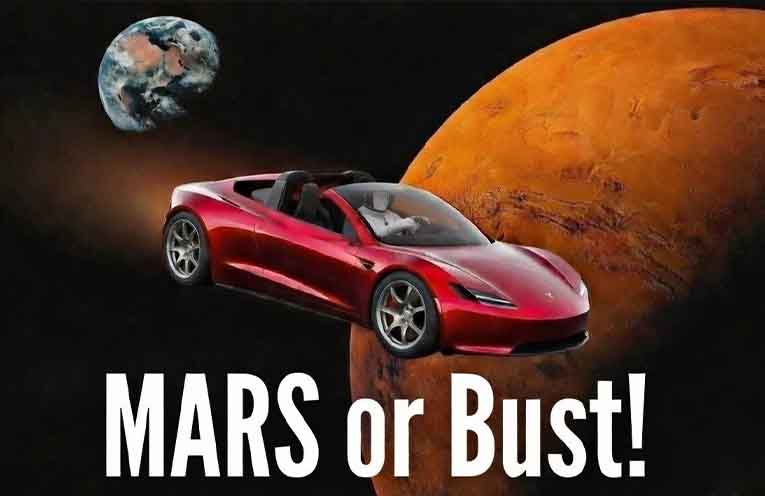
Elon Musk, the ever-present figure in the news, has a knack for capturing the world’s imagination. In February 2018, he did just that by orchestrating a rocket launch that was anything but ordinary. The event featured the debut of SpaceX’s Falcon Heavy rocket, which at the time was the most powerful operational rocket on Earth. However, it wasn’t just the rocket that made headlines; it was its unique payload—a cherry-red Tesla Roadster with a mannequin in a spacesuit, aptly named “Starman,” behind the wheel.
The launch took place at the Kennedy Space Center, where the Falcon Heavy roared into the sky, carrying the sports car and its unconventional passenger. The car’s stereo was reportedly set to play David Bowie’s “Starman,” adding a cultural nod that ensured the moment would be etched into internet lore. This spectacle was not merely a technical achievement but also a masterclass in showmanship.
The Vision Behind the Stunt
The idea of launching a Tesla Roadster into space was a brainchild of Elon Musk, the tech entrepreneur known for pushing boundaries. Instead of using a standard block of test weight, Musk opted for something more engaging. The plan was never to land the car on Mars due to strict planetary protection rules that prevent contamination of the Red Planet with Earthly materials. Instead, the Roadster was placed into a solar orbit that intersects Mars’ path, effectively turning it into a cosmic cruiser of the inner solar system.
The launch itself was an engineering marvel. Two side boosters of the Falcon Heavy separated and landed upright back on Earth with precision, a feat that left viewers around the world in awe. However, the central core missed its target, splashing down in the Atlantic Ocean—a stark reminder of the challenges inherent in space exploration.
Impact and Legacy
Despite the absence of scientific instruments or experiments on board, the launch of the Tesla Roadster captured the imagination of millions. It showcased the blend of serious science and theatrical flair, proving that space exploration could be both technically groundbreaking and visually spectacular. The spectacle was a testament to human ingenuity and the spirit of adventure.
Today, the Tesla continues its solitary orbit around the Sun, occasionally crossing paths with Mars. It may circle for millions of years, a silent symbol of human ingenuity—and perhaps a touch of showmanship.
Expert Opinions and Historical Context
Experts in the field of space exploration have lauded the Falcon Heavy launch as a significant milestone. According to space historian Dr. Robert Zubrin, “The launch demonstrated the potential for cost-effective, reusable rockets, paving the way for future missions to the Moon, Mars, and beyond.” The successful landing of the side boosters was particularly noteworthy, highlighting advancements in rocket reusability.
This event draws parallels with other iconic moments in space history, such as the Apollo 11 moon landing in 1969. While the Apollo missions were driven by scientific discovery and geopolitical competition, Musk’s stunt was more about capturing public interest and inspiring future generations.
Looking Ahead
The launch of the Tesla Roadster was more than just a publicity stunt; it was a bold statement about the future of space travel. It demonstrated the potential for private companies to play a significant role in space exploration, challenging traditional paradigms dominated by government agencies.
As SpaceX continues to develop its Starship rocket, designed for missions to Mars and beyond, the legacy of the Tesla Roadster serves as a reminder of the possibilities that lie ahead. The cosmic joyride, while whimsical, underscores the serious ambitions of humanity’s journey into the cosmos.
In the years to come, as we look to the stars, the image of a red convertible drifting through space will remain a powerful symbol of what can be achieved when innovation meets imagination.