



LONDON — Imagine all of Earth’s oceans, which cover approximately 70% of the planet and are primarily composed of hydrogen. Now, multiply that by nine. This staggering amount may represent the hydrogen content within Earth’s core, potentially making it the planet’s largest hydrogen reservoir, according to recent estimates by researchers.
The study, published Tuesday in the journal Nature Communications, suggests that the core could contain the equivalent of up to 45 oceans’ worth of hydrogen. This translates to hydrogen comprising roughly 0.36% to 0.7% of Earth’s total core weight. This finding challenges previous theories that Earth acquired most of its water through comet impacts, suggesting instead that the planet’s water was primarily acquired during its formation.
Understanding Earth’s Formation
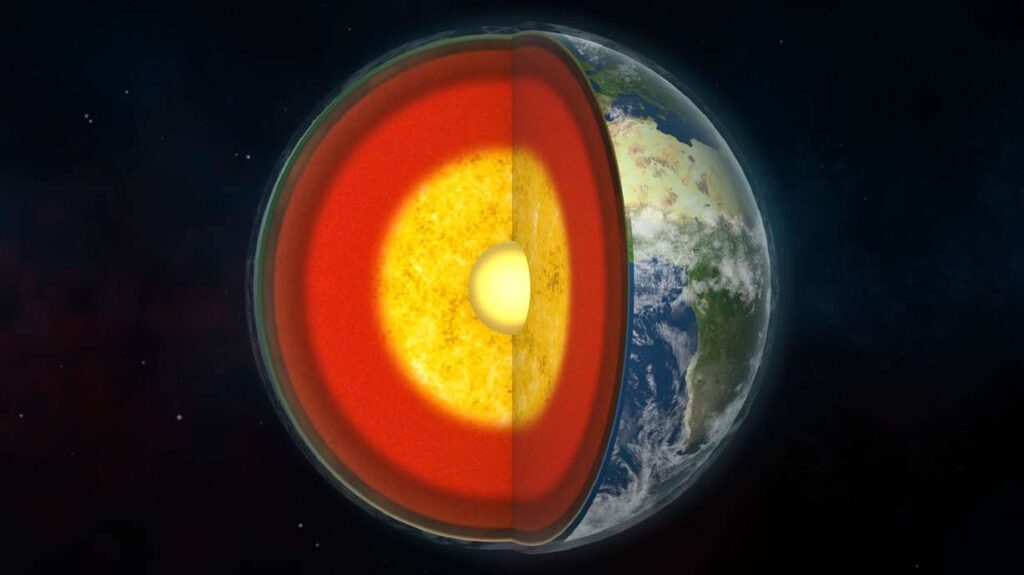
Over 4.6 billion years ago, a young Earth emerged from collisions of rocks, gas, and dust orbiting the sun. These collisions gradually formed the planet’s core, mantle, and crust. The core, a dense, hot, and fluid metal center, is composed mainly of iron and nickel and generates Earth’s protective magnetic field.
“Hydrogen can only enter the core-forming metallic liquid if it was available during Earth’s main growth phases and participated in core formation,” explained Rajdeep Dasgupta, a professor of Earth systems science at Rice University in Texas, who was not involved in the new research.
The Role of Hydrogen in Earth’s Core
Studying hydrogen’s origin and distribution is crucial for understanding planetary formation and the evolution of life. Scientists have long speculated about the amount of hydrogen buried in Earth’s molten metal core. However, the core’s depth and high-pressure conditions make direct observation challenging.
Lead study author Dongyang Huang, an assistant professor at Peking University, noted that hydrogen is difficult to quantify due to its light weight and small size, which exceed the capacities of routine analytical methods.
“Earth’s core would store most of the water in the first million years of Earth’s history,” Huang told CNN.
Innovative Techniques in Hydrogen Estimation
Previous research inferred core hydrogen content using X-ray diffraction to examine iron crystals’ lattice structure, which expands with hydrogen presence. However, these interpretations varied widely, ranging from 10 parts per million by weight to 10,000 parts per million.
The new study employed a fundamentally different technique. Researchers sharpened samples into needlelike shapes, placed them under high voltage, and ionized and counted the atoms individually. This method, known as atom probe tomography, allowed scientists to directly observe hydrogen and other core elements at the atomic scale.
By replicating core temperatures and pressures and using iron as a proxy for the liquid metal core, the researchers observed how hydrogen interacted with silicon and oxygen in nanostructures. They found a hydrogen-to-silicon ratio of approximately 1:1, which helped them estimate the core’s hydrogen content.
Implications and Future Research
The findings provide insights into how heat may have been released from the core into the mantle, initiating Earth’s magnetic field development. However, the researchers caution that more work is needed to confirm and refine these estimates, as uncertainties remain.
“The amount of core hydrogen could be much higher than the new estimate suggests,” said Kei Hirose, a professor at the University of Tokyo, who was not involved in the study.
One area of uncertainty involves the potential loss of hydrogen during decompression, which was not accounted for in the new calculations. Hirose’s previous work estimated hydrogen makes up 0.2% to 0.6% of Earth’s core weight, potentially more than the new study suggests.
If the study’s measurements hold true, it implies hydrogen was delivered throughout Earth’s growth. Gas from nebulas and water from comets and asteroids may have contributed to Earth’s hydrogen supply, according to Hirose.
“Hydrogen is an essential element for life on Earth, along with carbon, nitrogen, oxygen, sulfur, and phosphorus,” noted Dasgupta. “The new paper will definitely inform our future synthesis and discussion on this topic.”
The discovery of hydrogen’s potential abundance in Earth’s core not only reshapes our understanding of planetary formation but also opens new avenues for research into the elements that make Earth habitable.