



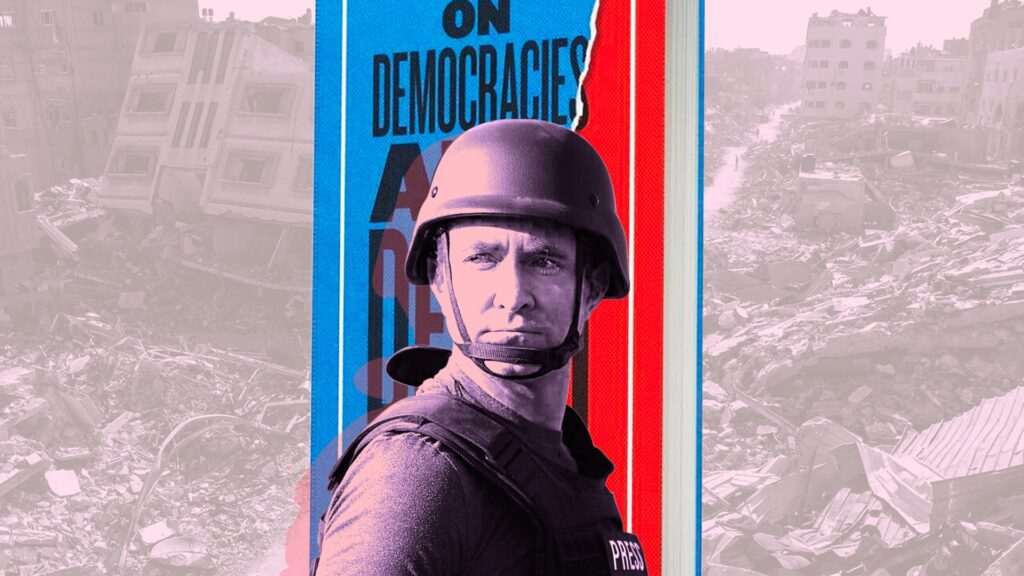
Douglas Murray’s latest book, On Democracies and Death Cults: Israel, Hamas and the Future of the West, has sparked significant debate and criticism for its portrayal of complex geopolitical issues. The book, which delves into the Israeli-Palestinian conflict, is being scrutinized for what critics describe as poor sourcing, factual inaccuracies, and a lack of historical context.
The controversy surrounding Murray’s work is not new. Known for his polemical style, Murray has previously criticized others for spreading misinformation. In an April article for the New York Post, he lambasted guests on the Joe Rogan show for making “demonstrably false” claims, asserting that there should be consequences for spreading misinformation. Ironically, critics now argue that Murray’s own book falls short of the standards he advocates.
The London Protests: A Case of Misrepresentation?
One of the book’s contentious points is its depiction of Palestine solidarity protests in London. Murray claims that the first major anti-Israel march occurred on October 15, while records indicate it took place on October 14. Furthermore, Murray alleges that protestors chased individuals they identified as Israeli, a claim for which he provides no evidence. Interviews with participants, such as Katy Colley, contradict Murray’s account, describing the demonstration as largely peaceful.
Similarly, Murray’s portrayal of the October 21 protest conflates a separate Hizb ut-Tahrir rally with the larger Palestine Solidarity Campaign march. The Guardian reported these as distinct events, with the latter being peaceful according to Metropolitan Police Assistant Commissioner Matt Twist.
Middle East Conflicts: Historical Inaccuracies
Murray’s grasp of Middle Eastern conflicts is also under fire. His narrative on the Yemen conflict simplifies the complex geopolitical dynamics, omitting crucial details such as Iran’s initial advisement against the Houthi takeover of Sanaa. Critics argue that Murray’s omission of the US-backed Saudi intervention, responsible for significant civilian casualties, skews the narrative.
His characterization of Gaza as an “Iranian colony” overlooks Hamas’s political autonomy and the distinct theological differences between the two entities. This perspective ignores the nuanced reality of Gaza’s political landscape and the historical context of Israeli occupation.
Iran’s Influence: A Misguided Allegation
In discussing Iran’s influence in Iraq post-2003, Murray accuses Iran of “colonizing” the country without providing evidence. This claim disregards the cultural and religious ties between Iran and Iraq, as well as the significant role of the US and UK in the region’s destabilization.
Murray’s book is criticized for its “deliberately misleading propaganda and even outright serious factual errors in need of correction,” according to Nathan Robinson in Current Affairs.
Gaza and the West Bank: Questionable Claims
Murray’s assertions about Palestinian intentions and Israeli policies are similarly contentious. He claims that a Palestinian state would exclude Jews, a statement unsupported by evidence. Palestinian leaders have consistently stated that Jews would be welcome to apply for citizenship in an independent Palestine.
Furthermore, Murray’s depiction of Israeli policies as equitable is challenged by data showing significant disparities in health and housing for Palestinian citizens of Israel. Reports from Human Rights Watch and other organizations highlight systemic discrimination, contradicting Murray’s narrative.
Operation Cast Lead: A Misleading Account
Murray’s account of Israel’s 2008-2009 assault on Gaza, known as Operation Cast Lead, is criticized for omitting the context of a broken ceasefire. Reports indicate that Israel’s military actions were aimed at re-establishing deterrence rather than solely stopping rocket fire, a nuance missing in Murray’s narrative.
Conclusion: A Call for Accountability
As Murray’s book continues to attract attention, the debate over its accuracy and integrity underscores the importance of rigorous sourcing and balanced reporting in geopolitical discourse. Critics argue that Murray’s work, while compelling in its narrative, fails to meet the journalistic standards he himself champions.
Harper Collins, the book’s publisher, faces calls to ensure factual corrections in future editions. As the discussion unfolds, the broader implications for public understanding of the Israeli-Palestinian conflict remain significant.