


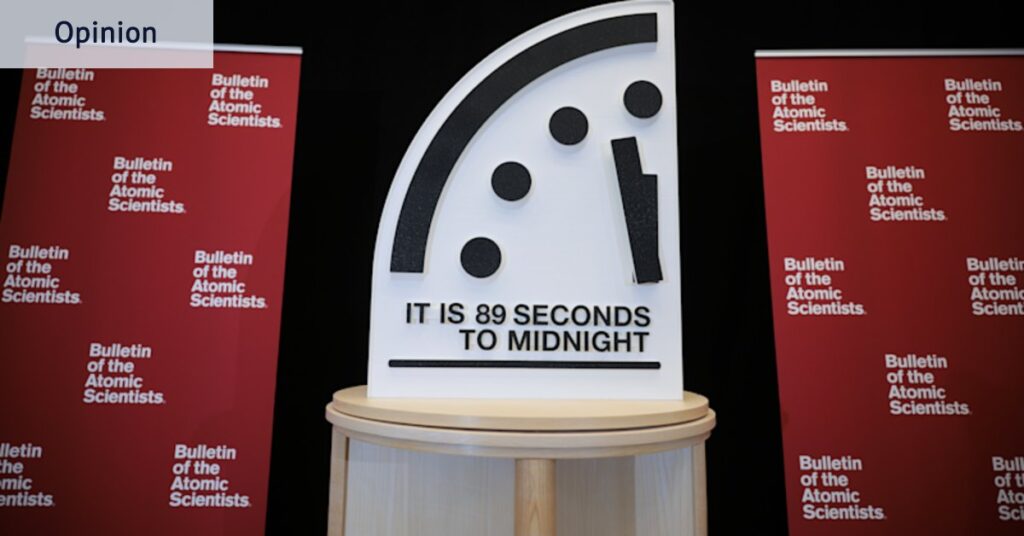
As the world edges closer to the annual resetting of the Doomsday Clock, anticipation builds over what the Science and Security Board of the Bulletin of Atomic Scientists will announce on January 27, 2026. The clock, which symbolizes the likelihood of a man-made global catastrophe, was set to 89 seconds to midnight last year, marking the closest point to doomsday in its history.
The Doomsday Clock, often dismissed as a mere metaphor, carries significant weight. It was conceived by some of the 20th century’s most brilliant minds, including Albert Einstein and Robert Oppenheimer, to alert humanity to the existential threats it faces. Initially set at seven minutes to midnight in 1947, the clock has since evolved to reflect a broader range of dangers beyond nuclear war, including climate change, biotechnology, and the spread of disinformation.
The Evolution of an Ominous Symbol
The clock’s hands have moved numerous times over the decades, reacting to pivotal global events. In 1949, the Soviet Union’s emergence as a nuclear power inched the clock to three minutes to midnight. By 1953, the testing of the first thermonuclear bomb brought it to two minutes. The Cuban Missile Crisis in 1962 was a stark reminder of how close humanity could come to annihilation, prompting efforts like the Partial Test Ban Treaty and the Nuclear Non-Proliferation Treaty.
However, the journey has been far from linear. The 1980s saw renewed tensions as nuclear arsenals expanded, pushing the clock back to three minutes. Yet, the end of the Cold War and disarmament treaties in the early 1990s offered hope, moving the clock to 17 minutes to midnight, the farthest it has ever been from the brink.
New Threats in a Complex World
In recent years, the clock has ticked closer to midnight once more, driven by new and complex threats. The invasion of Ukraine by Russia in 2023, coupled with nuclear threats, pushed the clock to 90 seconds. The past year has seen further deterioration, with the expiration of the last arms-control treaty between the US and Russia looming in February, and both nations modernizing their nuclear arsenals.
China’s expanding nuclear capabilities and the persistent tensions between nuclear-armed neighbors like India and Pakistan add to the precariousness. The advent of artificial intelligence introduces the risk of autonomous weapons systems, potentially reducing decision times in a crisis to mere minutes.
“Artificial intelligence threatens to make many kinds of weapons ‘autonomous’ and shrink decision times in a nuclear crisis to minutes,” experts warn.
Climate Change and Disinformation: Potent Threat Multipliers
Beyond nuclear threats, climate change remains a significant concern. Despite increasing greenhouse gas emissions and worsening weather patterns, the United States, historically the largest emitter, has distanced itself from international climate commitments. The Trump administration’s decision to exit the Paris Agreement and boycott the UN climate conference in 2025 underscores this shift.
Simultaneously, misinformation and disinformation have emerged as potent threat multipliers. The spread of false information blurs the line between truth and falsehood, complicating efforts to address global challenges. John Mecklin, editor of the Bulletin, highlights this danger: “They are ‘potent threat multipliers’ because they ‘blur the line between truth and falsehood.’”
Looking Ahead: A Call for Global Action
As the world awaits the Bulletin’s 2026 announcement, the stakes have never been higher. The Doomsday Clock serves as a stark reminder of the urgent need for international cooperation and decisive action to avert catastrophe. With nuclear risks, climate change, and misinformation all converging, the path forward requires a concerted effort from global leaders and citizens alike.
The clock’s imminent reset is not just a symbolic gesture but a call to action. As history has shown, humanity has the capacity to step back from the brink. Whether it chooses to do so now will determine the future of the planet.