


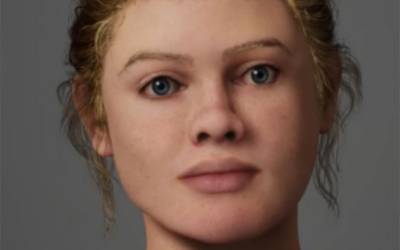
The mystery surrounding the Beachy Head Woman, a Roman-era individual discovered in southern England, has been resolved. Scientists from University College London (UCL) and the Natural History Museum have successfully sequenced high-quality DNA from her skeletal remains, confirming her origins as British.
Previously speculated to have roots in sub-Saharan Africa or the Mediterranean, the comprehensive study published in the Journal of Archaeological Science now reveals that the Beachy Head Woman descended from the local British population of Roman-era southern England. This breakthrough was achieved through the application of cutting-edge DNA sequencing technologies.
Unveiling the Past: Scientific Breakthroughs
Dr. William Marsh from the Natural History Museum, who conducted the DNA analysis, stated, “By using state-of-the-art DNA techniques, we were able to resolve the origins of this individual. We show she carries genetic ancestry that is most similar to other individuals from the local population of Roman-era Britain.”
Since her discovery, little was known about the Beachy Head Woman. Radiocarbon dating indicated she lived between 129 and 311 CE, aligning with the Roman occupation of Britain. Skeletal analysis suggests she was 18-25 years old at the time of her death and stood just over 4.9 feet tall. A healed leg wound hints at a serious but non-fatal injury during her lifetime. Dietary analysis, examining carbon and nitrogen values in her bones, suggests a diet rich in seafood.
The Journey to Discovery
The Beachy Head Woman’s remains were first brought to attention in 2012, discovered in the collections of Eastbourne Town Hall. The box containing her remains indicated they were found at Beachy Head in the 1950s, though details of the excavation remain elusive.
Initial morphometric analysis suggested African origins, leading to her inclusion in a display at the Eastbourne Museum and sparking media interest. In 2017, unpublished DNA work hinted at Mediterranean origins, possibly Cyprus, but was based on limited data. The recent study, however, utilized advanced DNA sequencing technology, retrieving ten times more DNA than previous attempts, allowing for more definitive conclusions.
Andy Walton, PhD student at UCL, explained: “Using newly developed DNA sequencing technology, we were able to retrieve about 10x the amount of DNA from Beachy Head Woman’s remains as the attempt in 2017. It was this, combined with advances in computational methods and genetic datasets which allowed us to tell so much more about her than ever before.”
Implications and Future Research
The study highlights the evolving nature of scientific inquiry and the importance of revisiting historical findings with new technologies. Dr. Selina Brace, senior author and researcher at the Museum and UCL, emphasized, “Our scientific knowledge and understanding is constantly evolving, and as scientists, it’s our job to keep pushing for answers. Thanks to the advancement of technology that has occurred in the past decade since Beachy Head Woman first came to light, we are excited to report these new comprehensive data and share more about this individual and her life.”
This development not only reshapes our understanding of the Beachy Head Woman but also underscores the potential of modern science to unlock the secrets of the past. As technology continues to advance, researchers anticipate further revelations about historical populations and their movements.
The findings about the Beachy Head Woman serve as a reminder of the rich and complex history of Britain during the Roman era. Future studies may continue to build on these insights, offering deeper understanding of the lives and origins of ancient populations.