



February 21, 2026 — 8:55am
Samarkand, a city steeped in history and cultural significance, stands as a testament to the grandeur of the ancient Silk Road. Located in modern-day Uzbekistan, this 3000-year-old city has witnessed the rise and fall of empires, from Alexander the Great to Genghis Khan. Today, it remains a vibrant hub of architectural marvels and historical relics.
Registan Square: A Persian Architectural Masterpiece
At the heart of Samarkand lies Registan Square, a UNESCO World Heritage site renowned for its stunning Persian architecture. While the city has seen its share of conquerors, the most enduring structures date back to the 14th-century Islamic reign of the Turco-Mongol leader Temur. The square is home to three majestic madrassas adorned with intricate blue and turquoise mosaics, offering a visual feast for visitors. As night falls, a mesmerizing light show illuminates the square, providing a free spectacle that captivates all who witness it.
The Amir Temur Mausoleum: A Gilded Legacy
The Amir Temur Mausoleum, another architectural gem, draws visitors with its historical significance and artistic splendor. Known in the West as Tamerlane, Temur was a formidable conqueror whose campaigns left an indelible mark on history. His final resting place is marked by a dark green jade stone, surrounded by a chamber adorned with four kilograms of 24-carat gold leaf. The mausoleum’s white onyx walls and Arabic inscriptions further enhance its grandeur.
Shah-i-Zinda: The Avenue of Mausoleums
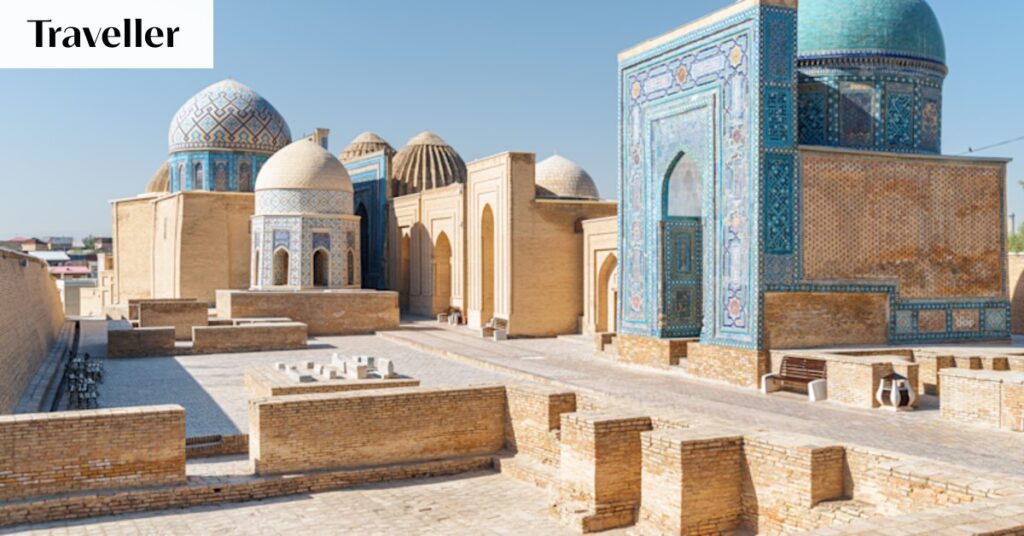
Shah-i-Zinda, often referred to as “the avenue of mausoleums,” offers a breathtaking glimpse into 14th-century Islamic architecture. This necropolis features a series of tombs with striking turquoise and blue tilework, much of which has been meticulously restored. Visitors are particularly drawn to the original majolica tiles in the second tomb on the left, which date back to the late 14th century. Sunrise at Shah-i-Zinda creates an ethereal atmosphere, though it is a popular spot for photographers and influencers alike.
Ulugh Beg Observatory: A Scientific Marvel
The Observatory of Ulugh Beg, built in the 1420s, stands as a testament to the scientific prowess of Temur’s grandson. A mathematician and astrologer, Ulugh Beg constructed this observatory to advance the study of astronomy. The site includes a partially excavated 15th-century quadrant used for naked-eye observations of the sky. Despite his scientific achievements, Ulugh Beg met a tragic end, assassinated by his eldest son due to perceived conflicts with Islamic beliefs.
Bibi Khanym Mosque: A Monumental Marvel
Commissioned by Temur’s primary wife, the Bibi Khanym Mosque is Samarkand’s largest monument. Its grand entrance gate, or pishtaq, soars to 38 meters, while the main dome reaches 40 meters. The mosque complex includes two smaller mosques and a marble book holder crafted for the giant Uthman Koran, dating back to the 7th century. This remarkable piece can be viewed in the Hazrati Imam Complex in Tashkent.
The Siab Bazaar: A Bustling Market
Adjacent to the Bibi Khanym Mosque, the Siab Bazaar has been a vital trading hub for over 2000 years. Spanning five hectares, the market offers a vibrant array of goods, from dried fruits and nuts to ceramics and traditional Uzbek chapan robes. Despite the bustling atmosphere, the bazaar’s dim lighting can make shopping a bit challenging.
Reviving Ancient Papermaking Traditions
On the tranquil banks of the Siab River in Konigil village, the Meros Paper Mill has revived the ancient art of papermaking. Founded by the Mukhtarov brothers, this small outfit uses traditional methods to craft silk paper by hand from mulberry trees. A water wheel powered by the river drives the gears that mash the mulberry wood, preserving a centuries-old tradition.
The writer travelled as a guest of Golden Eagle Luxury Trains. For more information, visit goldeneagleluxurytrains.com.
More: Central Asia, Uzbekistan, Asia
Jenny Hewett is a Sydney-based freelance travel writer who has lived in South-East Asia and the Middle East, and loves nothing more than being among nature and wildlife.