




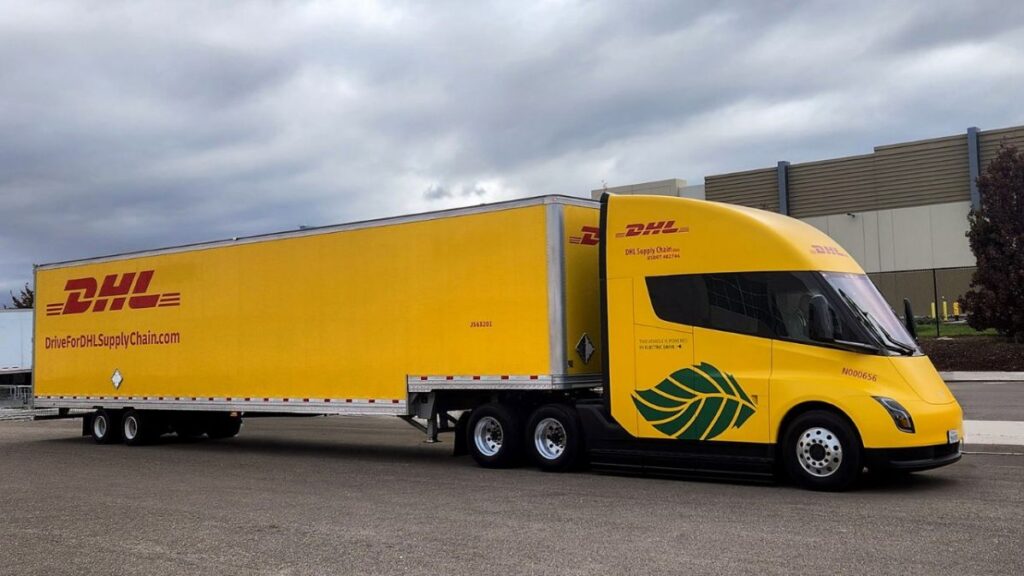
Tesla, renowned for revolutionizing the passenger electric vehicle market, is now making significant strides in the logistics sector with its Tesla Semi electric truck. This move aims to drastically reduce transport emissions and transform the heavy freight industry worldwide.
In a groundbreaking development, DHL, a global leader in logistics, has taken delivery of its first Tesla Semi. The company recently completed a two-week trial, covering nearly 5,000 kilometers, and the results have been nothing short of impressive.
DHL’s Successful Tesla Semi Trial
The trial, initially reported by the American Journal of Transportation and shared by Tesla and EV news enthusiast Sawyer Merritt, saw the Semi trucks operate at an average speed of 80 km/h. Remarkably, the trucks achieved an average energy consumption of 1 kWh/km, positioning them among the most efficient in their class.
Fully loaded tests were also conducted, with one instance showing the Semi successfully covering 628 kilometers while carrying a 34-tonne load. Jim Monkmeyer, President of Transportation at DHL Supply Chain North America, expressed satisfaction with the trial’s outcomes.
“Integrating the Tesla Semi into our fleet is an important step toward achieving our decarbonization goals and delivering more sustainable solutions for our customers,” Monkmeyer stated. “With its range of up to 500 miles, the Semi unlocks opportunities that were previously beyond the limits of heavy-duty EVs, and we’re excited to partner with Tesla to make that a reality.”
Expanding the Fleet and Reducing Emissions
DHL plans to expand its fleet of Tesla Semis in the United States, aligning with its strategy to reduce emissions as a road logistics operator in the coming years. This initiative follows Tesla’s initial deliveries of the Semi to PepsiCo in 2022, which marked the beginning of the truck’s real-world applications.
In May 2024, PepsiCo announced the expansion of its Tesla Semi fleet to 50 trucks, operating out of its California manufacturing and distribution facility. This move underscores the growing confidence in the Semi’s capabilities among major industry players.
Technological Advancements and Future Prospects
Recent months have seen Tesla unveil an updated design of the Semi, boasting several class-leading upgrades. These enhancements include improved range and charging specifications, with the updated model now capable of delivering over 800 kilometers of range and equipped with an 800 kW drivetrain. Energy consumption remains impressively low at 1.06 kWh/km, consistent with DHL’s trial results.
The Semi also features 1.2 MW ultra-fast charging capabilities, utilizing Tesla’s supercharging infrastructure to achieve these speeds. Furthermore, Tesla is gearing the Semi for autonomous operations, leveraging its in-house full-self-driving (FSD) technology, which is already being tested in its Robotaxi fleet and the upcoming Cybercab.
This technological leap could provide operators like DHL with access to some of the most advanced trucking fleets, potentially reducing driver stress and fatigue.
Looking Ahead: The Road to Mass Production
Over the past few years, sightings of the Tesla Semi being used by major retailers like Walmart and Costco have increased, signaling a growing adoption of electric trucks in the logistics industry. As Tesla prepares for mass production of the upgraded Semi in 2026, the industry anticipates a significant shift towards sustainable transportation solutions.
The integration of the Tesla Semi into logistics fleets represents a pivotal step in reducing carbon footprints and enhancing operational efficiency. As more companies follow DHL’s lead, the logistics landscape is poised for a transformative shift towards sustainability.