




After five years of meticulously mapping the universe in three dimensions, the Dark Energy Spectroscopic Instrument (DESI) project is receiving a moment of recognition from the scientific community. In January 2026, DESI will be honored with the American Astronomical Society’s Lancelot M. Berkeley Prize for its outstanding contributions to astronomy. This accolade not only acknowledges DESI’s creation of the largest 3D map of the universe but also its ambitious quest to unravel the mysteries of dark energy.
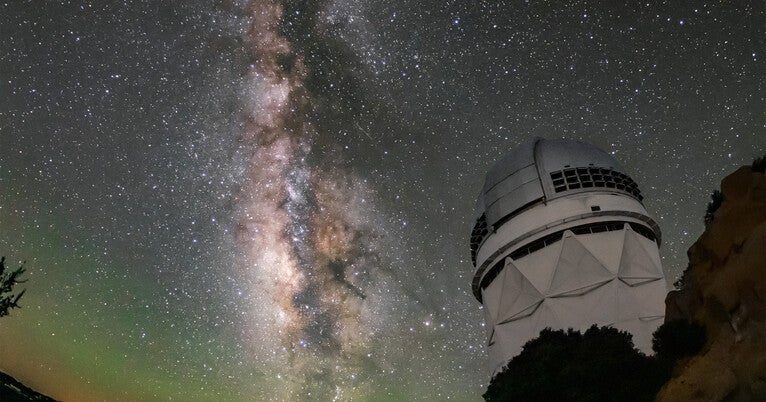
Dark energy, a theoretical form of energy that permeates all of space, is believed by physicists to account for approximately 75% of the universe’s mass-energy content. Unlike other forms of energy, dark energy does not emit light or radiation, making it observable only through indirect methods such as the distribution of galaxies. DESI’s role in this scientific endeavor is pivotal, utilizing the 4-meter Mayall Telescope at Kitt Peak Observatory in Arizona to capture light from 5,000 galaxies simultaneously, mapping over 30 million galaxies and quasars across a third of the sky.
Understanding the Universe’s Composition
The U.S. Department of Energy’s Lawrence Berkeley National Laboratory manages DESI, which comprises 750 researchers from 70 institutions worldwide, including Yale University. Charles Baltay, a co-founding researcher at DESI and the Eugene Higgins Professor Emeritus of Physics and Astronomy at Yale, expressed satisfaction with the project’s progress. “DESI has worked wonderfully well so far,” said Baltay. “We’re even slightly ahead of schedule.”
Yale’s involvement in DESI extends beyond Baltay, with contributions from Nikhil Padmanabhan, David Rabinowitz, and Xinyi Chen, among others. Baltay places DESI within the context of groundbreaking scientific endeavors, emphasizing the fundamental question at its core: “What is the universe made of?”
The Role of 3D Mapping
DESI’s 3D map of galaxies serves a crucial purpose in understanding the universe’s composition. By examining baryon acoustic oscillations—imprints of intense heat from the universe’s infancy—DESI can study galaxy distribution and clustering, testing these observations against the Lambda CDM model, the prevailing cosmological model.
Baltay notes that DESI’s findings suggest the need for new physics to explain the accelerating expansion of the universe, a phenomenon first highlighted by Nobel laureate Saul Perlmutter. This acceleration implies the presence of a repulsive form of energy, possibly dark energy, pushing the universe apart.
“There is an indication from the first year of data that dark energy may not be constant with time, challenging Einstein’s cosmological constant.”
Historical Context and Future Implications
The potential discovery that dark energy changes over time would be a monumental shift in our understanding of the universe, akin to the revolutionary discoveries of quantum mechanics and relativity in the early 20th century. Baltay compares this potential breakthrough to the historical moments when established physics was upended by new findings.
Yale’s significant contributions to DESI include the design and installation of the Fiberview Camera, essential for aligning optical fibers with target galaxies to obtain precise spectra. This technology is crucial for measuring distances to galaxies millions of light-years away, enabling the creation of DESI’s comprehensive 3D map.
Looking Ahead
As DESI continues to analyze its extensive data set, the scientific community eagerly anticipates whether the project will confirm the initial indications of a dynamic dark energy. Such a discovery would not only redefine our understanding of the universe but also guide astronomical research for decades to come.
Baltay reflects on the journey of discovery, drawing parallels to historical scientific advancements. “If the full DESI data set confirms the indication that dark energy is changing with time, it will show that dark energy is different from Einstein’s cosmological constant. It’s an exciting time.”