



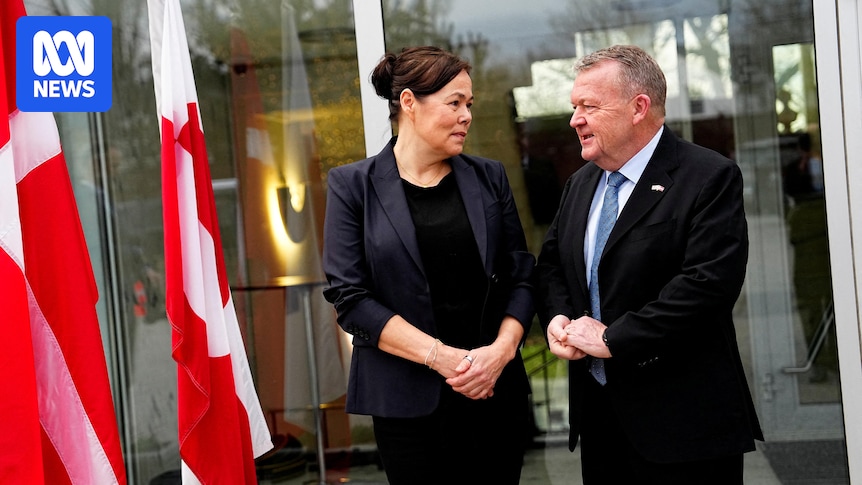
Denmark has firmly stated its opposition to the United States’ interest in acquiring Greenland, declaring such a move “totally unacceptable.” This stance was reiterated during a high-level meeting in Washington on Wednesday, where US Vice President JD Vance and Secretary of State Marco Rubio met with Danish Foreign Minister Lars Rasmussen and Greenlandic Foreign Minister Vivian Motzfeldt.
The meeting was prompted by President Donald Trump’s renewed assertions that the US “needs” control over Greenland to counter perceived threats from Russia and China. Trump suggested that acquiring the island could be a strategic necessity, even hinting at the possibility of using force.
Denmark’s Firm Stance on Territorial Integrity
Foreign Minister Rasmussen acknowledged shared concerns with the US regarding the evolving security landscape in the Arctic. However, he emphasized that these concerns do not justify a US takeover of Greenland. “The big difference is whether that must lead to a situation where the US acquires Greenland, and that is absolutely not necessary,” Rasmussen stated.
To address these issues, Denmark and the US have agreed to establish a high-level working group aimed at finding common ground. “The group, in our view, should focus on how to address the American security concerns, while at the same time respecting the red lines of the Kingdom of Denmark,” Rasmussen added.
Denmark, along with Sweden and Norway, has begun deploying armed forces to Greenland to strengthen its defense capabilities. Germany is also contributing to the effort by sending 13 soldiers on a reconnaissance mission to assess the security situation in the region, according to Reuters.
Greenland’s Strategic Importance
Greenland, the world’s largest island, holds significant strategic value due to its location between Russia and North America. It is a semi-autonomous territory of Denmark, which is a NATO member, and home to approximately 57,000 people. Notably, about 80 percent of Greenland is covered in ice.
Greenlandic Foreign Minister Vivian Motzfeldt emphasized the strong alliance and friendship between the US and the Danish territory, while firmly rejecting the notion of US ownership. “But that doesn’t mean that we want to be owned by the United States,” she stated.
US Perspective and Future Implications
On his Truth Social platform, President Trump argued that Greenland is vital to America’s national security and claimed that “without the vast power of the United States … NATO would not be an effective force or deterrent” against Russia and China.
Following a signing ceremony in the Oval Office, Trump remarked that he had not yet been briefed on the meeting. He sidestepped questions about the US’s commitment to NATO, instead suggesting that Denmark would be defenseless against Russian or Chinese aggression without American support.
As of now, neither Rubio nor Vance has commented on the outcome of the meeting.
Looking Ahead
The establishment of the working group signals a willingness on both sides to explore solutions that respect Denmark’s sovereignty while addressing security concerns. However, the path forward remains uncertain, and the implications of this diplomatic standoff could have lasting effects on US-Danish relations and Arctic security dynamics.
As the situation develops, the international community will be closely monitoring how these discussions evolve and what potential compromises may be reached. The strategic importance of Greenland ensures that this issue will remain a focal point in global geopolitical conversations.