



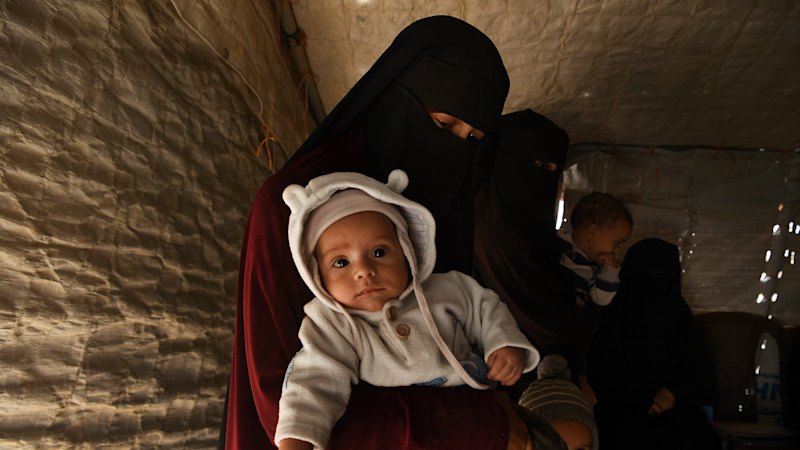
Sami Sheebo, a leader of the Yazidi community in Australia, is deeply concerned about the potential return of Australia’s so-called ISIS brides. Having spent seven years in a Syrian camp, Sheebo fears that these women may not have abandoned the extremist ideology they once embraced. His apprehension is rooted in personal history; he fled Iraq after ISIS fighters invaded his village in 2014, leaving behind mass graves and a legacy of terror.
Sheebo’s concerns are echoed by others who have suffered under ISIS rule. Youel Zaya and Ismail Ismail, Assyrian Christians who escaped Syria, share similar fears. Their village was overrun, their churches desecrated, and they were given an ultimatum to convert or flee. The trauma of their experiences fuels their distrust of the returning families.
Political and Social Implications
The debate over repatriating these women and children has polarized Australian society. On one side, advocates argue that the women were coerced by their husbands and that the children are innocent victims. On the other, critics, including Sheebo, insist that these individuals pose a significant threat to national security.
As Sheebo succinctly puts it, “They are responsible for their life – they made that decision by themselves and they have to accept that.” This sentiment underscores a broader concern about the potential risks these individuals may pose if reintegrated into Australian society.
Expert Opinions and Analysis
Josh Roose, an associate professor at Deakin University and an expert on violent extremism, questions the narratives of coercion. He notes that ISIS’s violent ideology was clear from the outset and that many were drawn to it willingly. Roose highlights that 200 to 300 Australians were attracted to ISIS’s call, one of the largest proportions globally.
Roose explains that some Western women became actively involved in ISIS’s operations, including recruitment and propaganda. However, he admits that little is known about the current cohort’s activities in Syria and Iraq.
“Unless there is an extraordinary claim against them, we’ll probably have to let them back in,” Roose suggests, emphasizing the need for thorough investigations into their past actions.
Challenges of Reintegration
Reintegrating these individuals poses significant challenges. The Australian Federal Police and ASIO have conducted risk assessments, but the details remain undisclosed. Mike Burgess, ASIO’s director-general, noted that the threat level of a terror attack has been adjusted from “probable” to “possible,” factoring in the potential return of these individuals.
Hakamia Ibrahim, the Syrian camp director, described the Australian women as “well-behaved,” contrasting them with others in the camp. However, the lack of concrete evidence regarding their activities complicates efforts to assess their threat level.
Community and Government Responses
Family advocate Kamalle Dabboussy argues that there is no evidence of danger posed by these women, who were primarily focused on survival. He highlights that many women quickly regretted their decisions, facing poor treatment and forced marriages.
Dr. Clarke Jones, a criminologist working with terrorist offenders, acknowledges the complexity of deradicalization programs. He notes that while complete deradicalization may be impossible, disengagement from violence is achievable. The quiet reintegration of those who have returned so far is encouraging.
“No untoward incidents … It’s gone more smoothly than I would have thought,” Jones remarks on the success of existing programs.
The Path Forward
As Australia grapples with this issue, the focus remains on balancing security concerns with humanitarian obligations. Experts like Jones stress the importance of removing children from the camps to prevent further radicalization.
“When they are being continually exposed to IS ideology, then … as each week passes it gets worse,” Jones warns.
The debate over the repatriation of ISIS brides and their children is far from resolved. As discussions continue, the need for robust reintegration programs and careful monitoring remains paramount to ensuring the safety and security of all Australians.