


Dark energy, a mysterious force driving the universe’s accelerated expansion, has long puzzled scientists. Recent findings suggest that dark energy might be evolving, challenging established cosmological theories. This revelation stems from discrepancies in data collected by the Dark Energy Spectroscopic Instrument (DESI), which could have profound implications for our understanding of the universe.
Physicists have observed that the universe’s expansion isn’t aligning with predictions, leading to speculation that dark energy could be changing over time. A pre-print paper by Dr. Slava Turyshev, a prominent advocate of the Solar Gravitational Lens mission, explores whether these discrepancies might actually result from inaccuracies in measuring cosmological features, such as supernovae.
Data Discrepancies and Theories
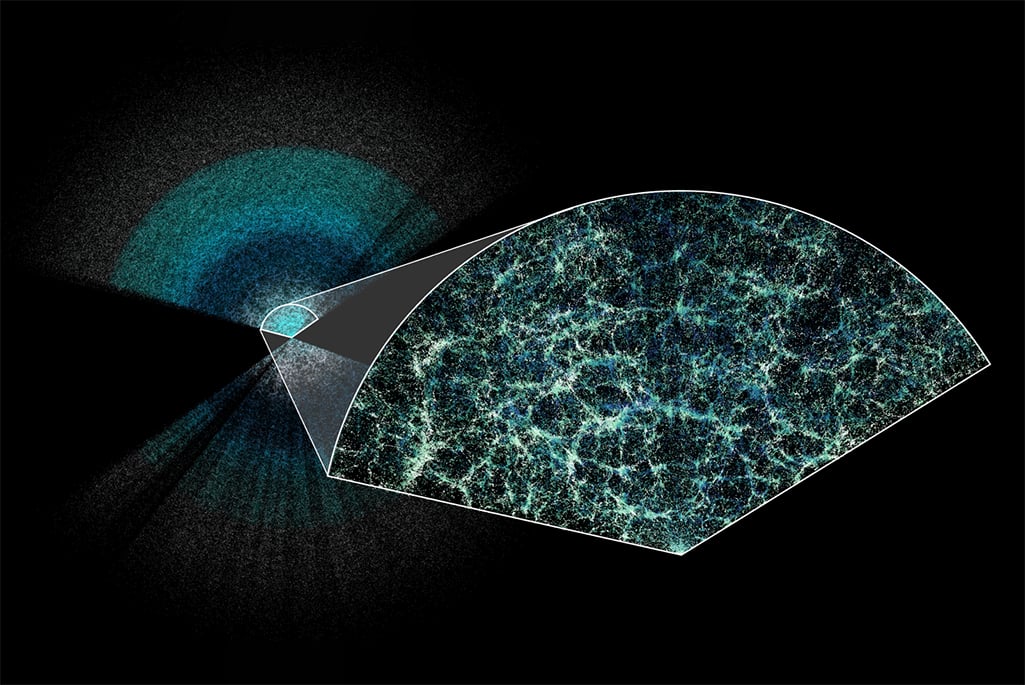
The debate intensified with the release of DESI’s second data batch, known as DR2. Previous studies identified a disconnect between DESI’s galaxy maps and the Cosmic Microwave Background (CMB), the Big Bang’s afterglow. One hypothesis is that dark energy is “evolving,” either strengthening or weakening over billions of years.
Dr. Turyshev, however, urges caution, stating that extraordinary claims require extraordinary evidence. He points out that even a small error in supernova measurements, as little as 0.02 magnitudes, could explain the observed data discrepancies. Supernovae are critical for measuring cosmic distances, and Turyshev questions whether current telescopes can achieve the necessary precision.
The Role of Cosmic Rulers
Another potential source of error involves a “cosmic ruler” known as the “sound horizon.” This measures how far matter moved in the early universe, dictated by sound speed in the primordial plasma. These Baryon Acoustic Oscillations ceased when the universe cooled enough for atoms to form, freezing these patterns in place.
Errors in measuring the sound horizon can cascade into further inaccuracies. To address this, Turyshev proposes using the Alcock-Paczynski (AP) diagnostic, a mathematical approach that doesn’t rely on potentially flawed early-universe measurements.
Exploring New Models
If dark energy continues to fluctuate despite these checks, Turyshev offers new models to explain it. One is the Late-Transition Interacting Thawer (LTIT) model, suggesting dark energy “thaws” over time, gradually interacting more with the universe and driving its expansion.
Another theory, known as “Phantom Crossing,” posits that dark energy might become exceptionally powerful, transitioning into “phantom” energy. If true, this would necessitate a new physics framework, as it doesn’t fit the current standard model.
Ongoing Research and Future Prospects
Despite these uncertainties, the quest to understand dark energy continues. New data from the Euclid probe has been released, offering fresh insights for astrophysicists. Meanwhile, DESI is preparing for its third data release, which will include three years of survey data, expected later this year.
“We are still collecting more evidence on dark energy and its mysteries,” says Dr. Turyshev. “With each new data set, we inch closer to understanding this dark force.”
The scientific community remains hopeful that these efforts will illuminate the nature of dark energy, a force that holds the key to the universe’s ultimate fate. As new data emerges, the debate over dark energy’s evolution will likely continue, promising more discoveries and insights into the cosmos.