




The latest findings from the Dark Energy Survey (DES), a collaborative effort involving researchers from University College London (UCL), have unveiled a groundbreaking approach to measuring the universe’s expansion. For the first time, the survey combined four distinct methods to enhance our understanding of dark energy, the mysterious force accelerating the universe’s expansion and constituting about 70% of its total content.
By analyzing how the universe’s expansion rate varies over time, scientists aim to refine theories about the nature and behavior of dark energy. The recent results, which encompass six years of data on weak lensing and galaxy clustering, offer new insights that significantly narrow down the potential models explaining the universe’s dynamics.
Combining Forces: A New Approach to Cosmology
The DES analysis is a synthesis of 18 supporting papers, presenting initial results from the integration of four probes: baryon acoustic oscillations (BAO), type-Ia supernovae, galaxy clusters, and weak gravitational lensing. This comprehensive approach, envisioned at the inception of DES 25 years ago, has yielded constraints more than twice as stringent as previous analyses, while maintaining consistency with earlier findings.
Advancements in weak lensing methods have been pivotal, allowing scientists to robustly reconstruct the universe’s matter distribution over six billion years of cosmic history. By measuring the probability of two galaxies being a certain distance apart and similarly distorted by weak lensing, researchers can ascertain the amounts of dark energy and dark matter present at various points in time.
Testing Models: Standard vs. Extended Cosmology
In their analysis, DES scientists evaluated their data against two cosmological models. The standard model, Lambda cold dark matter (ΛCDM), assumes a constant dark energy density, while the extended model, wCDM, allows for variability in dark energy density over time. The findings predominantly align with the standard model, though they also accommodate the extended model without showing a significant preference.
Professor Ofer Lahav, a former co-chair of the DES Science Committee and Chair of DES:UK, remarked,
“It is exciting to see results from the full DES data set, more than two decades after the project was first conceived. The sample of 140 million galaxies with shape measurements is phenomenal. While the headline results support a constant dark energy density, future analyses will test the intriguing possibility of an evolving dark energy.”
UCL’s Role and Future Prospects
DES is an international collaboration involving over 400 astrophysicists and scientists from 35 institutions across seven countries. Led by the U.S. Department of Energy’s Fermi National Accelerator Laboratory, the collaboration includes significant contributions from UCL and other UK universities. UCL’s Astrophysics Group has been integral to DES since 2004, contributing to both instrumentation and scientific analysis.
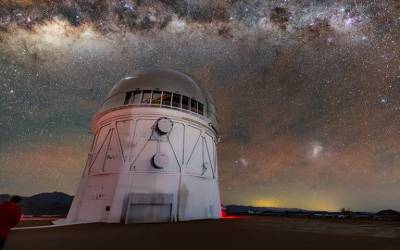
The DES optical corrector, installed on the U.S. NSF Blanco 4-meter telescope, was assembled at UCL’s optical laboratory under the leadership of Professors Peter Doel and David Brooks, with support from a Science and Technology Facilities Council (STFC) grant. UCL’s faculty, post-docs, and PhD students have played crucial roles in DES analyses over the past two decades.
Recent UCL-Led Studies
Recently, UCL has spearheaded several key studies. The method of ‘Simulation-Based Inference’ (SBI) applied to the first three years of DES data has delivered tighter constraints on cosmological parameters. Dr. Niall Jeffrey noted,
“This work demonstrates how scientific AI techniques can improve our understanding of dark energy beyond what is possible with classical statistics.”
Another analysis, based on DES three-year data, examined the spatial distribution of galaxies and mass around clusters and voids. Dr. Qianjun Ellen Hang commented,
“We quantified the correspondence between the distribution of galaxies and matter around troughs and peaks in the projected galaxy density. This method shows an interesting avenue for measuring field-level properties that can be applied to future lensing surveys such as Euclid and LSST-Rubin.”
Furthermore, improved cosmological constraints have been derived from a re-analysis of DES five-year sample of Type Ia supernovae. Dr. Paul Shah explained,
“Using generally accepted thresholds for model preference, our updated data exhibits only a weak preference for evolving dark energy relative to LambdaCDM.”
Other notable contributors to recent DES papers from UCL include Dr. Lorne Whiteway, PhD student Joshua Williamson, and Professor Ofer Lahav.
Looking Ahead: New Horizons in Dark Energy Research
Next, DES plans to integrate these findings with the latest constraints from other dark energy experiments to explore alternative gravity and dark energy models. This analysis is crucial as it sets the stage for forthcoming large surveys such as LSST-Rubin and ESA’s Euclid, in which UCL is actively involved.
The ongoing research not only enhances our comprehension of the universe’s expansion but also opens new avenues for exploring the fundamental forces shaping our cosmos. As scientists continue to unravel the mysteries of dark energy, the DES collaboration remains at the forefront of this exciting field, pushing the boundaries of our understanding and paving the way for future discoveries.