


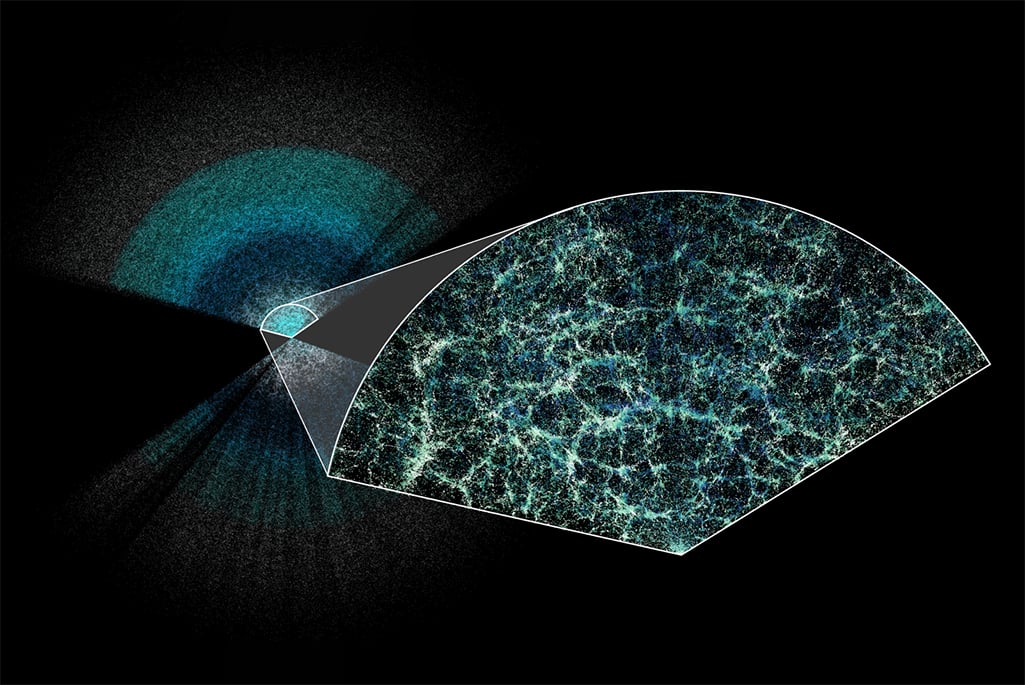
Dark energy, the mysterious force accelerating the universe’s expansion, is under fresh scrutiny as physicists question whether it might be evolving. This debate has gained momentum following new data from the Dark Energy Spectroscopic Instrument (DESI), which suggests discrepancies in the rate of cosmic expansion. A recent paper by Dr. Slava Turyshev, available on arXiv, explores whether these inconsistencies could be due to measurement inaccuracies rather than changes in dark energy itself.
The discussion was sparked by DESI’s second data release, known in astronomical circles as DR2. This data showed a misalignment between DESI’s galaxy maps and the Cosmic Microwave Background (CMB), the afterglow of the Big Bang. One hypothesis for this mismatch is that dark energy is “evolving” over billions of years, either increasing or decreasing in strength.
Challenging the Evolution Hypothesis
Dr. Turyshev, a prominent advocate of the Solar Gravitational Lens mission, argues that extraordinary claims require extraordinary evidence. He suggests that the disconnect between DESI DR2 and the CMB could be explained by inaccuracies in how we measure supernovae. These celestial events are crucial for determining cosmic distances, and even a minor error of 0.02 magnitudes could skew results significantly.
“If our measurements of supernovae are off, it could explain the disconnect,” Dr. Turyshev notes, emphasizing the importance of precision in astronomical observations.
Moreover, another potential source of error lies in the “cosmic ruler” known as the sound horizon. This measures the distance matter moved in the early universe, dictated by the speed of sound in the primordial plasma. Slight inaccuracies in these measurements could further contribute to the observed discrepancies.
Alternative Explanations and New Models
To address these potential errors, Dr. Turyshev proposes using the Alcock-Paczynski (AP) diagnostic, a mathematical approach that bypasses the need for precise measurements of the sound horizon. This method relies on a calculated shape of the universe, offering a potentially more reliable framework.
If dark energy fluctuations persist even after these corrections, Dr. Turyshev introduces the Late-Transition Interacting Thawer (LTIT) model. This theory suggests that dark energy could “thaw” and begin interacting more significantly with the universe over time, explaining the accelerated expansion we observe today.
Another intriguing possibility is the “Phantom Crossing” theory, where dark energy might become overwhelmingly powerful, transforming into “phantom” energy. However, this scenario would require a radical overhaul of existing physics, as it doesn’t align with the standard model.
The Road Ahead: New Data and Future Discoveries
As the scientific community continues to unravel the complexities of dark energy, more data is eagerly anticipated. The Euclid mission recently released its initial dataset, providing fresh insights into this enigmatic force. Meanwhile, DESI is preparing for its third data release, which will include findings from the first three years of its main survey, expected later this year.
These developments underscore the dynamic nature of cosmological research. As Dr. Turyshev and other astrophysicists delve deeper into the mysteries of dark energy, the potential for groundbreaking discoveries remains vast.
“We’re still collecting more evidence on dark energy and all its associated mysteries,” notes one researcher, highlighting the ongoing quest for understanding.
The implications of these findings could reshape our comprehension of the universe, challenging long-held assumptions and paving the way for new scientific paradigms. As the search for answers continues, the astronomical community remains poised for what could be one of the most significant revelations in modern cosmology.