




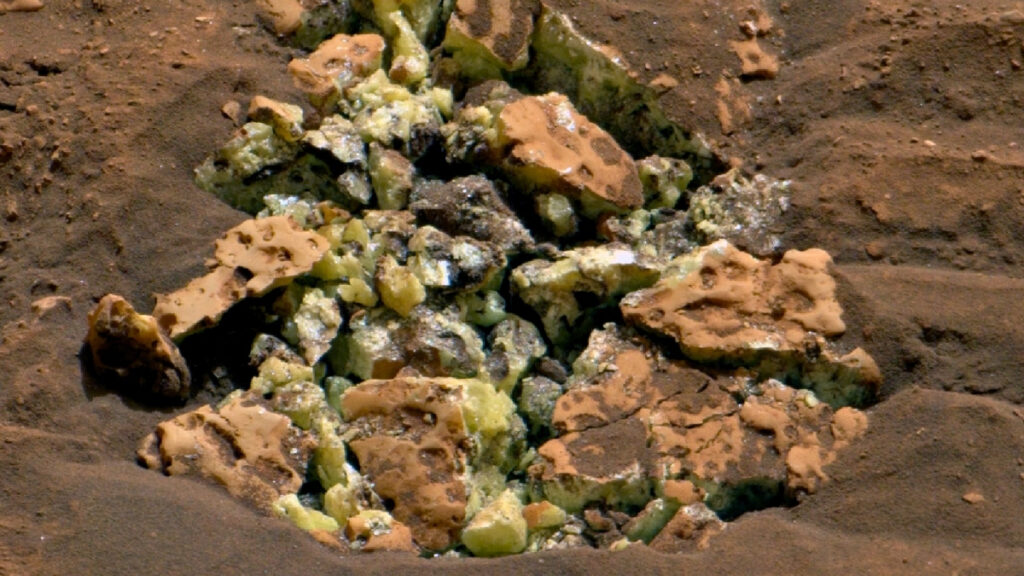
A surprising discovery on Mars has captivated scientists after NASA’s Curiosity rover inadvertently cracked open a rock, revealing a treasure trove of yellow crystals. This unexpected find occurred in May 2023 when the rover’s nearly 900-kilogram body rolled over a fragile mineral deposit, exposing elemental sulfur, or brimstone, for the first time on the red planet.
The discovery took place in the Gediz Vallis Channel, a region now suspected to be rich in similar sulfur deposits. This revelation has sparked excitement among researchers, as it suggests that elemental sulfur might be more abundant on Mars than previously thought.
Unveiling the Unexpected
Elemental sulfur’s presence on Mars is a significant geological puzzle. While sulfates, which form when sulfur compounds mix with other minerals in water, are common on Mars, pure sulfur requires specific conditions to form—conditions not previously known to exist in the region where Curiosity made its find.
“Finding a field of stones made of pure sulfur is like finding an oasis in the desert,” said Ashwin Vasavada, Curiosity project scientist at NASA’s Jet Propulsion Laboratory. “It shouldn’t be there, so now we have to explain it. Discovering strange and unexpected things is what makes planetary exploration so exciting.”
Implications for Mars’ Geological History
The presence of pure sulfur on Mars could offer new insights into the planet’s geological history. Sulfates have long been used to study Mars’ water history and its weathering processes. However, the discovery of elemental sulfur suggests there might be unknown geological processes at play.
“There are a lot of things we don’t know about the geological history of Mars, but the discovery of scads of pure sulfur just hanging about on the Martian surface suggests that there’s something pretty big that we’re not aware of.”
Sulfur is crucial for life as we know it, often utilized by living organisms in the form of sulfates to produce essential amino acids. While the discovery of pure sulfur doesn’t directly indicate life, it adds to the growing list of Martian features that could have supported life in the past.
Curiosity’s Continuing Mission
Curiosity’s serendipitous discovery underscores the challenges and surprises of planetary exploration. The rover’s instruments were able to analyze and identify the sulfurous rocks, but had it not taken the specific route that led to the accidental crack, the sulfur might have remained hidden.
The next steps involve understanding how this sulfur came to be in Gediz Vallis. This will likely require detailed modeling of Mars’ geological evolution. Meanwhile, Curiosity continues its journey, collecting data and uncovering more of Mars’ secrets.
Broader Mars Exploration Efforts
Curiosity’s findings are part of a broader effort to understand Mars’ past and potential for life. NASA’s Perseverance rover, now more than five years into its mission, continues to explore the Martian surface, setting records and making discoveries of its own.
On June 19, Perseverance completed the longest road trip of any robot vehicle on another planet, covering 411 meters in a single drive. This achievement highlights the advancements in rover technology and the ongoing quest to unravel Mars’ mysteries.
The Mars rovers symbolize human curiosity and determination, pushing the boundaries of exploration and expanding our understanding of the universe. As Curiosity and Perseverance continue their missions, the scientific community eagerly anticipates what new discoveries lie ahead.
For more updates, follow Curiosity’s adventures on the rover’s science update blog, and stay tuned for the latest findings from Mars.