




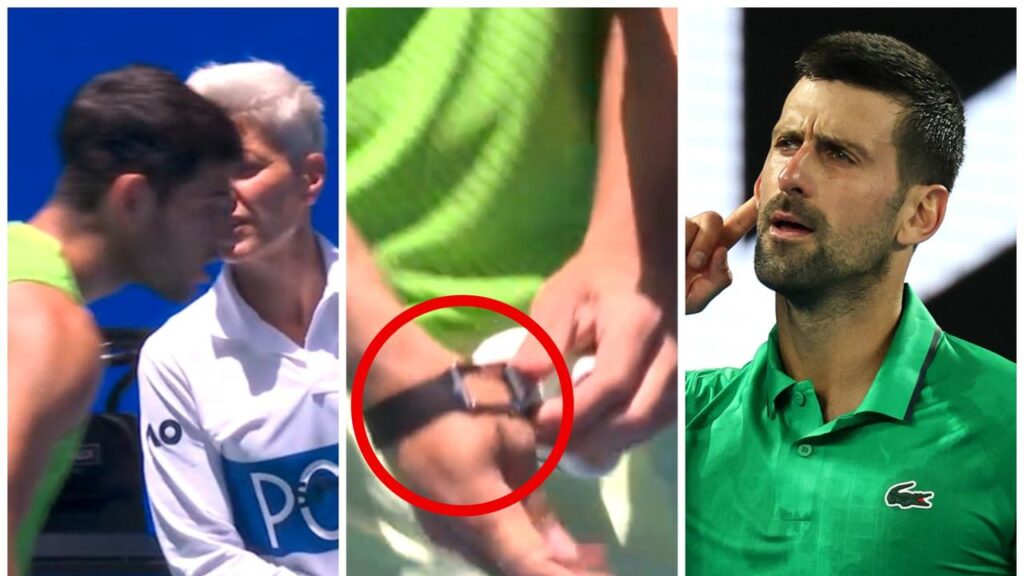
Carlos Alcaraz, the world No. 1 tennis player, found himself at the center of a heated debate during his fourth-round victory against Tommy Paul on Sunday. The controversy unfolded at the Rod Laver Arena when chair umpire Marija Cicak instructed Alcaraz to remove a fitness-tracking Whoop watch from his wrist, citing tournament regulations that prohibit the device. This incident occurred just before his anticipated quarter-final match against Alex de Minaur, where Alcaraz will face the challenge of competing against a home crowd.
The decision to ban the Whoop watch, which is designed to monitor athletes’ physiological data, has sparked outrage among tennis legends and the device’s proponents. Television cameras captured the moment Alcaraz complied with the umpire’s request, but the ruling has not sat well with everyone involved.
Debate Over Technology in Sports
The incident has reignited a broader debate about the role of technology in sports, particularly in tennis. Whoop’s founder, Will Ahmed, took to social media to express his disapproval of the decision, emphasizing that the device is approved by the International Tennis Federation (ITF) for in-match wear and poses no safety risk.
“Ridiculous. Whoop is approved by the International Tennis Federation for in-match wear and poses no safety risk,” Ahmed posted on X (formerly known as Twitter). “Let the athletes measure their bodies. Data is not steroids.”
Australian tennis legends Todd Woodbridge and Lleyton Hewitt also voiced their frustration over the inconsistency in rules regarding the use of such devices. Woodbridge highlighted the disparity between the men’s and women’s games, while Hewitt criticized the ITF’s approach to rule-making.
Calls for Consistency and Clarity
Woodbridge, speaking on Channel Nine, called for greater consistency in tennis regulations. He pointed out that the Women’s Tennis Association (WTA) allows the use of Whoop devices, whereas the ITF does not.
“We saw yesterday that Carlos Alcaraz had the Whoop underneath his sweatband and, of course, it says the WTA have a deal where the women can wear it at their times, the ITF say you can’t wear it,” Woodbridge remarked. “Now, a Whoop is to collect data about how you’re feeling and they worry about perhaps you could use it for coaching.”
Woodbridge questioned the rationale behind preventing players from accessing their own physiological data, which includes vital metrics such as heart rate, sleep patterns, and recovery status.
“Sometimes our rules in tennis, one rule is over here and then the other one says ‘no’. Can we get our rules the same, please?” he added.
Hewitt chimed in, questioning the necessity of the ITF’s involvement in such matters. He referenced the organization’s previous controversies, including issues with the Davis Cup, as reasons to scrutinize their decision-making process.
“Do we really need the ITF? They’ve had a horror with Davis Cup and now with this, making new rules … When you can use it on the WTA Tour, it doesn’t make any sense whatsoever,” Hewitt stated.
The Future of Wearable Technology in Tennis
This incident highlights the ongoing tension between traditional sports governance and the integration of modern technology. Wearable devices like the Whoop watch offer athletes valuable insights into their physical condition, potentially enhancing performance and well-being. However, the lack of uniformity in regulations across different governing bodies complicates their adoption.
The debate raises important questions about the future of technology in sports. As devices become more sophisticated and capable of providing real-time data, sports organizations must grapple with balancing innovation and fairness. The controversy surrounding Alcaraz’s Whoop watch underscores the need for clear, consistent rules that accommodate technological advancements while maintaining the integrity of the sport.
As the tennis world watches Alcaraz’s upcoming match against Alex de Minaur, the discussion around wearable technology is likely to continue. Stakeholders, including players, governing bodies, and technology developers, will need to collaborate to establish guidelines that reflect the evolving landscape of sports science.
Ultimately, the resolution of this issue could set a precedent for how sports integrate technology, potentially influencing policies across various disciplines. For now, the tennis community remains divided, with calls for change echoing throughout the sport.