



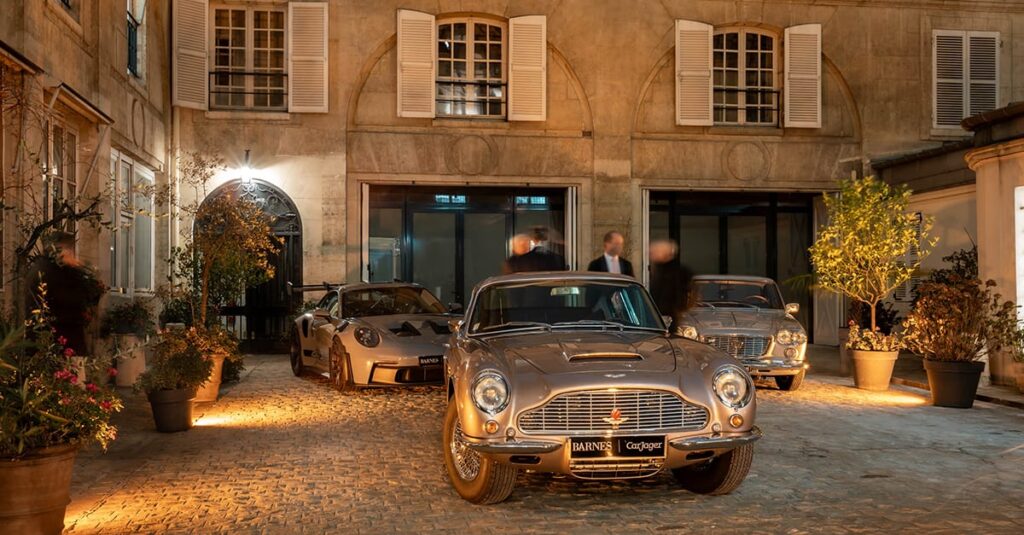
Once the domain of a select few enthusiasts, classic cars have evolved into a significant segment within the realm of tangible assets. These vehicles, which blend cultural heritage with emotional allure, are increasingly relevant in wealth planning. In a rapidly changing economic and societal landscape, the question arises: what is the true significance of classic cars today? How can one evaluate an asset shaped by both generational shifts and technological advancements?
To explore these questions, Lombard Odier France recently hosted an event titled “Classic Cars: Passion or Investment?”. The gathering featured industry experts such as Vladimir Grudzinski, Co-founder and CEO of CarJager, Maxime Lépissier, Partner and expert at CarJager, and Alexis Chardigny, Senior Private Banker at Lombard Odier France, alongside motoring journalist and collector Grégory Galiffi. Their discussions painted a picture of a paradoxical market—one that is expanding yet undergoing profound change.
The Dynamic Growth of the Classic Car Market
The classic car market is witnessing robust growth, with annual transactions reaching EUR 45 billion and an estimated total fleet value of nearly EUR 800 billion by 2024. This market has grown approximately 10% annually since 2000, making it one of the most dynamic and resilient segments in the world of “passion” assets. Alexis Chardigny emphasizes that this trajectory illustrates how tangible assets have become a foundational pillar of alternative asset management.
This expansion is not accidental. It is driven by a rare phenomenon in the world of collectors: the near-uniformity of tastes worldwide. From Paris to Los Angeles, Dubai to Tokyo, classic cars like the Ferrari 275 GTB and Porsche 964RS attract similar interest globally. Maxime Lépissier notes, “It’s a global market. The reference points are the same everywhere. A Ferrari F40 has the same evocative power worldwide.”
The global circulation of vehicles reinforces this market depth. CarJager, a digital trading platform for vintage, classic, and sports cars, conducts nearly half of its transactions outside France, highlighting the market’s fluidity. However, this momentum conceals structural paradoxes extensively discussed by event participants.
Market Accessibility and Opacity
Despite the apparent accessibility offered by the internet, the classic car market remains opaque. Vladimir Grudzinski points out, “The cars available online are only the tip of the iceberg.” Nearly 50% of the market operates off-market, through private networks, discreet collectors, and specialized brokers.
This invisibility creates organized scarcity and confusion. The market is rife with intermediaries, uneven practices, and transactions lacking safeguards. Maxime Lépissier describes the buying experience as “often lengthy, complex, and unsettling,” especially for newcomers unfamiliar with the process.
To address this, CarJager structured its model in 2018, consolidating information and professionalizing each stage of the client journey. Grudzinski likens this digital transformation to “Christopher Columbus discovering America.”
Generational Shifts in Automotive Preferences
A significant transformation is occurring in automotive desires. Iconic models from the 1950s to 1970s are losing their appeal among enthusiasts. Vladimir Grudzinski explains, “The enthusiasts who saw these cars on the streets when they were young are increasingly unable to buy them as they grow older. They pass them on, but the next generation doesn’t identify with the same automotive culture.”
Today’s buyers, aged 30 to 50, are gravitating towards models from their own childhood, such as the Porsche 964 and 993, Ferrari 360 Modena, and BMW M3 E46. These cars offer a blend of analogue charm and mechanical modernity, making them attractive investments. For instance, a Porsche 964 Carrera 2, once priced at EUR 25,000, now sells for over EUR 80,000.
Contemporary Supercars and Market Speculation
The most dramatic price increases have been seen in supercars from the 1990s onwards. The Pagani Zonda LM Roadster, initially priced at EUR 1 million, recently sold for USD 11 million, showcasing the segment’s speculative power.
Ferrari holds a unique position in this market. Its mastery of the primary market, strict car allocations, and “Icona” program enhance its desirability and global demand. However, some hybrids, like the SF90, struggle to retain value due to oversupply and rapid technological turnover. Maxime Lépissier notes, “Even the most prestigious manufacturers struggle with hybrid technology: it looks fantastic on paper, but has sometimes been developed too quickly.”
Challenges in the French Market
While the global collector’s market thrives, France faces challenges. Environmental penalties, weight-based taxes, and potential wealth taxes on cars create a discouraging climate. Maxime Lépissier highlights the disparity: “An Audi RS3, marketed at EUR 80,000, incurs an additional penalty of around EUR 70,000 in France, compared with EUR 80,000 elsewhere in Europe.”
These conditions encourage French buyers to look abroad or reconsider new purchases, potentially strengthening the market’s international dimension.
The Balance of Passion and Investment
One key takeaway from the conference was the emphasis on passion in wealth planning. Vladimir Grudzinski compares buying a classic car to purchasing a horse: “When you buy a horse for EUR 300,000, you know that in 20 years it will no longer be there. Yet you buy it anyway.” This analogy underscores that classic cars are not purely financial assets but “passion” assets requiring maintenance and considered use.
Understanding generational cycles and selecting the right vintages can help anticipate market movements. Grégory Galiffi states, “For exceptional cars from makers such as Ferrari, Porsche, and a few others, the French perspective doesn’t come into it: the value of an F40 is the same worldwide.”
Future Outlook: Evolution Amidst Tradition
Looking ahead, several trends are emerging. Classic models from the 1950s to 1970s will continue to segment into icons and secondary models. “Modern classics” from the 1980s to early 2010s will rise, driven by passionate and financially capable buyers. Ferrari will likely maintain its benchmark status.
The energy transition with electric vehicles may enhance the appeal of exceptional combustion-engine models. Grégory Galiffi notes, “Collecting classic cars will become a luxury leisure pursuit, much like sailing or horse riding.”
In conclusion, the classic car market is undergoing profound transformation, yet passion remains a constant. At Lombard Odier, this vision is part of a broader wealth management strategy, integrating alternative assets into a sustainable framework.