

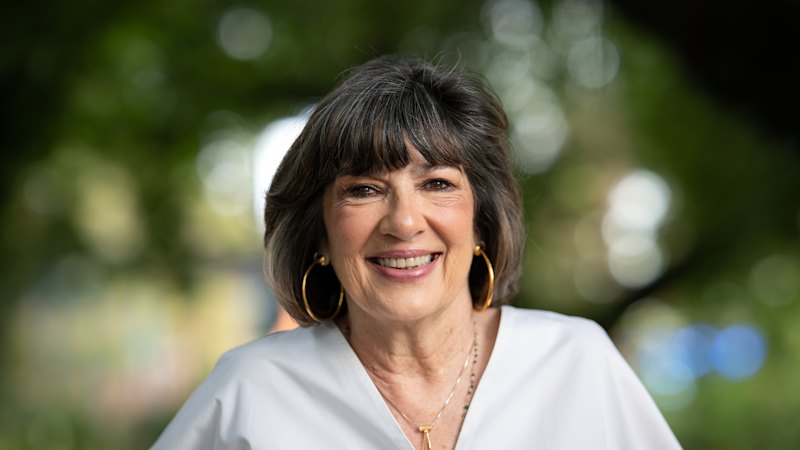
Fizzing with intelligence, warmth, and moral clarity, renowned war correspondent Christiane Amanpour isn’t so much participating in this interview as executive producing it. We meet, incongruously, in an interview room at the Australian Open, Melbourne’s tennis center—a far cry from the front lines where she made her name, firstly reporting on the genocidal Bosnian War of the 1990s and later staring down strongmen and dictators such as Robert Mugabe, Muammar Gaddafi, and Nicolas Maduro.
“You try your best to hold them accountable despite the fear,” she says of her famous news-making interviews. “In our democracy, the function of journalism is a key function that upholds a healthy society.”
Amanpour’s commitment to journalism is unwavering. “I strongly believe that, and I’ve lived my professional life according to that belief that I have to ask the questions, I cannot be afraid, I must push back when I can. And I can’t let them get away with insults, bullying, and lies.”
The Art of Interviewing and Holding Power to Account
How does one interview a legendary interviewer? In nervous preparation, I write five topics on a paper serviette: power, authority, women, tennis, death. But Amanpour is not one for preambles. “Don’t tell me, just ask the questions!” she urges. Her tone is not brusque, but warm and encouraging. Amanpour might have firm ideas about our ride together, but she’s politely taking me along with her.
Our small interview room in a building near Rod Laver Arena is more used to hosting the fears and dreams of Grand Slam tennis hopefuls, but today we are to discuss Trump, Gaza, democracy, dictatorship, world affairs, her new podcast, and—if I can summon up the courage to ask—how she once found herself in bed with famed BBC war correspondent Martin Bell.
The Australian Open has invited the British-Iranian journalist, CNN’s chief international anchor, to headline its Inspirations lecture, following in the footsteps of a variety of figures including ex-prime minister Julia Gillard. Today, the tennis fan (whose attendance at Melbourne Park completes a spectator Grand Slam of all four majors) is dressed in casual spectator chic, with an oversized pink shirt and white slacks. She is, I realize, halfway through proceedings, completely barefoot, her toenails adorned with an expensive pedicure in a shade of rich girl soft peach.
From Graphics Creator to Global Fame
In 1983, Amanpour was a lowly graphics creator at a small NBC channel before starting at the fledgling Cable News Network in another lowly role on the international desk. She received a break when she covered the Gulf War in 1990, and her reports from the genocidal Bosnian War from 1992 onwards brought her global fame.
But she has not interviewed US President Donald Trump, apart from throwing him a few questions about his yacht during his New York socialite phase in the 1980s. “He’s still the same person … acquisitive,” she says drily.
“President Trump is a yacht person. He’s a very rich guy. The idea that he’s appealing to the forgotten is just unbelievable because he’s the elite.”
Here she delivers what is less like an answer and more like a perfectly articulated live cross from a global hotspot. “What he’s done is come into the most powerful office in the world and exercise power,” she continues.
Trump is, she says, the definition of “exhibiting brute force, might makes right,” and pushing the guardrails formed to maintain a coherent world order. “It’s a new thing for our order. It’s not a new thing for dictators and authoritarians and totalitarians all over the world, which I’ve covered. And I’ve said, you know, I’ve been in the ring toe to toe with a lot of them.”
Reflections on a Career in Conflict Zones
She has interviewed the Zimbabwean dictator Mugabe, Libyan strongman Gaddafi, and Slobodan Milosevic, the murderous Yugoslav and Serbian leader who died after he was charged with war crimes. And her advice for anyone seeking to hold authority to account is to try your hardest and be fully prepared.
“The big issue is not to be afraid. This is very important because Trump is wielding power through fear and through bullying of journalists.”
A few days ago, Amanpour was pictured watching a match next to former Australian tennis star John Alexander and recalled as a child watching the Aryamehr Cup in Tehran, where Alexander reached the singles final in 1971.
Amanpour was born in England, and her family moved to Iran soon afterwards as her father was an Iranian airline executive. She returned to England for her schooling, and when the shah was deposed in the 1979 Iranian Revolution, her family lost everything. It prompted her to become a journalist.
“Right now, I am in a pretty terrible situation because I am part Iranian and I’m not allowed back in Iran,” she says, referring to the brutal repression of anti-regime protesters. But she frequently discusses the country’s future with her ex-husband, Jamie Rubin, a former US state department official, in a podcast entitled The Ex Files.
The Bosnian War: A Defining Moment
The Bosnian War changed her life. The Serbs, and their clients, the Bosnian Serbs, used their weapons and ammunition to not just kill the military, but to terrorize, kill, and displace a Bosnian Muslim civilian population.
“I understood that my role was to tell the story, but to not use any kind of factual or moral equivalence,” Amanpour says firmly. It was controversial. Once confronted by a critic, she retorted by asking how they would have expected her to cover the Holocaust.
“You know, people accuse me of taking sides, and I eventually said, ‘Yeah, I’m taking a side for truth.’”
So how does she map that onto Israel and Gaza? “I say that it’s, again, not political – it is about telling the truth. What happened on October 7th was an unexpected, unacceptable heinous crime leveled not just against Israeli soldiers, but against civilians, men, women, and children, who were not only criminally attacked, but also then held hostage. And then you have to say, ‘That’s unacceptable’, and then you watch the response, and you just report on what the response is.”
She points out that journalists have not been allowed to report freely in Gaza, saying “this is an indefensible position.”
“And the people who criticize us for wanting to get there think that it’s political,” she says, her famously modulated voice rising in indignation. “No. Our job is to tell the news from every single side, whether it’s popular or not. It was Ted Turner, the creator of CNN, who taught us that.”
She describes the campaign in Bosnia as a genocide, a judgment backed by international courts. But is that applicable to Gaza? Here the war correspondent is cautious.
“I’m not going to get into that legal terrain, but I will say this. More and more Israelis and Jews are using that term. And these are very thoughtful, learned, considered people who don’t just pop off words for the hell of it.”
Amanpour was born in 1958 and grew up in the shadow of the Second World War and the Holocaust. “I grew up in the world of ‘never again’. When I was covering Bosnia, I couldn’t believe that the world was not intervening.”
“Just like nobody should have accepted what happened in World War II, nobody should be accepting – and this is what I’ve spent my career doing – in Rwanda, in many places, confronting these forces. So that’s where I come from.”
She carries a certain amount of PTSD. “I’m not doing it now, but I could burst into tears talking about Bosnia and stuff like that,” she says. But it is where she learned her moral clarity.
“My slogan is truthful not neutral. I had to learn it myself, nobody taught me that, and I had to learn it under fire. And I had to learn despite the fact that people didn’t like me being truthful. Like tennis players have to train, I was trained in the crucible. Life trained me. I didn’t have a tutor.”
Mention of tennis again leads me to ask Amanpour what she thinks about Australia, a time-honored tradition when interviewing foreign visitors. But she instantly smashes my lob to just inside the baseline.
I start gamely. “How does the Australian Open compare …”
She cuts me off with a glint “… to a war zone?”
But the tennis fan is full of genuine praise about the tournament, its people, and atmosphere. “I think the infrastructure is absolutely fantastic, it’s just beautiful and sleek.”
Personal Anecdotes and Reflections
At another point, I begin a long-winded explanation of reading as a youth BBC correspondent Martin Bell’s 1995 memoir In Harm’s Way, which goes behind the scenes into the frontline lives of correspondents reporting the Bosnian War.
“Are you talking about how we went to bed together,” Amanpour interrupts, laughing.
Bell’s recounting of the incident had stayed with me for decades. The pair were covering an awful Croat massacre of Muslims in central Croatia and staying with a local family, which had only one double bed to spare.
Bell offered to share, and Amanpour accepted, with a caveat, telling him: “‘Listen Martin, I will accept your invitation, but don’t you even try to jump my bones,’ is what I said.”
Bell duly reported all this in his memoir. Was she cross when she read he had written about a private behind-the-scenes moment?
“No. I laughed because it was funny.”
It turns out Amanpour’s sandals are neatly tucked under a side table hidden from my eye line. Just before we part, she expresses her thrill at meeting Olympians Ian Thorpe and Cathy Freeman, and how she was moved by the tournament’s acknowledgment of Country.
“How people push themselves … to excel and succeed, it’s just so exhilarating to watch,” the correspondent says. “It made me feel great. It made it feel like we are all in it together. I’ve been very moved by the references to the ancestors, to the custodians, to the First Nations.”
“I know there are still problems but at least they are saying it here. They don’t say it anywhere else that I know of.”
We leave our interview bubble as soaring temperatures make parts of Australia the hottest place in the world. But as I walk back into that wider world, the record temperatures are not the reason I feel warmer inside.