



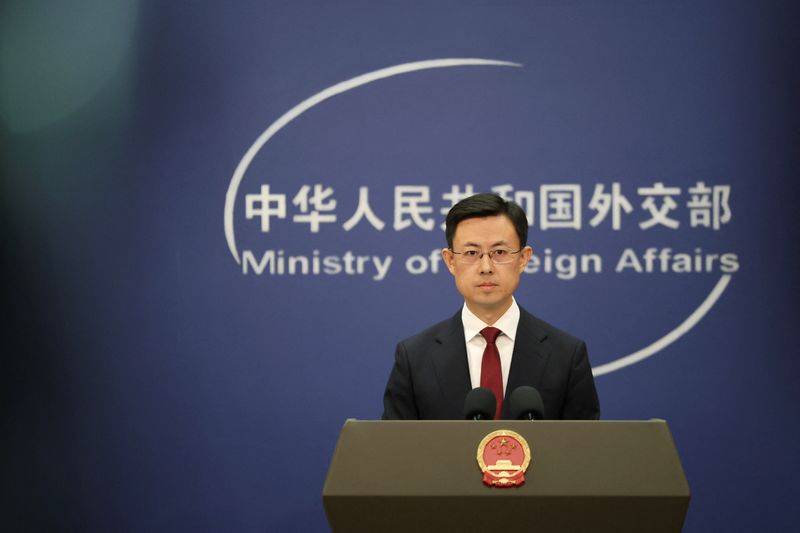
Chinese Foreign Ministry spokesperson Guo Jiakun attends a press conference in Beijing, China January 7, 2025. REUTERS/Florence Lo
BEIJING, Jan 21 (Reuters) – China has announced that its plans for a new embassy in London fully adhere to international diplomatic practices and relevant legal frameworks, according to a statement from a foreign ministry spokesperson on Wednesday. This announcement follows Britain’s approval on Tuesday for China to construct its largest European embassy in the UK capital, a move intended to bolster bilateral relations despite concerns from British and U.S. politicians about potential espionage activities.
Guo Jiakun, a spokesperson for the Chinese foreign ministry, emphasized at a regular press conference that it is the host nation’s international obligation to facilitate the construction of diplomatic premises. “The approval process for the plans followed international diplomatic norms and British legal procedures,” Guo stated.
Historical Context and Local Opposition
The new embassy is planned to be built on the historic Royal Mint Court site, a location rich with two centuries of history. However, the project faced a three-year delay due to opposition from local residents, lawmakers, and Hong Kong pro-democracy activists in Britain. This resistance highlights the complex interplay between local sentiments and international diplomacy.
Tuesday’s approval precedes an anticipated visit to China by British Prime Minister Keir Starmer, marking the first visit by a British leader since 2018. Some officials from both nations indicated that the embassy approval was a crucial factor for the visit to proceed.
Implications for UK-China Relations
The approval for the embassy comes at a time when both countries are seeking to revive what was once termed a “golden era” of business dialogue. According to sources, Prime Minister Starmer’s visit is expected to include top executives from both nations, signaling a potential thaw in economic relations.
Despite the diplomatic overtures, the decision has not been without controversy. Critics in the UK and the US have voiced concerns that the new embassy could serve as a hub for intelligence activities. This apprehension is part of a broader narrative of suspicion surrounding China’s global diplomatic infrastructure.
Expert Opinions and Forward-Looking Analysis
Experts in international relations suggest that the embassy’s approval is a strategic move by the UK to maintain a balanced relationship with China amidst global geopolitical tensions. According to Dr. Emily Chen, a professor of international diplomacy, “The UK is navigating a delicate path, trying to engage economically with China while addressing security concerns.”
“Deeper cooperation and exchange between China and Britain serve their interests and those of the world, particularly in the ‘unstable and turbulent’ global situation,” Guo Jiakun noted.
The decision to approve the embassy could also be seen as a pragmatic approach to ensure continued dialogue and cooperation on global issues such as climate change and trade, where China plays a pivotal role.
Next Steps and Potential Outcomes
As the embassy construction moves forward, the UK government will likely continue to monitor the situation closely, balancing diplomatic engagement with national security considerations. Meanwhile, Prime Minister Starmer’s upcoming visit to China could set the tone for future interactions between the two nations, potentially paving the way for renewed economic and cultural exchanges.
The international community will be watching closely to see how this development influences broader geopolitical dynamics, particularly in the context of UK-China relations and their impact on global stability.