

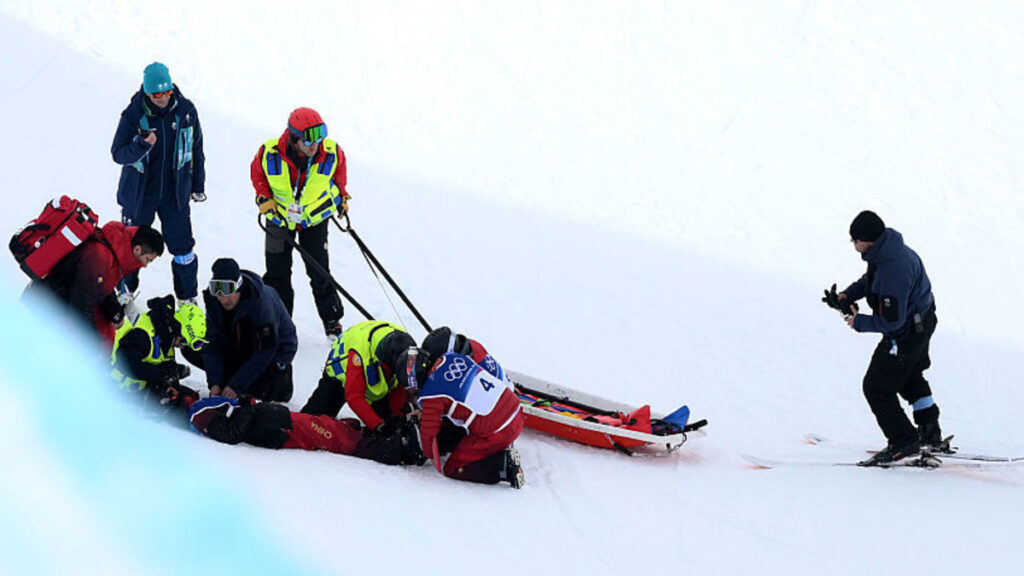
Standing atop the halfpipe in Livigno, Australian snowboarder Emily Arthur faced an unsettling sight as China’s Liu Jiayu suffered a severe crash during her second qualifying run. The incident, which occurred on the slopes of the women’s snowboard halfpipe competition, led to a ten-minute delay as medics attended to Liu, who was eventually stretchered off the course.
The Chinese athlete, known for her prowess in the sport, was nearing the completion of her run when a miscalculated trick resulted in a hard fall. The vibrant atmosphere, characterized by cheering crowds and lively commentary, quickly turned somber as the gravity of the situation became apparent. Despite the disruption, Arthur had to maintain her focus, preparing to start her run once the course was cleared.
Impact on Competitors
Emily Arthur, reflecting on the incident, shared her thoughts with Australian reporters, including Wide World of Sports. “It is a lot to handle,” Arthur admitted, recalling a similar experience at the World Championships in Georgia that left her shaken. Although she didn’t witness the crash directly, the sound of the sled being called was enough to unsettle her.
Arthur’s brother, also her coach, advised her to avoid watching the scene and to stay relaxed. The 26-year-old complied, but the fear of a similar fate loomed large. “I am so scared, we all are,” she confessed. “We see people get hurt a lot. I knew what I was trying [on the halfpipe] was close enough and safe, so I knew I’d be fine.”
Despite the alarming incident, Liu Jiayu was reported to be “awake and alert” after the crash, aware of her surroundings despite having hit her head on landing. Such crashes are not uncommon in the high-risk world of snowboard halfpipe, both in training and competition.
Challenges for the Australian Team
The Australian team faced additional hurdles, as Arthur’s teammate Misaki Vaughan had to withdraw from the competition after a training crash resulted in a concussion. Vaughan’s helmet cracked upon impact, underscoring the dangers inherent in the sport. The team provided an update on her condition, stating she was experiencing “minor symptoms” and remained under medical supervision in the athletes’ village.
Amelie Haskell, another Australian competitor, also faced difficulties. Her second run ended in a crash, preventing her from securing a spot in the finals. In an interview interrupted by Jiayu’s crash, Haskell expressed the emotional toll of competing after Vaughan’s accident. “Misaki’s so cool and we have a little girl group,” she said. “We’ve got Emily and Misaki and I, and we all train together, so it’s such a bummer not to have all three of us.”
High Stakes and Bold Moves
When it was finally her turn, Emily Arthur opted for a bold approach, aiming for a high-risk, high-reward performance. At 26 and in her third Olympics, Arthur was determined to leave it all on the line. “I knew it was a risk to [do what I did], but I was willing to take that risk. If I landed, I would have made finals, but I am glad I went for the risk. I am proud of myself.”
Haskell, just 18 and making her Olympic debut, shared a similar mindset. “My first run was pretty good. It was sick to land a run,” she said. Encouraged by her coach to go big on her second run, Haskell emphasized the camaraderie and excitement of competing at this level. “It is so cool to be here. I am just really hyped to just be here. Rather than [looking at] my result and everything, it is so nice to be with all the girls, competing and training with each other.”
Top Performers and Future Prospects
Despite the challenges faced by many, American snowboarder Chloe Kim delivered an outstanding performance. The two-time gold medalist secured her place in the finals with a score of 90.25 on her first run, allowing her to take a more relaxed approach on her second attempt. Kim’s return to competition was notable, having recently recovered from a shoulder injury.
As the competition progresses, the 12 qualifiers will return to the Livigno halfpipe for the final showdown. The event promises to deliver thrilling performances as athletes push the boundaries of the sport, all while navigating the inherent risks that come with high-level snowboarding.