



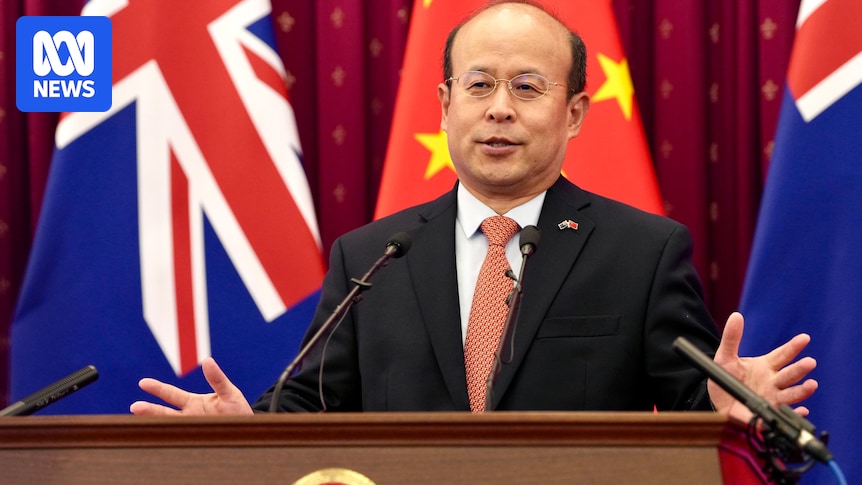
China’s ambassador to Australia, Xiao Qian, has raised concerns over the Australian government’s intention to reclaim the Port of Darwin from Chinese control, suggesting potential retaliatory measures. The move, he argues, appears motivated by financial gains, as the port recently turned profitable.
Both Prime Minister Anthony Albanese and the Coalition had pledged to terminate Chinese company Landbridge’s 99-year lease of the port by the 2025 federal election. However, eight months on, no concrete deal or timeline has been established for this reversal.
In a rare press conference on Wednesday, Mr. Xiao confirmed ongoing “communication” between Beijing and Canberra regarding the port. He questioned the motives behind Australia’s pledge and warned that altering the arrangement could affect China’s “substantive investment” in the country.
“Starting from last year, Darwin Port stopped losing money and started to make money. It was at this juncture that suddenly we hear the government of Australia wants to take [it] back … so I really question the ethic value,” he said.
Background and Economic Implications
Landbridge acquired the 99-year lease for the Port of Darwin in 2015 for $506 million, a transaction that raised alarms in Washington and was discussed by former US President Barack Obama with then-Australian Prime Minister Malcolm Turnbull. Last financial year, Landbridge reported a $9.6 million profit, a significant recovery from a $37 million loss the previous year.
Mr. Xiao highlighted that Landbridge’s ownership had encouraged “many more Chinese companies” to invest in Australia. He cautioned that any changes to the lease could have economic repercussions and might prompt a diplomatic response from China.
“If anything happens, like the port [being taken] back by force or forceful measures, then we have an obligation to take measures to protect the Chinese company’s interest. That is our position,” he asserted.
He further noted that over the past decade, Landbridge had heavily invested in the infrastructure surrounding the port. The potential forced exit of Landbridge, he argued, could negatively impact investment, cooperation, and trade between Chinese companies and Australia.
Australian Government’s Stance
In response to Mr. Xiao’s comments, Prime Minister Albanese reiterated the government’s commitment to reclaiming the port. Speaking to reporters in Timor-Leste, he emphasized that returning the port to Australian control aligns with national interests.
“We are committed to making sure that that port goes back into Australian hands because that is in our national interests,” he said.
Military Exercises and Diplomatic Tensions
In a related development, Mr. Xiao sought to downplay concerns over a Chinese navy task group’s circumnavigation of Australia in early 2025. The exercises, which included live fire drills about 300 nautical miles southeast of Sydney, coincided with the onset of Australia’s federal election campaign and were initially reported by a commercial pilot.
Mr. Xiao urged Canberra not to misinterpret China’s intentions, emphasizing that the military activities were not aimed at Australia.
“It just happened to be connected in that region, in that part of the world. It happened to be near Australia, but not in Australian territory, or even in the EEZ, the exclusive economic zone,” he explained. “It has nothing to do with Australia.”
Broader Geopolitical Context
Amidst these tensions, Mr. Xiao reiterated China’s unwavering stance on Taiwan, echoing President Xi Jinping’s commitment to reunification. He criticized Australia’s Department of Foreign Affairs for its “misleading statements” regarding Chinese military exercises around Taiwan, which were described as “deeply concerning.”
Beijing maintains that Taiwan is a province of China, while countries like Australia and the United States advocate for maintaining the status quo, recognizing Taiwan as a self-governing democracy.
The unfolding situation highlights the complex interplay between economic interests and geopolitical strategies, with potential implications for diplomatic relations and regional stability.