




In a groundbreaking study, researchers at the University of Michigan have unveiled a theoretical framework that could enable synthetic materials to mimic the lifelike movements of living tissues. This development, published in the journal Physical Review Letters, could revolutionize applications in robotics and other advanced technologies by creating materials that can beat, twitch, and shiver like human muscles.
The study, titled “Mechanochemical feedback drives complex inertial dynamics in active solids,” highlights how chemical reactions sensitive to force can power engineered materials. “Our interest was to think about fast movements,” said Suraj Shankar, an assistant professor of physics at the University of Michigan. “If we want to make soft engines and soft machines that pack a punch and can drive extremely fast motions, that’s a really difficult task.”
Biological Inspiration for Synthetic Innovation
Drawing inspiration from biology has long been a strategy for scientists and engineers aiming to develop soft, elastic, and lightweight materials for engines, robots, and other devices. However, replicating the active, powerful features of living tissue remains a significant challenge. The University of Michigan’s model suggests a pathway to overcome this hurdle by coupling a material’s internal mechanics with its chemistry.
“Think of a passive soft material, like a piece of rubber,” explained Xiaoming Mao, a professor of physics and senior author of the study. “If you stretch it, it’ll slowly go back and relax to its original shape. The language we’d use to describe that is to say the energy gets dissipated through the damping of the material.”
The Role of Chemical Reactions
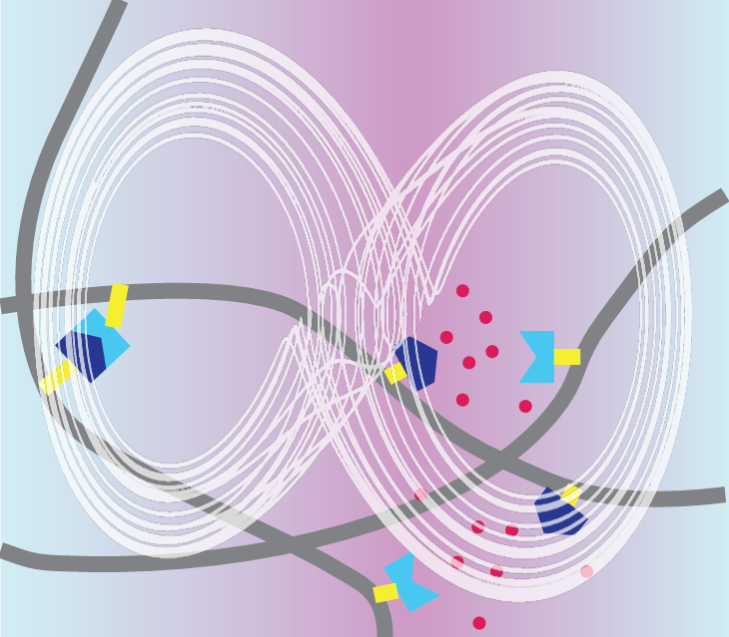
The key to this innovation lies in the material’s ability to contain reactive chemical ingredients that provide energy through their reactions. These reactions must be sensitive to the forces exerted when the material is deformed. This coupling creates a positive feedback loop that counteracts natural damping behavior, making the material’s motion more complex and lifelike.
“This property that is usually neglected—the inertia of the system—is actually important,” said Biswarup Ash, a research fellow and co-author of the study. “It actually generates this interesting behavior.”
Chaos as a Catalyst
The study reveals that if the feedback loop is sufficiently strong, the material’s motion becomes chaotic. “Imagine you have a gel that’s shivering or twitching,” Shankar noted. “That’s physically what this sort of chaotic behavior would look like for an actual material.” Although these active materials have yet to be fully realized, individual components of the feedback cycle have been demonstrated in other experiments.
For instance, some materials change color when compressed due to a chemical reaction, while others have engineered reactions that cause them to change shape or move. “As far as we know, though, these components have not been combined together,” Mao said. “But it’s plausible that in the near future they could be, with some smart chemistry.”
Future Implications and Applications
The implications of this research are vast. By harnessing chaos theory and mechanochemical feedback, scientists could create synthetic materials with unprecedented capabilities, potentially transforming fields such as robotics, medicine, and materials science. The study was supported by the U.S. National Science Foundation, U.S. Army Research Office, and Office of Naval Research, underscoring the significance of this research in advancing technology.
The study’s co-authors include Siddhartha Sarkar, a U-M postdoctoral scholar; Nicholas Boechler, a professor of engineering at the University of California, San Diego; and Yueyang Wu, a U-M undergraduate researcher. Their collaborative efforts highlight the interdisciplinary nature of this research, bridging physics, engineering, and chemistry to pave the way for future innovations.
As researchers continue to explore the potential of these active materials, the prospect of creating lifelike synthetic materials that can perform complex, energetic movements remains an exciting frontier. With further advancements, the line between biological and synthetic could blur, leading to new technologies that enhance our capabilities in unprecedented ways.