




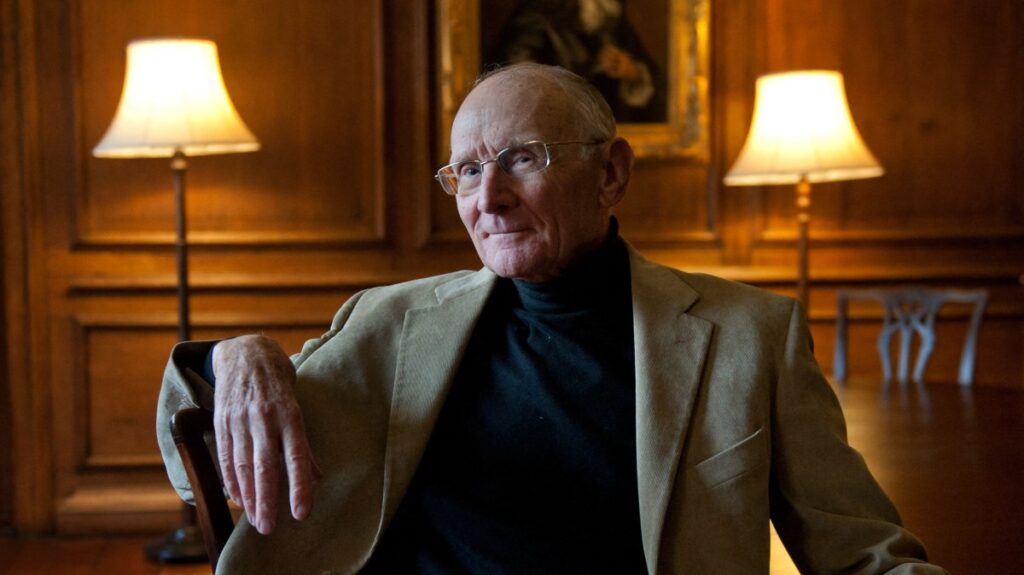
John Carey, who served as the chief literary critic for The Sunday Times for an impressive 46 years starting in 1977, was a stalwart of the literary world. Renowned for his unwavering commitment to the craft, Carey produced a review every fortnight, regardless of the circumstances. His dedication and distinctive approach made him an ideal literary critic.
In his personal life, Carey was known for his modesty and ascetic lifestyle, shunning the superficial aspects of the literary scene. He avoided literary parties and maintained a small circle of literary acquaintances, ensuring that his focus remained solely on the integrity of his reviews. His moral compass, shaped by his lower-middle-class upbringing and Orwellian egalitarian ideals, often led him to critique the pretentiousness and elitism he perceived in literary circles.
Unyielding Integrity and Controversial Critiques
Carey’s commitment to honesty in his critiques sometimes led to dramatic encounters. At a Sunday Times Books Christmas party, a fellow critic, upset by a review, poured a glass of wine over Carey’s head. This incident underscored Carey’s reputation for not allowing personal relationships to influence his professional assessments.
His intellectual prowess was undeniable. As the Merton Professor of English Literature at Oxford University for 25 years, Carey authored insightful books on literary giants such as Dickens, Milton, Thackeray, and John Donne. He had a knack for making complex ideas accessible, often employing humor to engage his readers. In one memorable critique, he described the Victorian historian Thomas Carlyle as “so poisonous it’s a wonder his mind didn’t infect his bloodstream.”
A Diverse and Enthusiastic Reviewer
Carey’s versatility as a critic was evident in the breadth of his interests. He was as comfortable reviewing a book on Tintin as he was discussing the works of Tintoretto. His enthusiasm for reviewing was unparalleled; he likened the process to a drug, expressing restlessness if he didn’t have a project in hand. His editor at The Sunday Times recalled Carey’s eagerness to tackle new books, noting his prompt and thoughtful selection of titles to review.
Despite his popularity, Carey was not without his detractors. His 1992 book, The Intellectuals and the Masses, criticized the elitism of literary modernism, earning him criticism from some quarters. Similarly, his 2005 work, What Good Are the Arts?, stirred controversy by challenging cultural norms.
Admiration and Influence
Nevertheless, Carey garnered a legion of admirers. Nobel laureate Kazuo Ishiguro praised him for his ability to infuse academic insights with personal experience. Dominic Sandbrook, a fellow reviewer, admired Carey’s courage, clarity, and enthusiasm, describing him as “totally unstuffy, democratic and populist in the best sense of the word.”
Carey’s influence on literary culture was profound. He was instrumental in bringing attention to emerging talents, such as a young Seamus Heaney, whose early works Carey championed. His impact extended beyond his reviews; he shaped the editorial direction of The Sunday Times books pages, setting a standard of clarity and engagement that his colleagues aspired to emulate.
A Lasting Legacy
John Carey’s legacy as a literary critic is unmatched. His principled, insightful, and often humorous critiques set a benchmark for literary criticism. As his editor at The Sunday Times reflected, Carey was the embodiment of the publication’s literary pages, a role model for those passionate about books. His absence will be keenly felt, but his contributions to literature will continue to inspire future generations.
In the words of his admirers and colleagues, John Carey was “the greatest literary critic of his age,” and his influence will endure in the literary world for years to come.