



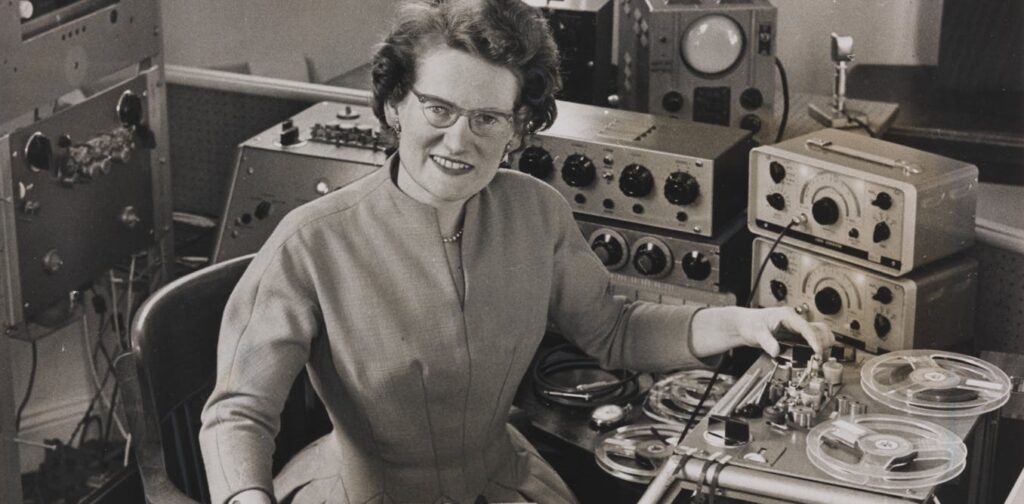
Daphne Oram, born in 1925 and passing in 2003, stands as one of Britain’s most influential early electronic composers. Her journey into the realm of electronic music began with her training as a pianist and composer. Remarkably, she declined an offer from the Royal College of Music to join the BBC, where her late-night experiments with tape, microphones, and oscillators guided her away from traditional composition into the pioneering world of electronic sound.
In 1958, Oram co-founded the BBC Radiophonic Workshop, a studio dedicated to creating sound effects and electronic scores for radio and television. On its wall, she placed a passage from Francis Bacon’s 17th-century utopia, New Atlantis, describing imaginary sound-houses where scientists manipulate echoes and invent new instruments. This vision is often seen as a prophetic sketch of the modern electronic music studio.
The Workshop would later produce the iconic Doctor Who theme, yet Oram’s tenure was brief. Less than a year after its inception, she left, frustrated by the bureaucracy and the institution’s limited vision for electronic sound. Despite her profound influence, Oram’s name remains less recognized than the ideas and technologies she helped to pioneer.
The Early Influences and Innovations of Daphne Oram
This December marks Oram’s centenary, sparking new works, releases, and performances from her archive, proving her ideas remain vibrant and adventurous. Here are five essential insights into this visionary woman.
1. A Childhood Steeped in the Supernatural
Oram’s upbringing in a household where séances were commonplace deeply influenced her. Her parents’ involvement in the spiritualist movement introduced her to the concept of disembodied sound as a gateway to other worlds. This environment, where unseen forces and signals were taken seriously, made Oram’s later fascination with invisible vibrations and electronic sound seem almost predestined.
2. The Creation of Oramics
After leaving the BBC, Oram established Oramics Studios for Electronic Composition at her home, whimsically named Tower Folly. Here, she began constructing her own instrument: the Oramics system. This innovative machine used 35mm film strips, on which she drew shapes to control pitch, volume, timbre, and envelope. These drawings were then converted into sound through photo-electric cells and oscillators.
While Oram was not the first to experiment with “drawn sound” systems, Oramics was unique in its ambition and its focus on the composer’s hand, eye, and imagination, thus humanizing electronic sound. The partially restored Oramics machine is now housed at the Science Museum in London.
3. Envisioning Future Possibilities Through Sound
In her 1972 book, An Individual Note of Music, Sound and Electronics, Oram wrote:
Do you think it is the role of music always to reflect the life of the day? I think it is much more than that […] I think it should not only reflect the life of the day but show the possibilities for the future.
This statement encapsulates Oram’s forward-looking perspective that permeates much of her work. She frequently returned to Bacon’s “soundhouses” as a metaphor for envisioning technological and social progress through sound. Her ambitious 1960 manifesto, Atlantis Anew, reimagines Bacon’s utopian vision, proposing an expanded societal role for sound, from rehabilitating criminals to facilitating communication with the non-human world.
Oram’s Legacy and Continued Influence
4. The Groundbreaking “Still Point”
At just 23, Oram composed Still Point in 1948, a piece for two orchestras, turntables, and real-time electronic processing. Although shelved for years, it finally premiered at the BBC Proms in 2018. Still Point is considered one of the first works to incorporate live electronic processing of an acoustic ensemble, treating sound as spatial and architectural, not just musical.
Oram’s vision was ahead of its time, as she scored the piece for two orchestras: one “dry,” shielded with acoustic baffles, and one “wet,” more exposed and resonant. Their sound was picked up, routed through turntables, amplified, and fed into echo, reshaping the orchestras in real time as dynamic sonic objects. The work was submitted for the inaugural Prix Italia in 1950 but was rejected because the adjudicators couldn’t comprehend its “acoustic variants and pre-recording techniques.”
5. A Vision for an Inclusive Future
In her 1994 essay, Looking Back … To See Ahead, Oram reflected on women’s roles in music. She candidly addressed the sidelining of women in studios and institutions but remained optimistic. She foresaw the rise of personal computers and home recording as a means for women to bypass traditional gatekeepers and work independently of male-dominated studio cultures.
This vision is now becoming reality. The Oram Awards, established in 2017, support women and gender-diverse artists in sound. For her centenary, they have partnered with nonclassical and the Daphne Oram Trust on vari/ations, Ode to Oram, a compilation where contemporary electronic artists create new work from samples of Oram’s tapes.
Oram’s legacy is honored by a new generation using her archive not as a museum piece but as raw material for the worlds they want to create. Her profound thoughts on sound, futurity, and access continue to inspire and shape the future of electronic music.