




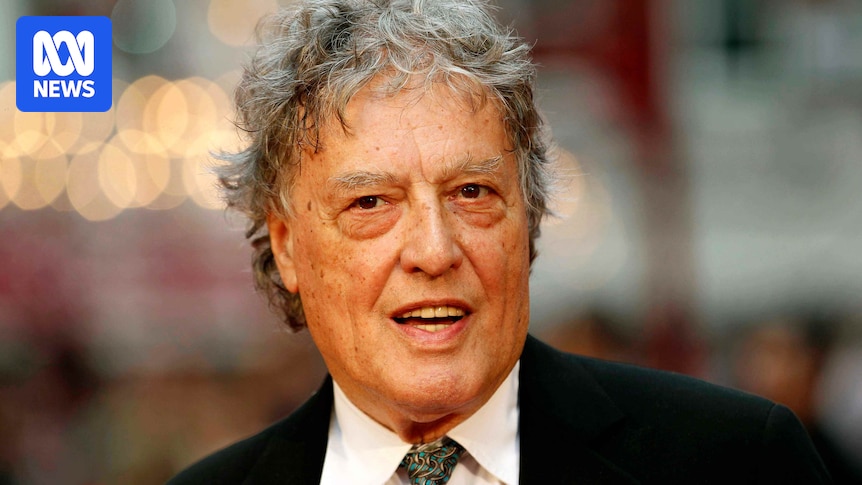
British playwright Tom Stoppard, renowned for his dazzling works that span theatre, radio, and screen, has died at the age of 88. Stoppard, who won an Academy Award for the screenplay of the 1998 film Shakespeare In Love, passed away peacefully at his home in Dorset, England, surrounded by family, according to a statement released by United Agents on Saturday.
“He will be remembered for his works, for their brilliance and humanity, and for his wit, his irreverence, his generosity of spirit and his profound love of the English language,” the statement read. “It was an honour to work with Tom and to know him.”
Tributes Pour In for a Literary Giant
The Czech-born Stoppard, often hailed as the greatest British playwright of his generation, leaves behind a legacy adorned with numerous accolades, including a plethora of theatre awards. Tributes have flowed in from across the globe, including from Mick Jagger of the Rolling Stones, who described Stoppard as his favourite playwright. “He leaves us with a majestic body of intellectual and amusing work,” Jagger shared on social media, accompanied by three photos of the playwright.
Over a career spanning six decades, Stoppard’s brain-teasing plays explored themes from Shakespeare and science to philosophy and the historic tragedies of the 20th century. Five of his plays received Tony Awards for best play: Rosencrantz and Guildenstern Are Dead (1968), Travesties (1976), The Real Thing (1984), The Coast of Utopia (2007), and Leopoldstadt (2023).
A Life Shaped by History
Born Tomás Sträussler in 1937 to a Jewish family in Zlín, then Czechoslovakia, Stoppard’s early life was marked by upheaval. His father, a doctor for the Bata shoe company, moved the family to Singapore when Nazi Germany invaded in 1939. As Japanese forces advanced in 1941, Stoppard, his mother, and brother fled to India, while his father stayed behind and later died trying to leave Singapore.
In 1946, Stoppard’s mother remarried an English officer, Kenneth Stoppard, and the family relocated to postwar Britain. The young Tom embraced his new identity, famously stating he “put on Englishness like a coat,” growing up to become a quintessential Englishman with a love for cricket and Shakespeare.
From Journalist to Playwright
Stoppard’s career began in journalism at the age of 17 in Bristol, later transitioning to theatre criticism for Scene magazine in London. His breakthrough came with the play Rosencrantz and Guildenstern Are Dead, a reimagining of Shakespeare’s Hamlet from the perspective of two minor characters. The play debuted at the Edinburgh Fringe Festival in 1966 and was later staged at Britain’s National Theatre before moving to Broadway.
A Prolific and Diverse Career
Stoppard’s oeuvre includes a variety of works characterized by their intellectual depth and wit. His plays, such as The Real Inspector Hound and Jumpers, blend tragedy with absurdist humour, while Travesties imagines historical figures colliding in Zurich during World War I. His late play Leopoldstadt draws on his family’s history, exploring the experiences of a Jewish Viennese family in the early 20th century.
“It’s those three things in gear together which make him so remarkable,” said Stoppard biographer Hermione Lee, referring to his plays’ “mixture of language, knowledge and feeling.”
Stoppard’s film work includes the dystopian comedy Brazil, the war drama Empire of the Sun, and the Elizabethan romcom Shakespeare in Love, which earned him an Oscar. He was knighted by Queen Elizabeth II in 1997 for his contributions to literature.
A Legacy of Influence
Stoppard’s personal life was as rich as his professional one. He was married three times, to Jose Ingle, Miriam Stern (known as Dr. Miriam Stoppard), and TV producer Sabrina Guinness, with the first two marriages ending in divorce. He is survived by four children, including actor Ed Stoppard, and several grandchildren.
His passing marks the end of an era for British theatre, but his works continue to inspire and challenge audiences worldwide. As the world reflects on his contributions, his legacy as a playwright who deftly combined intellectual rigor with emotional depth remains unchallenged.