



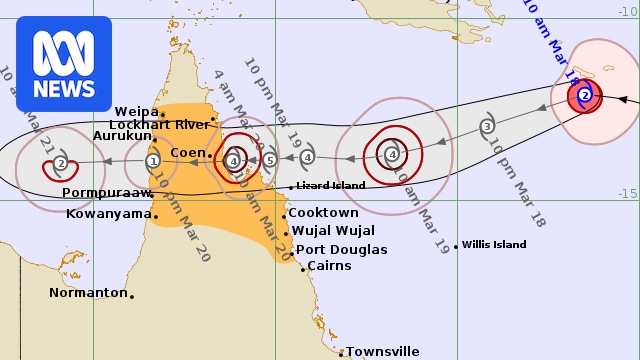
Cape York residents are being urged to seek out robust buildings to weather the impending Tropical Cyclone Narelle, which threatens to hit the region as a category four or five system on Friday morning. The cyclone is expected to bring destructive wind gusts reaching up to 250 kilometers per hour, posing a significant threat to areas lacking designated cyclone shelters.
The Bureau of Meteorology’s tracking map consistently indicates that the cyclone will make landfall near Coen, a small town in Far North Queensland. Coen business owner Sara Watkins expressed her deep concern about her property’s vulnerability, noting its construction from corrugated iron and single-pane glass windows, likely dating back to the 1960s or 70s. “If it does turn into a major cyclone, I think we’re really going to see the impact of what that is on the building,” she stated.
Lack of Cyclone Shelters Raises Concerns
The Cook Shire, home to approximately 5,000 residents, lacks official cyclone shelters. However, following Cyclone Jasper in 2023, the council designated certain “places of refuge” within some communities. Meanwhile, in Lockhart River, with a population of around 650, the absence of a cyclone shelter has been a long-standing issue. David Clarke, the Aboriginal Shire Council’s chief executive, has been advocating for such a facility for over a decade without success.
Cook Shire Council Mayor Robyn Holmes downplayed the lack of shelters as a significant issue, urging residents to contact the council if they had concerns. “Most people generally take shelter in homes and with friends or family,” she explained, adding that the population typically decreases during the wet season. Coen, directly in the cyclone’s path, has the C.S. Love Hall as a designated place of refuge for its 320 residents.
Community Resilience and Preparedness
Mayor Holmes expressed confidence in the community’s preparedness, noting that homes in Coen meet cyclone ratings. “I’m not overly concerned about the building stock in Coen, and they have been through cyclones in the past,” she said, emphasizing the community’s ability to come together in times of need. “If anyone’s in need, they just knock on someone’s door,” she added, while advising against unnecessary travel due to saturated roads and rising rivers.
David Clarke, who has served as Lockhart River’s chief executive for two decades, highlighted the community’s resilience, recalling past cyclones such as Monica in 2006 and Trevor in 2019. “One thing our community is very, very good at is resilience and they don’t take fright easy,” he remarked.
Logistical Challenges and Historical Context
Lockhart River’s road access has been compromised for about eight weeks due to the Pascoe, Wenlock, and Claudie river systems inundating crossings on the Peninsula Development Road. Clarke noted that the community relies solely on air and sea logistics, making isolation a non-issue. In the absence of dedicated shelters, the council has historically ensured that residents take refuge in sturdier buildings.
Clarke has been campaigning for a cyclone shelter for over a decade, pointing out the community’s frequent exposure to cyclones. “I know there’s a batting order and bigger communities probably still don’t have one, but we’re certainly in the firing line and history paints that picture,” he said.
Government Response and Future Prospects
Local state and federal representatives were reportedly unaware of the campaign for a cyclone shelter but expressed willingness to collaborate with local councils. Federal MP for Leichhardt Matt Smith mentioned that funding for shelters is available through the federal government’s Disaster Ready Fund, similar to those constructed in Kowanyama and Palm Island.
As Cyclone Narelle approaches, the focus remains on immediate safety and community support. The situation underscores the ongoing need for infrastructure improvements in cyclone-prone regions, highlighting the balance between immediate response and long-term preparedness.