



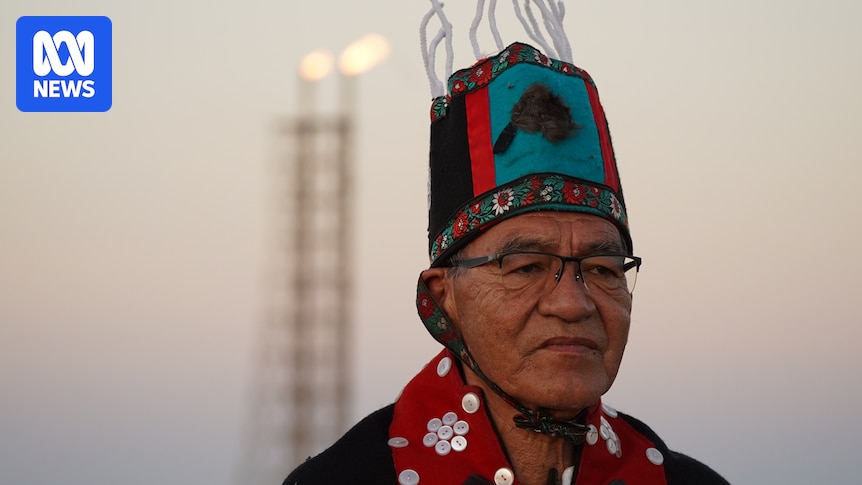
As hereditary Chief Na’Moks is driven around Western Australia’s Burrup Peninsula, the stark industrial landscape within the Murujuga National Park is impossible to ignore. A high chief of the Wet’suwet’en nation, he traveled from British Columbia’s snow-covered mountains to witness what the West Australian government claims is a successful coexistence between industry and ancient Aboriginal heritage.
“All I see is people being ignored,” Chief Na’Moks remarked, observing the operations of Woodside Energy, which has processed fossil fuel at two liquefied natural gas (LNG) plants on the peninsula, known by traditional owners as Murujuga, for 40 years. The company has permission to continue for another 45 years, a situation opposed by environmentalists and some traditional owners concerned about the proximity to the world’s oldest collection of rock art, recently inscribed into UNESCO’s World Heritage List.
“[It’s] the same type of path Canada’s putting itself on where the dollar becomes more important than the human,” Chief Na’Moks said.
Canadian LNG Development and Indigenous Opposition
Canada is only now beginning to develop an LNG export industry, focusing on the vast shale gas reserves within British Columbia’s Montney formation. However, similar to Australia, gas development has divided the region’s traditional owners.
“Over the last 25 years in our homelands, we have fended off upwards of 17 pipeline proposals and projects … until around 2019 and 2020,” explained Gwii Lok’im Gibuu Jesse Stoeppler of the Gitxsan nation. The project he refers to is Shell’s LNG Canada facility, which shipped its first cargo in June. Now, a second facility, Ksi Lisims, is proposed for British Columbia, driven by a consortium of gas companies, including Woodside, and the Nisga’a Nation, which owns the coastal lands where the facility would be built.
Proponents argue it will bring social benefits and jobs to Indigenous Nations and nearby communities. However, a 900-kilometer pipeline would need to be constructed, cutting through lands of other Indigenous nations, including Mr. Stoeppler’s, who have not consented to the project.
Government Policies and Indigenous Rights
The Canadian government is eager to bolster the economy with more mining and infrastructure projects, especially as it contends with unpredictable tariff policies from the Trump administration. The Ksi Lisims project was recently referred to the Major Projects Office, a new department designed to expedite approvals for projects of national interest. This mirrors the West Australian Labor government’s State Development Bill, which Premier Roger Cook aims to pass before the end of the year.
Premier Cook has openly expressed his desire to reduce bureaucratic hurdles for industry, stating to business leaders his “little bit of industrial FOMO” and an “obsession with big shiny job-creating projects, an insatiable desire for even faster approvals.”
Mr. Stoeppler believes these are perilous times for Indigenous rights across the western world. “It is dangerous when elected bodies of government seemingly create interest or appetite where there is none on a local landscape,” he said.
Murujuga traditional custodian Raelene Cooper, who guided Chief Na’Moks and Mr. Stoeppler around Murujuga, expressed her sadness at seeing other traditional owners endure similar struggles. “We shared the very same stories, you know, of the concerns, the betrayal from our governments,” she said. “Those individuals who are supposed to be speaking on behalf of us are basically opening the door and bringing us to the slaughter.”
Long-term Coexistence and Future Implications
A final investment decision for the Ksi Lisims project is anticipated early next year. Meanwhile, a Woodside spokesperson stated the company’s commitment to managing and protecting cultural heritage in the area, emphasizing their support for the World Heritage listing of the Burrup Peninsula as a reflection of successful long-term coexistence of heritage and industry.
“We actively engage with traditional custodians on the management of cultural heritage at our sites, including through heritage surveys, annual audits of heritage places, and on-country visits,” the spokesperson said. “In consultation with traditional custodians, we develop and implement cultural heritage management plans to ensure the heritage values of the area are protected as far as practicable and in line with the requirements of applicable approvals and relevant laws.”
The spokesperson added, “We believe long-term coexistence between cultural heritage and industry is possible when guided by credible science, traditional custodian leadership, and genuine collaboration.”
As these projects advance, the tension between economic development and the preservation of Indigenous rights and cultural heritage remains a critical issue, prompting ongoing debates and necessitating careful consideration of all stakeholders involved.