


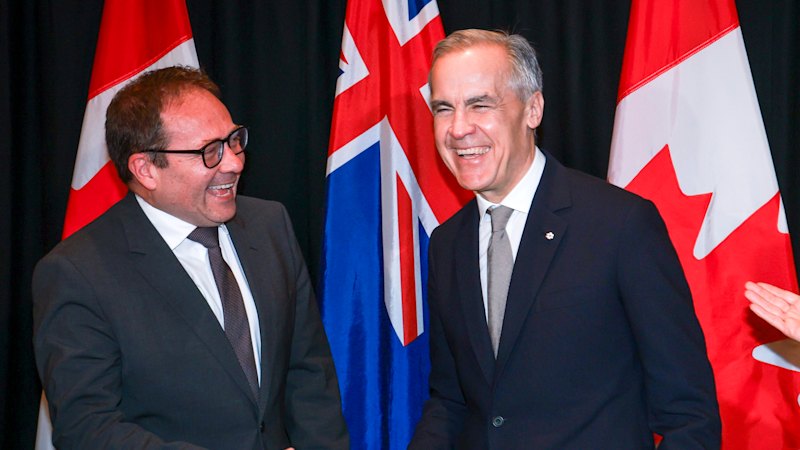
Australian and Canadian troops could soon move seamlessly between each other’s military facilities under a proposed agreement championed by Canadian Prime Minister Mark Carney. This initiative is part of Carney’s broader strategy to unite middle powers against coercion from global superpowers.
Carney, who recently captivated global leaders in Davos, Switzerland with a powerful address on the erosion of the global rules-based order, is set to present his vision for enhanced defense and economic ties with Australia. His proposal will be detailed in a speech to a rare joint sitting of the Australian parliament on Thursday, followed by a formal meeting with Prime Minister Anthony Albanese.
“Middle powers like Canada, and I would suggest Australia, should recognize that the rupture in the international system represents just that,” Carney stated during an address at the Lowy Institute, echoing sentiments from his Davos speech. “When we only negotiate bilaterally with a hegemon, we negotiate from weakness, we accept what’s offered, we compete with each other to be the most accommodating. And this isn’t sovereignty, it’s the performance of sovereignty.”
Strengthening Middle Power Alliances
Carney emphasized the importance of creating a “dense web of connections” with like-minded nations to prevent subordination by major powers. He argued that middle powers possess more influence than often recognized, and by collaborating, they can forge a significant third path in global politics.
While both Canada and Australia supported the initial US and Israeli strikes on Iran’s nuclear facilities, Carney called for a “rapid de-escalation of hostilities” to avoid prolonged conflict in the Middle East. This stance highlights a commitment to diplomatic solutions amidst rising tensions.
Economic Resilience Through Cooperation
Two of Carney’s senior ministers, National Defence Minister David McGuinty and Finance Minister François-Philippe Champagne, have underscored the need to elevate the Canada-Australia relationship. Champagne noted, “If you’re not at the table, you’re on the menu. If we don’t want to be on the menu, let’s organize a table where we have a seat.”
Champagne further advocated for cooperation in processing and refining critical minerals, a sector where both nations hold significant reserves. He likened the importance of these minerals to oil in the 21st century, emphasizing the need to prevent supply disruptions like those experienced by Japan at the hands of China.
“The world needs Canada and Australia,” Champagne asserted, highlighting the strategic importance of critical minerals.
Defense Partnerships and Strategic Presence
McGuinty expressed Canada’s desire for a “more direct and overt presence in the Indo-Pacific,” even as the US, under President Donald Trump, adopts a more assertive and self-interested stance. He highlighted the potential for mid-power democracies to collaborate on intelligence, security, and defense, a mission central to Carney’s visit.
During discussions, McGuinty proposed formalizing the defense partnership through a visiting forces agreement, which would provide a legal framework for military operations in each other’s territories. Such agreements are already in place between Australia and nations like Japan, Fiji, and the Philippines.
McGuinty also suggested increased joint military training exercises and mutual planning in the Indo-Pacific region, alongside regular meetings between Canadian and Australian defense ministers to solidify the relationship.
“Australia has a lot to teach Canada,” McGuinty remarked, acknowledging Australia’s extensive experience in the Pacific region.
Opportunities in Military Technology
The recent sale of a long-range, over-the-horizon radar system from Australia to Canada for $6.5 billion underscores the potential for collaboration in military technology. McGuinty sees this as an “enormous opportunity” for both countries to partner and innovate.
Champagne reiterated the importance of refining and processing critical minerals, areas where both nations need to scale up efforts. “That’s what we’re not scaled,” he admitted, emphasizing the need for joint ventures in these sectors.
As Carney’s visit to Australia unfolds, it marks a pivotal moment in redefining the bilateral relationship, with implications for broader geopolitical dynamics. The proposed agreements and collaborations could serve as a blueprint for other middle powers seeking to assert their influence in an increasingly multipolar world.