

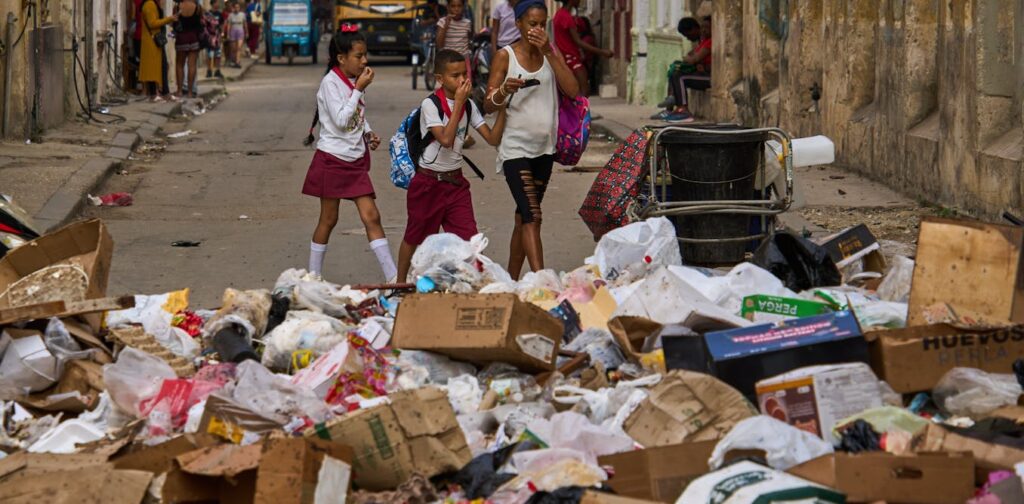
After successfully ousting Venezuela’s leader earlier this year, the Trump administration has shifted its focus to Cuba, imposing a near-total blockade that poses the most significant challenge to the island nation since the Cuban Missile Crisis of 1962. The embargo has led to a severe shortage of oil, plunging Cuba into a political and economic crisis that affects its 11 million residents.
The embargo, enforced by U.S. President Donald Trump, has effectively halted oil shipments to the island for months. Reports indicate that a Russian tanker is en route to Cuba in an attempt to breach the blockade, yet previous attempts have seen ships seized by U.S. authorities. The administration has also warned of tariffs on any nation attempting to supply Cuba with fuel, placing Latin American leaders in a precarious position. Mexican President Claudia Sheinbaum has criticized the embargo as “very unfair,” though she has been cautious to focus her remarks on the Cuban “people” rather than its government.
Historical Context of U.S.-Cuba Relations
This is not the first instance of U.S. efforts to isolate Cuba or pressure Latin American countries into compliance. For 66 years, Cuba has been under a U.S. embargo that has stifled its economy and inflicted widespread hardship. Despite these challenges, Cuba has historically found ways to endure. The question now is whether the island can withstand this latest surge of American pressure.
Animosity in the 1950s
The Cuban Revolution of 1959 caught the United States off guard. During the Cold War, the U.S. supported Latin American dictatorships, including Cuba’s Fulgencio Batista, with political, financial, and military backing, sparking anti-U.S. sentiment in the region. After Fidel Castro’s rise to power, he initiated modest reforms aimed at aiding the impoverished, which were met with opposition from then-U.S. President Dwight Eisenhower due to their impact on American commercial interests. This led to the U.S. embargo on Cuban sugar imports in 1960.
In retaliation, Castro turned to the Soviet Union for economic support, signing an oil deal that resulted in the nationalization of American and British refineries. By 1961, Castro had declared his commitment to “Marxism-Leninism,” further straining U.S.-Cuba relations. The Cuban military’s victory over a CIA-trained force at the Bay of Pigs in 1961 bolstered Castro’s popularity across Latin America, despite the Soviet Union’s military and intelligence support.
Life Under the Embargo
The U.S. embargo has prevented Cuba from fully modernizing, keeping it in a socialist bubble that prioritizes the welfare of its people over economic advancement. Despite this, Cuba’s Cold War economic growth was on par with its neighbors. By 1970, Cuba’s nominal GDP per capita was US$645, slightly less than Mexico’s and double that of the Dominican Republic. By 1990, it had risen to US$2,565, about 80% of Mexico’s GDP and more than triple the Dominican Republic’s.
Cuba achieved full literacy before any other Latin American nation and extended healthcare to all its citizens, later exporting teachers and doctors throughout Latin America and beyond.
However, the collapse of the Soviet Union left Cuba without a clear economic ally, leading to the “Special Period” from 1990 to 1994, marked by a 40% drop in food production, food rationing, and widespread malnutrition. Protests erupted in 1994, with approximately 35,000 Cubans fleeing to Florida.
Cuba and the U.S. Post-Cold War
The end of the Cold War brought renewed sympathy and support from Cuba’s neighbors. Venezuelan President Hugo Chavez provided oil in exchange for Cuban medical expertise. In 2009, the Organization of American States (OAS) voted to readmit Cuba, allowing regional trade and tourism to resume. U.S. President Barack Obama followed suit in 2014, acknowledging the failure of the embargo and initiating the “Cuban thaw.” This led to a historic visit by then-President Raul Castro to Washington in 2015, followed by Obama’s visit to Cuba in 2016, the first by a U.S. president since 1928.
While Obama did not lift the embargo, he opened the door to U.S. tourism, providing a crucial economic lifeline for Cuba.
Trump’s Renewed Pressure
Now, Trump has reinstated the Cold War-era embargo, intensifying pressure on President Miguel Díaz-Canel’s government. The White House contends that Cuba poses an “unusual and extraordinary threat” to the U.S., citing its cooperation with “dangerous adversaries” like Russia and China. Russian President Vladimir Putin has denounced Trump’s embargo, asserting, “we do not accept anything like this.”
If Russian oil successfully reaches Cuba, it could pave the way for further aid, potentially inviting Russia back into the Western Hemisphere and setting the stage for another Cold War-style standoff, with the Cuban people once again caught in the crossfire.
The implications of this renewed embargo are profound, not only for Cuba but for the geopolitical landscape of the Americas. As Cuba navigates this latest challenge, the world watches to see if the island can once again adapt and survive under the weight of U.S. pressure.