

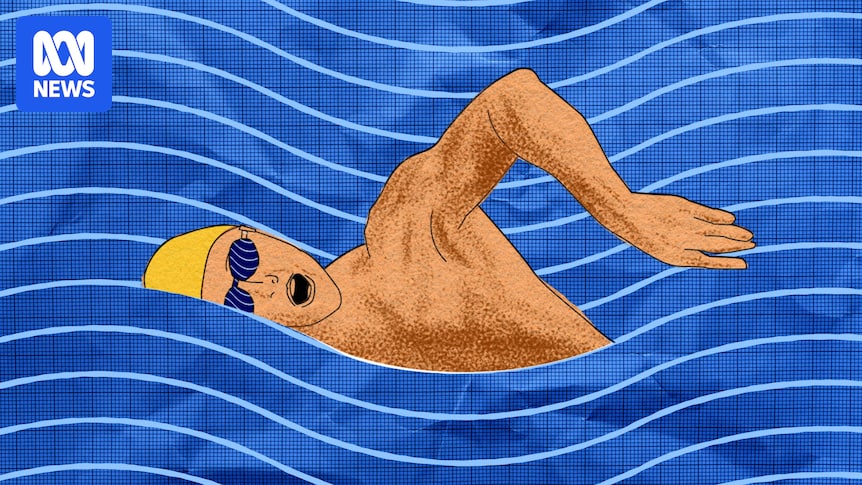
It takes just one breath. The moment Cameron McEvoy launches himself from the blocks, he breathes out, then takes a short, sharp breath in as he flies through the air. For the next 21 seconds, no more breaths are taken as he breaks the surface of the water, glides underneath, then emerges — arms and legs in concert, powering him down one 50-metre freestyle lap of the pool.
Years of stretching every tendon and testing every joint in the gym, then training in the pool at max capacity, constantly on the edge of physical pain and discomfort, all for 21 seconds. From the stands or in front of the TV, all we see is a mad wash of arms, legs, and white water. But for McEvoy, every moment is finely tuned to come together in absolute harmony.
“I’m basically in the hunt for perfection,” he says. The question is: how close can he go?
The Quest to Blur Sports, Science, and Art
He’s arguably already the best 50m freestyler in the world. McEvoy won the gold medal at the world championships in Fukuoka in 2023 and followed it up with victory at the Olympic Games last year. At the Australian Swimming Trials in June, he jumped out of the water after winning the final of the 50m free in 21.3 seconds and said it was a “pretty nice swim”.
That “pretty nice swim” remains the fastest time this year going into Friday’s heats at the world championships in Singapore, but McEvoy is after something more. “I’ve got that [Olympic] gold medal, and I’ve got the world championship gold medal. I guess you could say the chip is off the shoulder, or the leash is off, and I feel like I have free rein now to go after a time,” he tells ABC Sport.
The quest now is to blur the edges of sport, science, and art until the three disciplines are indistinguishable from one another. Much has been made of McEvoy’s university undergraduate degree in mathematics and physics. It was almost inevitable that in the Aussie sport tradition of exaggerating characteristics, he was nicknamed “The Professor”.
New Approach to Hone Technique
It began with tearing up the rule book on how to train a swimmer and critically examining the methods of other power athletes to see what he could apply in the pool. “You need to have the fitness to be able to sprint for 50m,” he says. “You need to have the strength to be able to apply that force to the water, and then you need to have the mobility to be able to do the shape of the freestyle stroke without having to fight against your own limitations in your body and the way your body moves.”
Rather than doing long hours in the pool swimming up to 30 kilometres per week, he spent far more time in the gym. Now he only swims two or three kilometres each week, but always at maximum intensity.
“The way I break it down is you have your first 15-metre segment, and then you have your swimming part afterwards, which also can be broken down into its various components,” he says.
McEvoy’s first 15m in Fukuoka took 5.22 seconds — slower than his competitors and predecessors. He says knocking 0.2 of a second in that start is “low-hanging fruit” that could take him into world-record territory.
The Science of Speed
“The 50m race is a race where you start from a dead start on the block, but the jump is your highest velocity that you reach in the entire race. From the jump and the underwater up until your first stroke, you’re travelling at your fastest and then from your first stroke into the rest of the race, you’re slowly slowing down,” he says.
This explains why McEvoy spent the best part of six months out of the pool after the Olympic Games, just working on his strength to improve his dive. “It boiled down to two things: The first one was take-off velocity off the block — that’s a function of your vertical jump — and so I had to develop my vertical jump as best I can,” he says. “And then the other one was the ability to get into streamline and that’s the function of mobility.”
That meant hours in the gym: Endless squats, hamstring curls, lower back strength work, and then the work to improve mobility. But getting stronger, heavier, and bulkier can interfere with the other goal of extra mobility and joint flexibility.
“There’s a precise way you have to program it and do things at a particular time in a particular order so that you don’t negate some of the gains that you’re making in one end by doing something on the other end as well,” he says.
And it worked. “My best vertical jump a week-and-a-half out from Paris was 56 centimetres, and this year I hit 62 centimetres,” he says. “That’s a massive gain just in vertical jump. It’s probably top four, top five dives in terms of fastest dives in history.”
The Impossible Hunt for Perfection
The goal now is to put everything together. The world record in the 50m freestyle of 20.91 seconds was set by Brazilian Cesar Cielo — one of just seven world records still standing from the supersuit era of 2008-09, when polyurethane suits were allowed. A huge number of world records tumbled during that time thanks to the suit’s buoyancy.
“If you take my best start to 15m and my best 15m to 50m and combine them together, I’m 0.02 under the world record,” McEvoy says. “Whether or not it can be done in reality, that’s a different question that I’m trying to see if I can answer.”
But on any given day, something could go wrong. A stroke might be slightly out of alignment, or a kick is marginally out of sync. Perfection is never attainable — especially across heats, semifinals, and a final — so McEvoy operates in a contradiction. He’s aiming for as close as possible to perfection, while also trying to be consistently average. Just so long as that “average” is very, very good.
In 2022, Cameron McEvoy was done with swimming. But he has a new lease on his life in the pool, with ambitions to race at Brisbane’s 2032 Games. “I could have upwards of 500 reps under my belt of suiting up, replicating the race, and sprinting and training before I even get behind the blocks,” he says.
“Leaning into the scientific side of things, if I lay out all of my reps along a bell curve, then I want my 50th percentile to be good enough to win. And hopefully, we get to a point where that 50th percentile is good enough to potentially start setting some pretty incredible times.”
As McEvoy continues to push the boundaries of what’s possible in swimming, he remains grounded in his passion for the sport and the science that underpins it. With a family to support and a legacy to build, he looks forward to the future with optimism and determination.