




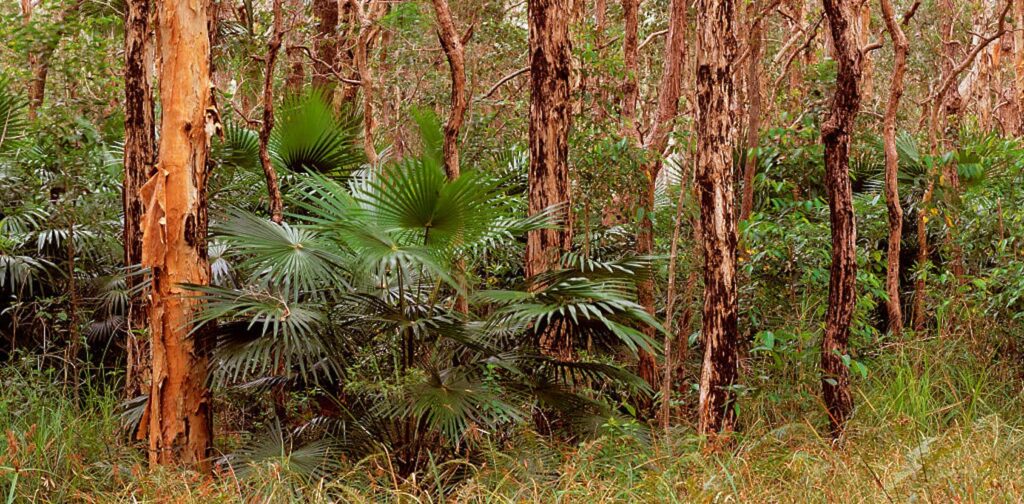
When envisioning palm trees, images of tropical islands and sun-drenched beaches often come to mind. However, the palm family is a vast and diverse group comprising roughly 180 genera and more than 2,000 species, many of which thrive in tropical climates. Among these, Australia boasts at least 50 native palm species, with the cabbage tree palm, Livistona australis, standing out as a remarkable example.
This slender and towering palm can reach heights of 25 meters or more, with a stem diameter ranging from 25 to 35 centimeters. Its habitat stretches along the Australian east coast, from southern Queensland to nearly Orbost in Victoria, marking it as the only native palm in Victoria.
Strength and Beauty of the Cabbage Tree Palm
The cabbage tree palm is renowned for its intricate stem patterning, formed by old leaf bases that contribute to its structural strength. However, damage to the stem is irreversible, highlighting the importance of careful handling. The palm’s fan-shaped leaves, measuring 10 to 30 centimeters, are attached to petioles that extend up to 2 meters. Its small white flowers, grouped on a panicle, can reach lengths of 1.5 meters.
As the fruits mature, they transition from red to black, signaling readiness for propagation. Young palms often feature protective prickles at the leaf bases, a common defense mechanism among palms. Despite their moderate frost sensitivity, cabbage tree palms become quite resilient once they reach a few meters in height, exhibiting drought tolerance and thriving in full sun.
In natural settings, the dead leaves of the cabbage tree palm serve as important nesting and feeding sites for birds and small native mammals like bandicoots. In urban gardens, they may provide shelter for possums and rodents. Although the dead leaves can burn intensely during bushfires, the palms are moderately fire-resistant, as evidenced by their recovery following the 2019–20 fires in areas like Mallacoota and New South Wales.
A Plant with Historical and Practical Uses
The cabbage tree palm has a rich history of human use, particularly among Indigenous Australians who utilized its leaves for basket-weaving and its fibers for making twines, ropes, and fishing lines. The young leaves, known for their sweetness, were traditionally boiled and consumed, giving rise to the name “cabbage tree palm.”
The fruits, although edible, require cooking due to their toughness, while parts of the stem can be consumed as “heart of the palm.” This practice is not unique to the cabbage tree palm; other palm species, such as the coconut palm and palmetto, are also sources of this delicacy, with the peach palm being the most commonly cultivated for this purpose.
Interestingly, the fibrous stems of cabbage tree palms were used by early European settlers to craft protective sun hats, known as cabbage tree hats. The dense, fibrous root systems of these palms make them easy to transplant, although this characteristic also puts natural populations at risk if not regulated properly.
Patience: A Key to Cultivating Cabbage Tree Palms
Like many tree-like plants, Livistona australis grows at a slow pace. Some estimates suggest these palms can live for nearly 400 years, emphasizing their long-term growth cycle. Patience is essential when cultivating cabbage tree palms, as they may take between 20 and 60 years to develop a proper stem.
In conclusion, the cabbage tree palm is a testament to the diverse and fascinating flora of Australia. Its unique characteristics, historical significance, and ecological role underline the importance of preserving and appreciating this native species.