


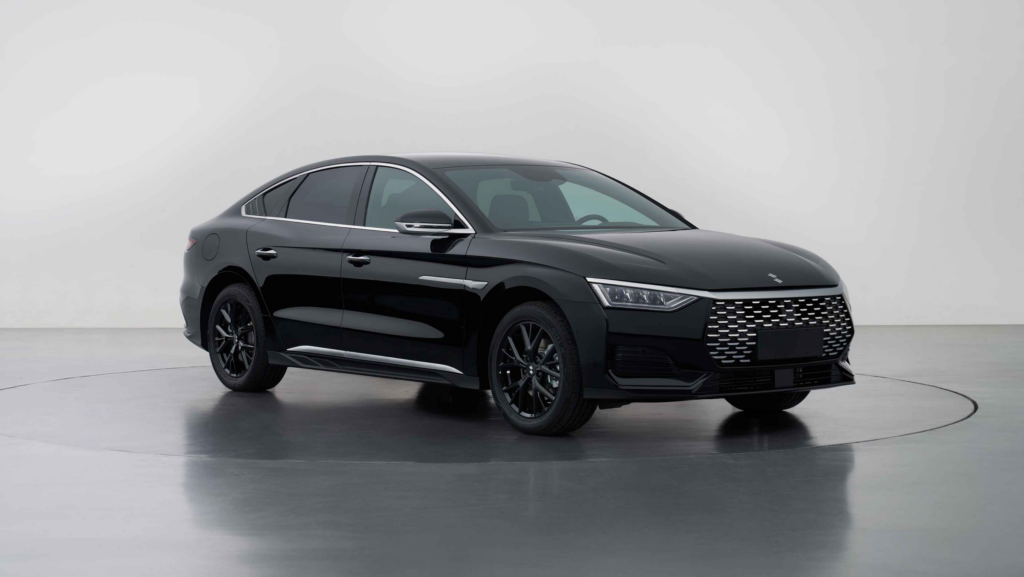
Chinese automotive leader BYD has announced the launch of a new sub-brand, “Linghui” (领汇), as indicated by recent filings with China’s Ministry of Industry and Information Technology (MIIT). This strategic move aims to mitigate the negative impact on sales due to the association of its vehicles with ride-hailing services. The filings include a new logo for Linghui, marking BYD’s effort to distinguish these models from its existing lineup. Four models—Linghui e5, Linghui e7, Linghui e9, and Linghui M9—have been submitted for approval.
The introduction of Linghui comes as BYD seeks to leverage its established platforms while creating a fresh identity for its vehicles. The models are based on existing BYD vehicles but are rebranded to appeal to a broader market.
Details of the Linghui Models
Linghui e9
The Linghui e9 is built on the BYD Han platform, featuring a recognizable family design language. It measures 4995mm in length, 1940mm in width, and 1495mm in height, with a wheelbase of 2920mm. Buyers can choose between two electric motor options, offering maximum outputs of 135 kW (181 hp) and 150 kW (201 hp), respectively.
Linghui e7
Similarly, the Linghui e7 maintains a family design language, with dimensions of 4780mm (length), 1900mm (width), and 1515mm (height), and a wheelbase of 2820mm. It offers two electric motor configurations, producing 100 kW (134 hp) and 130 kW.
Linghui e5
Based on the BYD Qin Plus EV, the Linghui e5 measures 4805mm in length, 1837mm in width, and 1530mm in height, with a wheelbase of 2718mm. It is equipped with a single electric motor delivering a maximum power output of 100 kW (134 hp).
Linghui M9
The largest of the initial offerings, the Linghui M9, is based on the BYD Xia, though specific details have been adjusted for the new brand. It boasts dimensions of 5200mm (length), 1970mm (width), and 1805mm (height), with a wheelbase of 3045mm. Unlike the other electric-only Linghui models, the M9 features a plug-in hybrid powertrain, combining a 1.5L engine with an electric motor that produces a maximum power of 200 kW (268 hp).
Strategic Implications of the Linghui Launch
The launch of Linghui is a strategic response to a common challenge faced by automotive brands whose vehicles are heavily utilized in ride-hailing services. Such associations can tarnish a brand’s image, making it difficult to maintain a premium status in the private vehicle market.
Historically, brands like GAC Aion and Neta have experienced declines in regular sales due to their widespread adoption in ride-hailing fleets. Neta, in particular, is now on the brink of collapse, illustrating the severe impact of such associations.
Geely offers a contrasting example, having effectively managed this issue by introducing the Maple brand for ride-hailing purposes. This separation has allowed Geely to preserve its premium image, as most consumers remain unaware of Maple’s connection to Geely.
Looking Ahead: BYD’s Market Position
BYD’s introduction of Linghui may help the company navigate the complex dynamics of the automotive market, where brand perception plays a crucial role in consumer decisions. By distinguishing Linghui from its main brand, BYD aims to maintain its appeal in the private vehicle market while continuing to serve the ride-hailing sector.
As the automotive industry evolves, the success of BYD’s strategy will depend on its ability to balance these dual objectives. The company’s approach could serve as a blueprint for other manufacturers facing similar challenges, highlighting the importance of brand differentiation in a competitive market.
With Linghui, BYD not only seeks to protect its market share but also to redefine its brand perception, ensuring its vehicles remain attractive to a diverse range of consumers.