

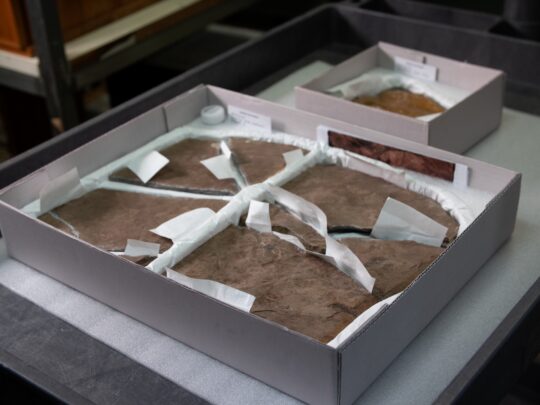
Brisbane’s only known dinosaur fossil has been identified as Australia’s oldest, dating back approximately 230 million years to the early Late Triassic period. This groundbreaking discovery was confirmed by new research from the University of Queensland (UQ) and published in the journal Alcheringa. The fossil, an 18.5 cm footprint, was originally discovered in 1958 by a teenager at Petrie’s Quarry in Albion, Brisbane’s inner north, but remained unstudied for over six decades.
Dr. Anthony Romilio, an evolutionary biologist from UQ’s Dinosaur Lab, highlighted the significance of the find, stating that it provides evidence of dinosaur presence in Australia earlier than previously recognized.
“This is the only dinosaur fossil to be found in an Australian capital city and shows how globally significant discoveries can remain hidden in plain sight,”
Dr. Romilio explained.
Uncovering Brisbane’s Prehistoric Past
The discovery of the footprint is particularly noteworthy as subsequent urban development has rendered the original site inaccessible, leaving this footprint as the sole surviving dinosaur evidence from the area. It is believed that the dinosaur was traversing a waterway when it left the footprint, which was later preserved in sandstone and eventually used in construction across Brisbane.
Dr. Romilio elaborated on the importance of preserving such materials, noting that without it, Brisbane’s dinosaur history would have remained unknown. Researchers identified the footprint as belonging to a small, two-legged dinosaur, likely an early sauropodomorph, a primitive ancestor of the later long-necked dinosaurs. This dinosaur would have stood about 75-80 cm tall, comparable to the height of an average human’s hip, and weighed around 140 kilograms.
The Journey of a Fossil
The fossil was collected by study co-author and UQ Honorary Professor Bruce Runnegar, who was a teenager at the time of its discovery. Professor Runnegar, who later pursued a career in palaeontology, kept the specimen throughout his academic journey.
“At the time, we suspected the marks might be dinosaur tracks, but we couldn’t have imagined their national significance,”
he reflected.
Throughout his career, Professor Runnegar showcased the fossil to students but never conducted a comprehensive study until now.
“It was a great example of a special kind of trace fossil because the footprint was made in sediment by a heavy animal,”
he said. The collaboration with Dr. Romilio finally led to the fossil’s formal documentation, marking it as Australia’s oldest dinosaur fossil.
Preserving the Legacy
Currently, the fossil is housed at the Queensland Museum, where it will be available for ongoing research. This discovery not only enriches Australia’s paleontological record but also underscores the potential for significant scientific findings in urban areas. The recognition of this fossil opens new avenues for research and highlights the importance of preserving historical sites amidst urban development.
Looking forward, this discovery may inspire further investigations into other potential sites across Australia, potentially rewriting parts of the continent’s prehistoric narrative. The research community remains optimistic about uncovering more hidden treasures that could offer insights into the ancient past.