


In a groundbreaking development, researchers from MIT and collaborating institutions have unveiled a new class of photonic devices that can efficiently beam light from chips into free space. This advancement could herald significant improvements in technologies ranging from augmented reality glasses to quantum computing systems.
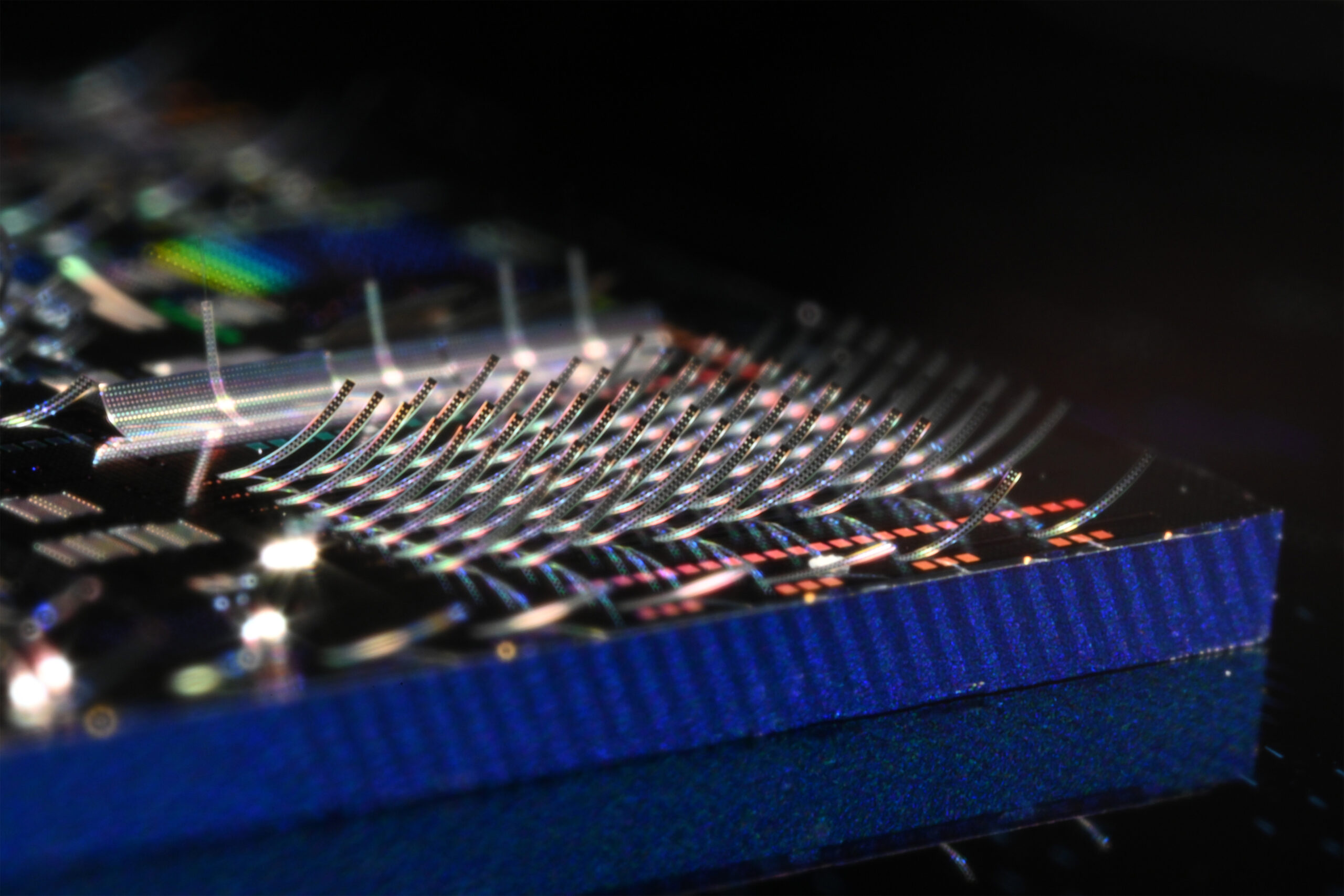
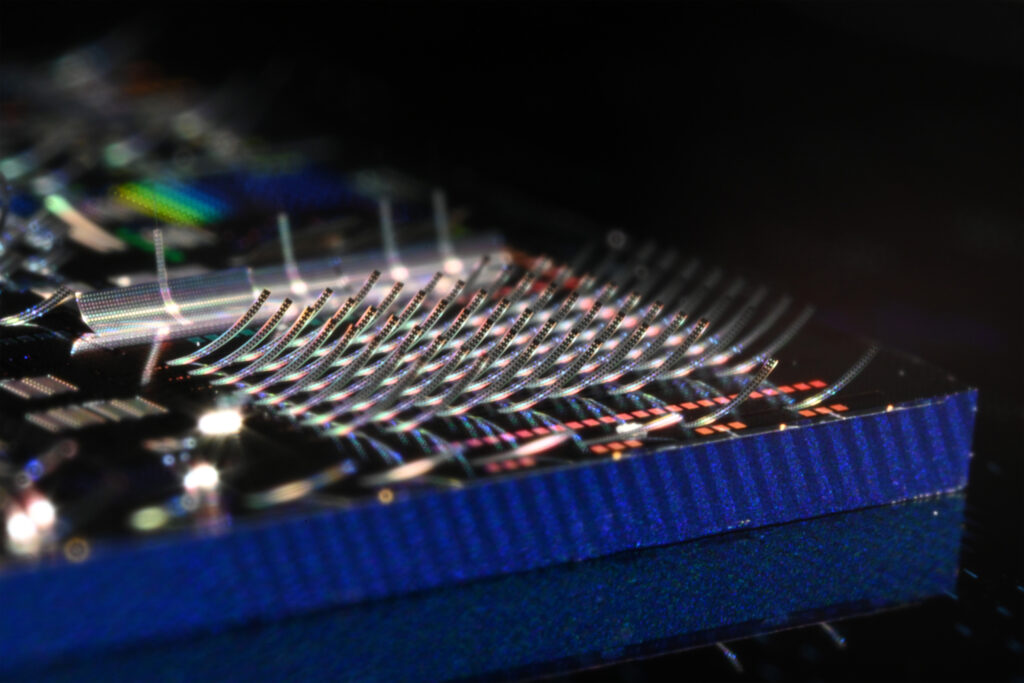
Photonic chips, which use light for data processing rather than electricity, offer faster communication speeds and greater bandwidth. However, most light remains confined within the chip’s optical wires, posing a challenge for external transmission. The new device, featuring an array of microscopic structures resembling tiny, glowing ski jumps, addresses this issue by enabling precise light broadcasting from the chip.
Revolutionizing Light Transmission
The researchers’ innovative platform allows for the projection of detailed, full-color images that are only about half the size of a grain of table salt. This capability could significantly impact the development of lightweight augmented reality glasses and compact displays. Additionally, the technology holds promise for controlling quantum bits, or qubits, in quantum computing systems.
Henry Wen, a visiting research scientist at MIT’s Research Laboratory of Electronics and MITRE, and co-lead author of the study, explained the significance of this breakthrough. “On a chip, light travels in wires, but in our normal, free-space world, light travels wherever it wants. Interfacing between these two worlds has long been a challenge. But now, with this new platform, we can create thousands of individually controllable laser beams that can interact with the world outside the chip in a single shot,” Wen stated.
A Scalable Solution
This development stems from the Quantum Moonshot Program, a collaboration involving MIT, the University of Colorado at Boulder, the MITRE Corporation, and Sandia National Laboratories. The program aims to create a novel quantum computing platform using diamond-based qubits, which require interaction with millions of qubits simultaneously.
“We can’t control a million laser beams, but we may need to control a million qubits. So, we needed something that can shoot laser beams into free space and scan them over a large area, kind of like firing a T-shirt gun into the crowd at a sports stadium,” Wen explained. Existing methods typically handle only a few beams at once and lack scalability.
The researchers developed a new fabrication technique to overcome these limitations. Their method involves producing photonic chips with tiny structures that curve upward from the chip’s surface, effectively shining laser beams into free space. This innovation was made possible by combining two materials, silicon nitride and aluminum nitride, which expand differently when cooled, creating the ski jump effect.
Applications and Future Prospects
The ability to broadcast light in different colors and adjust the density of emitted patterns allows researchers to essentially paint pictures in free space using light. “This system is so stable we don’t even need to correct for errors. The pattern stays perfectly still on its own,” Wen noted.
This platform’s potential extends beyond high-resolution displays and larger quantum computers. It could lead to the development of compact Lidars for tiny robots and accelerate 3D printing processes by rapidly generating controllable beams of light.
Looking ahead, the researchers plan to scale their system and conduct further experiments to assess the yield and uniformity of the light. They also aim to design larger systems to capture light from an array of photonic chips and test the devices’ robustness.
“We envision this opening the door to a new class of lab-on-chip capabilities and lithographically defined micro-opto-robotic agents,” Wen concluded.
This research was funded by the MITRE Quantum Moonshot Program, the U.S. Department of Energy, and the Center for Integrated Nanotechnologies, with findings published in the journal Nature.