




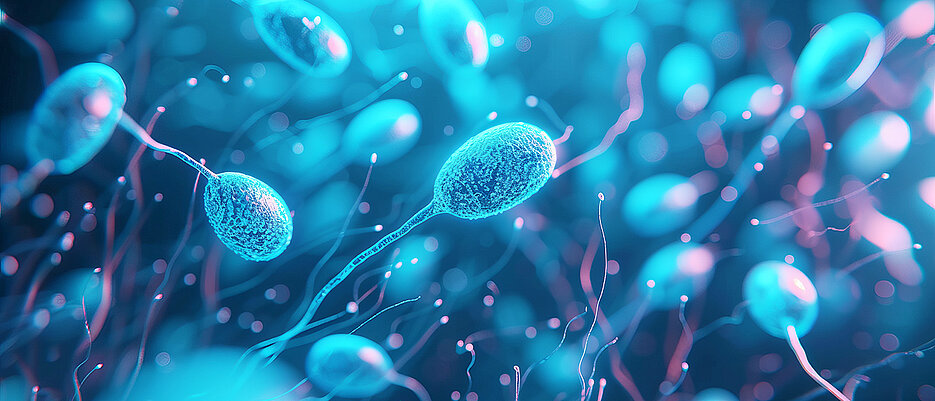
The development of functional sperm is a highly complex process and a fundamental requirement for male fertility. Disruptions in this process are a common cause of infertility. However, the molecular mechanisms that control the precise structure of a sperm cell have remained largely unknown. An international research team has now made significant strides in this area, using a novel method to visualize the cellular architecture of germ cells in unprecedented detail.
Utilizing a specially developed technique known as ultrastructure expansion microscopy (U-ExM), researchers have elucidated the central role of a protein complex in the formation of the sperm tail. This breakthrough could pave the way for new diagnostic approaches to male infertility.
Unveiling the Cellular Architecture
The team applied U-ExM to specific substructures of male germ cells for the first time. This technique allows scientists to physically expand cellular components, akin to inflating a balloon, making the tiniest details of the cell accessible for analysis. This cutting-edge technology was crucial in deciphering the remodeling processes during sperm maturation and identifying a crucial molecular support structure.
The findings were published in the journal Science Advances, with contributions from Hiroki Shibuya and Yutaka Takeda of the RIKEN Center for Biosystems Dynamics Research in Kobe, Japan, and Manfred Alsheimer from Julius-Maximilians-Universität Würzburg (JMU). Alsheimer, an expert in electron microscopy, played a pivotal role in elucidating the structural role of a specific protein in sperm development.
“My colleague from Japan asked me to investigate the function of this protein at the ultrastructural level using electron microscopy,” explains Alsheimer.
Combining high-resolution ultra-expansion microscopy data from Japan with electron microscopic analyses at the Biozentrum, the team gained new insights into the dynamic structure of centrioles and the role of the protein in sperm tail development.
A Molecular Scaffold as an Anchor for Motility
Central to these findings is the basal body, a structure that serves as a mechanical anchor for the sperm tail. Researchers discovered that during sperm maturation, a special internal scaffold made up of the proteins centrin and POC5 is massively reinforced in a tiny organizational center of the cell, known as the distal centriole. This centriole acts as the base to which the long, mobile flagellum—i.e., the sperm tail—is anchored.
This targeted reinforcement is a highly specialized adaptation that occurs exclusively in sperm. Unlike other cells that form flagellum-like structures, such as cilia, this process is unique to sperm. The analysis also revealed that the reinforcement is part of a complex maturation program involving a complete realignment of the basal body’s architecture, including an unexpected change in geometry and the targeted removal of proteins at the tip of the centrioles.
Consequences of a Missing Protein Scaffold
To demonstrate the exact function of the centrin-POC5 scaffold, the team studied mice in which the POC5 protein had been genetically removed. The results were unequivocal: male mice were physically healthy with no other developmental disorders, yet all were 100 percent infertile.
Without the stable anchor provided by the centrin-POC5 scaffold, no functional flagellum could form, leading to infertility.
These findings underscore the indispensable role of the centrin-POC5 scaffold specifically in male reproduction, while intriguingly, it is not required for the formation of similar structures in other cell types. The study provides a fundamental new understanding of the molecular causes of certain forms of male infertility.
Future Implications and Research Directions
Building on these findings, researchers aim to investigate the factors controlling this crucial remodeling process in sperm development. Although this research is currently at a basic level, these insights could eventually lead to the development of new diagnostic approaches for infertility.
The study deciphers a fundamental mechanism of sperm formation essential for successful reproduction, offering hope for advancements in fertility treatments. As research progresses, the potential for clinical applications could provide new avenues for addressing male infertility.
The publication, titled “Centrin-POC5 inner scaffold provides distal centriole integrity for sperm flagellar Assembly,” by Yutaka Takeda, Eriko Kajikawa, Jingwen Wang, Morié Ishida, Manfred Alsheimer, and Hiroki Shibuya, appeared in Science Advances on December 3, 2025. DOI: 10.1126/sciadv.aea4045.