




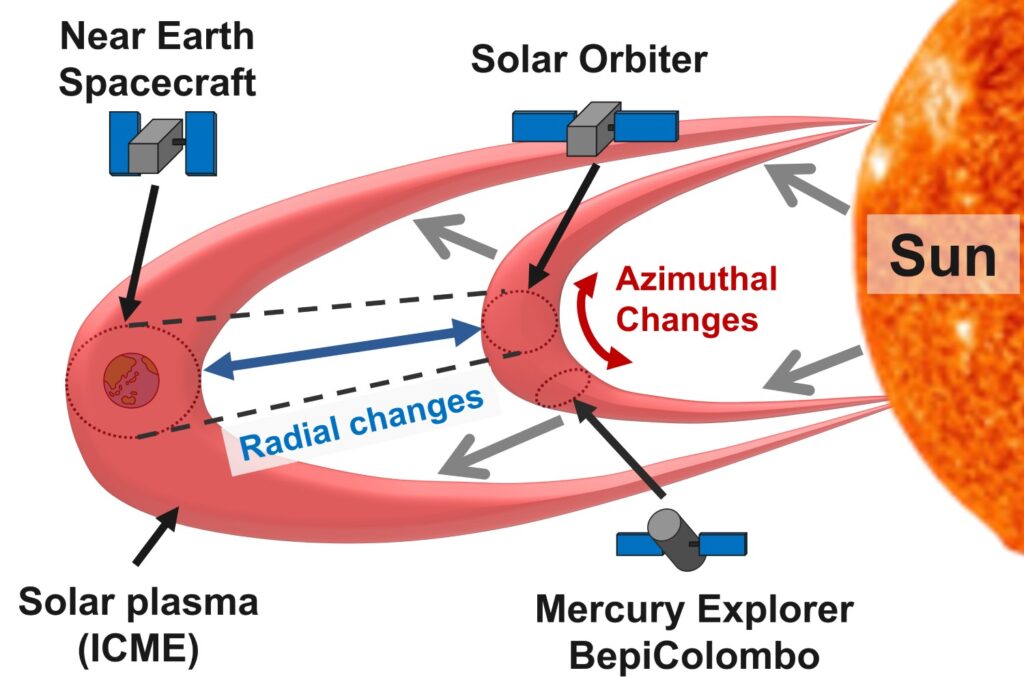
The sun’s occasional ejection of energetic material into space can significantly impact both space-based and ground-based electronic technologies. To mitigate these effects, researchers are striving to understand and forecast these phenomena, particularly how ejected material evolves as it travels through the solar system. In a groundbreaking study, researchers, including those from the University of Tokyo, have made high-quality measurements of an evolving cloud of solar ejecta using multiple space-based instruments not originally designed for this purpose. This study observed how these clouds reduce background cosmic-ray activity.
Solar storms, known as coronal mass ejections (CMEs), occur more frequently than many realize. When detected near Earth, satellites are often put into a safe, low-power mode to protect them from potential damage. However, as with terrestrial weather, the most damaging events are often those that catch us unprepared. Researchers are now focusing on understanding how CMEs evolve as they move away from the sun. A new approach, leveraging several scientific satellites, promises to enhance space-weather forecasting capabilities.
Understanding the Impact of Solar Ejections
“Understanding how huge clouds of solar material travel through space is essential for protecting satellites, astronauts, and even power grids on Earth,” said Ph.D. researcher Gaku Kinoshita from the Department of Earth and Planetary Science. “In our new paper, we show that the paths of these solar eruptions can be tracked using drops in cosmic rays, high-energy particles that constantly bombard the solar system, measured by spacecraft. By combining observations from several spacecraft at different locations, we were able to watch how one eruption changed shape and strength as it moved away from the sun, revealing new ways to improve space-weather forecasting.”
The researchers’ method capitalizes on an effect known as the Forbush decrease. This phenomenon occurs because a CME isn’t perfectly transparent to cosmic rays coming from behind it. The CME’s strong magnetic field deflects charged particles like cosmic rays. By observing cosmic rays as a CME passes through a region, the team could interpret the physical makeup of the CME and, crucially, how it changes over time.
Collaborative Observations and Technological Innovation
In March 2022, three spacecraft — the European Space Agency (ESA)’s Solar Orbiter, ESA and Japan Aerospace Exploration Agency (JAXA)’s BepiColombo, and NASA’s Near Earth Spacecraft — were ideally positioned to observe the same solar eruption from different locations in space. This rare alignment allowed researchers to compare how the event appeared from various directions and distances from the sun.
“By combining cosmic-ray data with magnetic-field and solar-wind measurements, we could link changes in the particle signal directly to the physical structure of the eruption,” said Kinoshita. “One of the most important results of this work is showing that instruments never designed for science can still deliver valuable scientific data. We used a simple system-monitoring instrument onboard the BepiColombo spacecraft, originally meant only to keep the spacecraft healthy, and, through careful calibration, turned it into a detector of cosmic-ray decreases. Data that had long been ignored turned out to be too valuable to waste.”
Future Prospects in Space Weather Forecasting
While advanced instruments capable of directly monitoring CMEs exist, their operational periods are limited. In contrast, the approach of repurposing more general instruments, which are always operational, allows for continuous data gathering. By combining data from multiple spacecraft, researchers can improve data quality and construct a comprehensive 3D picture of CMEs.
“Because the instruments used were never intended for scientific research, there was no existing framework to rely on,” Kinoshita explained. “We had to evaluate an instrument’s behavior, calibrate it from scratch, and develop new analysis methods ourselves before we could confidently use the data to study cosmic-ray decreases. With many spacecraft now operating between the sun and Earth, and more planned for the future, the chances of making routine multipoint observations are increasing. If we continue to combine data from multiple missions and use all available instruments, we can gain a far more complete picture of how solar ejections propagate through space.”
This development represents a significant step forward in understanding and predicting solar weather, with implications for safeguarding technology and infrastructure on Earth. As research continues, the potential for more accurate and timely solar weather forecasts grows, promising enhanced protection for our increasingly technology-dependent world.