


In a groundbreaking development, researchers have made significant strides in understanding and forecasting solar weather, particularly the phenomenon of coronal mass ejections (CMEs). These solar storms, which involve the ejection of energetic material from the sun, can have far-reaching consequences for both space-based and terrestrial electronic systems. For the first time, a team, including scientists from the University of Tokyo, has successfully measured the evolution of a solar ejecta cloud using multiple space-based instruments, shedding light on its impact on cosmic-ray activity.
CMEs are surprisingly common, and when they occur near Earth, they can prompt satellites to enter a safe, low-power mode to avoid damage. However, like unpredictable terrestrial weather events, unanticipated solar storms can cause significant disruptions. Researchers are now focusing on understanding how these CMEs evolve as they move away from the sun, with the aim of improving space-weather forecasting.
Innovative Approaches to Solar Weather Forecasting
The recent study employs a novel method that leverages the resources of several scientific satellites, potentially paving the way for more accurate forecasts. According to Ph.D. researcher Gaku Kinoshita from the Department of Earth and Planetary Science, understanding the trajectory of solar material is crucial for safeguarding satellites, astronauts, and even Earth’s power grids.
“Understanding how huge clouds of solar material travel through space is essential for protecting satellites, astronauts, and even power grids on Earth,” said Kinoshita. “In our new paper, we show that the paths of these solar eruptions can be tracked using drops in cosmic rays, high-energy particles that constantly bombard the solar system, measured by spacecraft.”
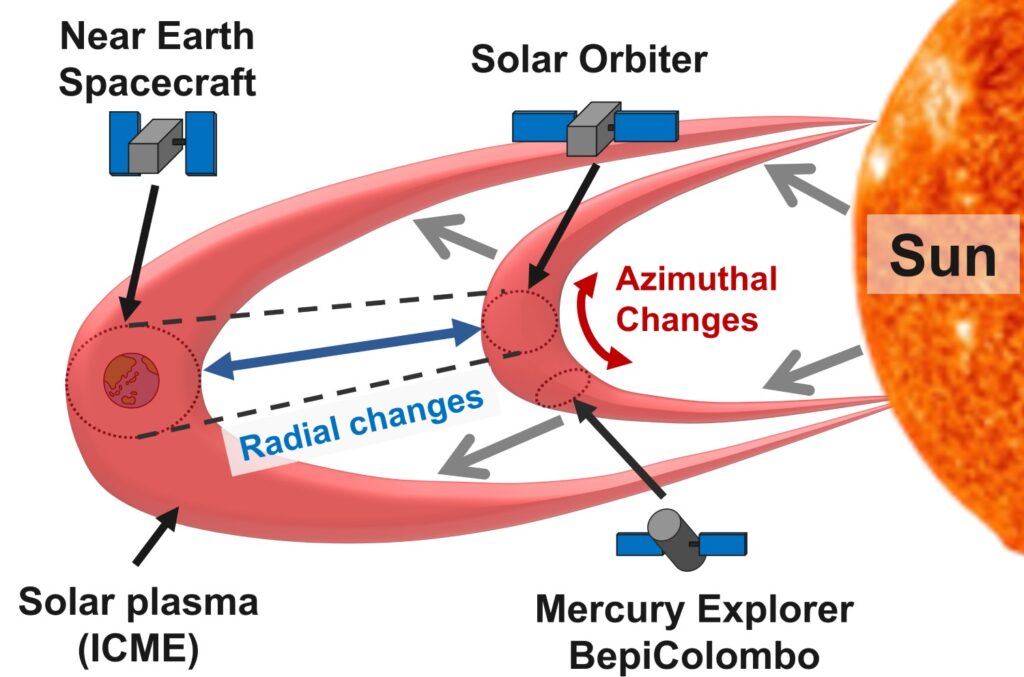
The researchers utilized an effect known as Forbush decrease, where a CME’s magnetic field deflects cosmic rays, to interpret the physical composition of the CME and its temporal changes. This innovative approach was made possible by the unique alignment of three spacecraft in March 2022: the European Space Agency (ESA)’s Solar Orbiter, ESA and Japan Aerospace Exploration Agency (JAXA)’s BepiColombo, and NASA’s Near Earth Spacecraft.
Repurposing Instruments for Scientific Discovery
One of the most remarkable aspects of this research is the use of instruments not originally designed for scientific purposes. By carefully calibrating a simple system-monitoring instrument onboard the BepiColombo spacecraft, the team transformed it into a detector of cosmic-ray decreases. This repurposing of existing technology underscores the potential of overlooked data in scientific research.
“One of the most important results of this work is showing that instruments never designed for science can still deliver valuable scientific data,” Kinoshita noted. “Data that had long been ignored turned out to be too valuable to waste.”
While advanced instruments capable of directly monitoring CMEs exist, their operational periods are limited. The new approach, however, utilizes general instruments that are always active, allowing for continuous data collection. By combining data from multiple spacecraft, researchers can enhance the quality of their observations and construct a three-dimensional picture of CMEs.
The Future of Space Weather Forecasting
The implications of this research are profound, as it opens up new possibilities for routine multipoint observations of solar ejections. With an increasing number of spacecraft operating between the sun and Earth, the potential for comprehensive data collection is growing. By integrating data from various missions and utilizing all available instruments, scientists can achieve a more complete understanding of how solar ejections propagate through space.
“With many spacecraft now operating between the sun and Earth, and more planned for the future, the chances of making routine multipoint observations are increasing,” Kinoshita explained. “If we continue to combine data from multiple missions and use all available instruments, we can gain a far more complete picture of how solar ejections propagate through space.”
This advancement in solar weather forecasting not only enhances our ability to predict and prepare for solar storms but also highlights the innovative potential of repurposing existing technology for scientific breakthroughs. As researchers continue to refine their methods and gather more data, the path to reliable solar weather forecasts becomes increasingly clear.