




Scientists at the California Institute of Technology (Caltech) have made a significant breakthrough in the engineering of tiny three-dimensional (3D) metallic components with nanoscale dimensions. This innovative process, which can be applied to any metal or metal alloy, produces components with remarkable strength despite their porous and defect-laden microstructure. The potential applications of this technology are vast, ranging from medical devices to computer chips and equipment for space missions.
The research, detailed in a paper published in the journal Nature Communications, was conducted in the laboratory of Julia R. Greer, the Ruben F. and Donna Mettler Professor of Materials Science, Mechanics, and Medical Engineering at Caltech, in collaboration with Huajian Gao of Tsinghua University in Beijing.
Revolutionary Two-Photon Lithography Technique
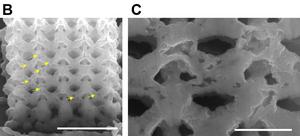
The researchers employed a method known as two-photon lithography, which allows for the precise construction of objects by controlling their geometry at the level of individual voxels—the smallest distinguishable volumes in a 3D image. The process begins with a light-sensitive liquid, from which a tightly focused femtosecond laser beam—a femtosecond being one quadrillionth of a second—creates a desired shape out of a gel-like material called hydrogel.
Once the hydrogel sculpture is formed, it is infused with metallic salts such as copper nitrate or nickel nitrate. The structure is then subjected to two heating processes in a specialized furnace, resulting in a shrunken metallic replica of the original shape.
“That’s where the magic happens,” says Greer, who also serves as the executive officer for applied physics and materials science at Caltech.
Thermal Processing and Material Shrinkage
During the first thermal step, all organic compounds in the hydrogel are burned off, leaving behind a metal oxide such as nickel oxide or iron oxide. This step may suffice for certain applications like optical elements. However, for other materials, a second thermal step is performed using a different set of gases to remove oxygen, leaving only the desired metal structure.
Greer notes that this thermal process results in significant shrinkage, reducing the preheated volume by as much as 90 percent. This allows for the creation of tiny lattices or heat exchangers with dimensions smaller than 50 microns, with building blocks measured in nanometers.
Understanding and Modeling Microstructural Defects
Greer’s team has also been able to dissect these miniature structures to reveal their defects, such as pores and grain boundaries. While such imperfections would typically weaken larger metallic parts, at the nanoscale, they contribute to the material’s strength.
By incorporating these microstructural details into models, the researchers have found that the nanoscale structures exhibit strengths up to 50 times greater than larger counterparts with similar microstructures. This phenomenon is attributed to the “smaller is different” size effect known at the nanoscale.
“We put exactly the microstructure we uncovered into the models. It’s not an inference. It’s not representative. It’s the actual microstructure that we made,” Greer explains.
Implications for Future Engineering
Greer emphasizes that these models, developed in collaboration with Nanyang Technological University in Singapore, are both physically relevant and reliable. This advancement suggests that in the future, as society moves towards nano-architecting custom parts, it will be possible to predict their properties accurately, even if they contain defects.
“I think this work basically shows that in the future, even when we ‘nano-architect’ our world with custom parts, we’ll be able to reliably predict their properties, something society hasn’t been able to accomplish yet,” Greer says. “And we don’t have to disqualify a part simply because it contains defects.”
Looking Ahead: Potential Applications and Support
The lead authors of the study, Wenxin Zhang and Zhi Li, highlight the potential for this technology to revolutionize industries that require precise, strong, and lightweight materials. The work has received support from the US Department of Energy and Singapore’s Agency for Science, Technology and Research, underscoring its global significance.
As the field of nano-engineering continues to evolve, the ability to create and model tiny, robust metallic structures could lead to significant advancements in various sectors, from healthcare to aerospace, marking a new era in material science.