




Bioorganisk elektronik
Visible light can now be harnessed to create electrodes from conductive plastics without the use of hazardous chemicals, according to a groundbreaking study by researchers at Linköping and Lund universities in Sweden. This innovative approach allows electrodes to be produced on various surfaces, paving the way for new types of electronics and medical sensors.
“I think this is something of a breakthrough. It’s another way of creating electronics that is simpler and doesn’t require any expensive equipment,” said Xenofon Strakosas, an assistant professor at the Laboratory of Organic Electronics (LOE) at Linköping University.
Revolutionizing Conductive Plastics
Researchers at LOE are focusing on conductive plastics, also known as conjugated polymers, to develop advanced technologies in fields such as medicine and renewable energy. These polymers combine the electrical properties of metals and semiconductors with the flexibility of plastics, offering a versatile material for various applications.
Conjugated polymers are composed of long chains of hydrocarbons, with each link in the chain referred to as a monomer. The process of forming polymers, known as polymerization, traditionally involves strong and sometimes toxic chemicals, which can hinder scalability and application in sensitive areas like medicine.
Visible Light: A New Method for Polymerization
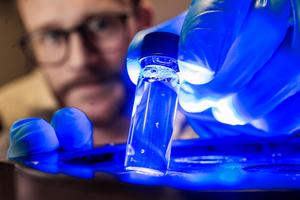
The researchers at Campus Norrköping, in collaboration with colleagues from Lund and New Jersey, have developed a method that uses visible light to initiate polymerization. This breakthrough is made possible by specially designed water-soluble monomers, eliminating the need for toxic chemicals, harmful UV light, or additional processes to create electrodes.
“It’s possible to create electrodes on different surfaces such as glass, textiles, and even skin. This opens up a much wider range of applications,” Strakosas added.
Practical Applications and Benefits
In practical terms, a solution containing the monomers can be applied to a substrate. By using a laser or another light source, electrodes can be patterned directly onto the surface. The unpolymerized solution can then be rinsed away, leaving the electrodes intact.
“The electrical properties of the material are at the very forefront. As the material can transport both electrons and ions, it can communicate with the body in a natural way, and its gentle chemistry ensures that tissue tolerates it – a combination that is crucial for medical applications,” explained Tobias Abrahamsson, a researcher at LOE and lead author of the study published in the scientific journal Angewandte Chemie.
Testing and Future Implications
The researchers have successfully tested the technology by photo-patterning electrodes directly onto the skin of anaesthetized mice. The results demonstrated a significant improvement in recording low-frequency brain activity compared to traditional metal EEG electrodes.
“As the method works on many different surfaces, you can also imagine sensors built into garments. In addition, the method could be used for large-scale manufacture of organic electronics circuits, without dangerous solvents,” Abrahamsson noted.
Looking Ahead
This development follows a growing trend in the electronics industry to find safer, more sustainable methods of production. The ability to create electrodes using visible light not only reduces environmental impact but also expands the potential for medical and wearable technology applications.
As researchers continue to refine this technology, the implications for both medical diagnostics and consumer electronics are vast. The move represents a significant step forward in the quest for more environmentally friendly and versatile electronic components.
With further research and development, this method could revolutionize the way we think about and use electronics in everyday life, offering a glimpse into a future where technology is seamlessly integrated into our surroundings.