



For decades, the ability to “play pretend”—to hold a mental image of an object that doesn’t exist while knowing it’s a fiction—was considered the final frontier of human cognitive uniqueness. That barrier officially collapsed this week with a landmark study published in the journal Science on February 5, 2026. The study provides the first experimental proof that great apes possess the capacity for secondary representation, the sophisticated mental machinery required for imagination, future planning, and empathy.
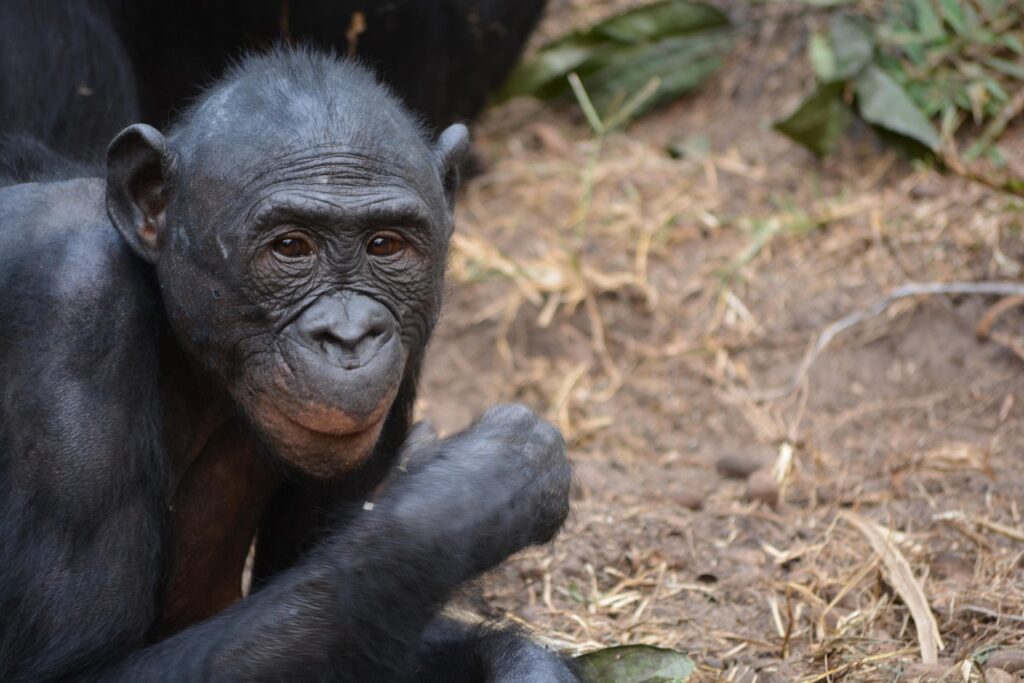
The star of this groundbreaking research was Kanzi, the world-famous 44-year-old bonobo, whose final contribution to science before his passing in March 2025 has redefined our understanding of the primate mind. Kanzi’s ability to engage in pretend play challenges long-held beliefs about human uniqueness in cognitive capabilities.
The “Tea Party” Experiments
Led by Dr. Amalia Bastos from the University of St. Andrews and Dr. Christopher Krupenye of Johns Hopkins, the research team designed a series of tasks that mirrored how developmental psychologists test 2-year-old human children. Kanzi, who was “enculturated”—raised with the ability to understand spoken English and communicate via a keyboard of lexigram symbols—provided researchers with a direct window into his thoughts.
The Imaginary Juice Test
In the primary experiment, a researcher sat across from Kanzi with two empty, transparent cups and an empty pitcher. The researcher performed an elaborate sequence of “pouring” imaginary juice into both cups. Then, the researcher “dumped” the pretend juice out of one cup, even shaking it to show it was empty.
“When asked, ‘Kanzi, where is the juice?’, the bonobo correctly pointed to the cup that still ‘contained’ the pretend liquid in 68% of the trials.”
Crucially, Kanzi succeeded on the very first attempt with no prior training, suggesting he intuitively understood the concept of a pretend object.
The Grape Substitution
To ensure the results weren’t a fluke, researchers repeated the test using “imaginary grapes.” They “placed” a pretend grape into one of two jars and “emptied” the other. Kanzi again successfully tracked the fictitious fruit with 69% accuracy, reinforcing the findings of the initial test.
The “Reality Check” Control
Skeptics often argue that apes might just be mimicking human movements without understanding the “pretend” aspect. To rule this out, the team ran a control: they offered Kanzi a choice between a cup of real juice and a cup of imaginary juice.
“Kanzi chose the real juice 78% of the time, proving he wasn’t ‘confused’ or hallucinating; he knew exactly which cup was empty, but he was choosing to ‘play along’ with the imaginary game when real rewards weren’t on the table.”
The Evolutionary “Smoking Gun”
The implications of the Bastos-Krupenye study are profound. By proving that a bonobo can maintain a “decoupled” mental representation (holding the idea of juice in an empty cup), the study suggests that the cognitive building blocks of the human imagination are much older than previously thought.
“This capacity didn’t appear out of thin air with the arrival of Homo sapiens,” said Dr. Bastos. “It likely dates back 6 to 9 million years to the last common ancestor we shared with bonobos and chimpanzees.”
This timeline pushes the origins of complex culture, symbolism, and perhaps even the roots of religion and storytelling into the deep Miocene epoch. It suggests that our ancestors were likely “playing pretend” in the forests of Africa long before they ever fashioned a stone tool or controlled fire.
Why Bonobos?
Bonobos (Pan paniscus) are often called the “forgotten ape,” overshadowed by their more aggressive cousins, the chimpanzees. However, their social structure—matriarchal, egalitarian, and famously peaceful—makes them ideal candidates for the evolution of imagination.
In the wild, bonobos use complex social signaling to prevent conflict. Researchers argue that the same “mental muscle” used to imagine what a rival is thinking (Theory of Mind) is the exact same muscle used to imagine a grape in an empty hand.
The Legacy of a Legend
The publication of this study comes at a somber time for the primatology community. Kanzi passed away on March 18, 2025, at the age of 44, following a brief struggle with heart disease. Raised by Dr. Sue Savage-Rumbaugh, Kanzi was a “linguistic pioneer” who could recognize over 3,000 spoken English words. He famously used his lexigram keyboard to ask for “marshmallows” and “fire,” and even learned to flint-knap stone tools.
“Kanzi was a bridge between two worlds,” said Dr. Krupenye. “He was uniquely qualified to help us prove that the human mind isn’t a lonely island. This final study is his parting gift to humanity—a reminder that our ‘superpower’ of imagination is a shared heritage with our forest cousins.”
Conservation and the Future
While the 2026 study used an enculturated bonobo, scientists are now racing to see if similar behaviors can be documented in wild populations. However, the window of opportunity is closing. Bonobos are endangered, with their populations in the Democratic Republic of Congo threatened by habitat loss and civil instability.
The discovery that these creatures share our capacity for fantasy adds a new moral weight to conservation efforts. As one researcher noted, “When we lose a bonobo, we aren’t just losing an animal; we are losing a mind capable of dreaming.”