


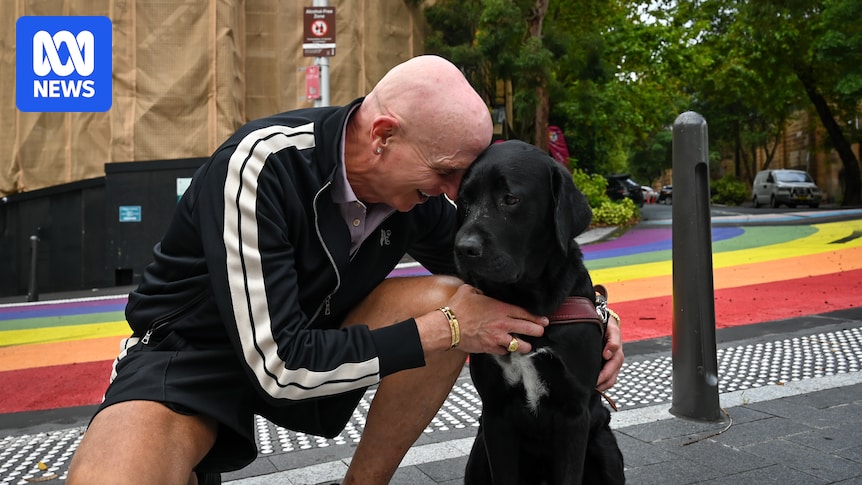
Scott Dixon-Smith, a blind participant in the Sydney Gay and Lesbian Mardi Gras Parade, will be marching with newfound confidence, thanks to his guide dog, Pretzel. The parade, set to take place tonight, marks a significant milestone for Dixon-Smith, who has been partnered with Pretzel for over a year. This will be their first appearance at the iconic event.
“It just felt like a natural thing to do,” Dixon-Smith shared. “What a great way to demonstrate to others how easy it is and how effortless it can be with a guide dog … he’s just amazing.” To ensure Pretzel’s comfort during the march, Dixon-Smith plans to carry a bag filled with Pretzel’s favorite treats, including kangaroo and chicken tenderloin, along with extra water.
The Journey to Acceptance
For Dixon-Smith, the parade represents more than just a public event; it is a personal triumph. After years of hiding his sexuality, he never imagined he would be marching in a pride parade in front of thousands. “But when I walked through the closet door, I closed it and never looked back,” he said.
The pair will be marching with Guide Dogs NSW/ACT, and Pretzel will don a special harness to ensure he is easily visible to the crowd. Dixon-Smith’s journey to this moment has been marked by significant challenges and triumphs.
A Life-Altering Diagnosis
Dixon-Smith was only 20 years old and studying at Westminster College in the US on a sports scholarship when he began to notice problems with his vision. Initially dismissed by his coach as laziness, his struggles on the tennis court led to more serious conversations and eventually a diagnosis of retinitis pigmentosa in 1979.
“[It’s] kind of like a little Pac-Man running around and eating up the retinal cells,” he explained.
Following his diagnosis, Dixon-Smith pivoted from his dreams of professional tennis to a career in marketing at IBM. Despite the challenges of accessibility in corporate America during the 1980s, his workplace made accommodations for his vision impairment.
Overcoming Personal Barriers
While his colleagues accepted his blindness, Dixon-Smith felt compelled to hide his sexuality. “I knew at the time going into corporate America, it wasn’t something that was readily approved of,” he recalled. Hearing derogatory comments about gay people led him to live a double life, separating his personal and professional identities.
This dual existence changed when Dixon-Smith started his own company. “When somebody would ask me if I were married or if I was dating I would let them know — ‘Yes, and his name is so-and-so,'” he said. “I felt good about that … If somebody else has an issue with that, that issue belongs to them, not to me.”
The Impact of a Guide Dog
By the age of 40, Dixon-Smith had lost his vision completely. Although he had considered getting a guide dog in the past, the demands of starting a software company left him with little time for the necessary training. As his work obligations decreased, he sought training to improve his cane use, which led to the suggestion of a guide dog.
In September 2024, Dixon-Smith met Pretzel, and the connection was immediate. “You cannot even begin to imagine the amazing difference it has made in my life,” he said. After more than 30 years, he traded his cane for Pretzel’s harness, embracing the newfound freedom it provided.
“I had no hesitation. I grabbed the harness and off I went. I thought ‘OMG’ — you could not take the smile off my face,” Dixon-Smith said.
Looking Ahead
Pretzel and Dixon-Smith’s participation in the parade is a testament to overcoming personal and societal barriers. “I hope it gives them [parade attendees] the opportunity to say, ‘Hey I’d like to talk to him’, because I would love for anybody to reach out to me and I welcome that conversation,” Dixon-Smith expressed.
Reflecting on his past, Dixon-Smith is proud of his journey and hopes to inspire others with vision impairments to engage more in community events. “There should never be a barrier, and we should be proud of who we are,” he said. “The only barrier is the one we set for ourselves — and we are better than that.”