

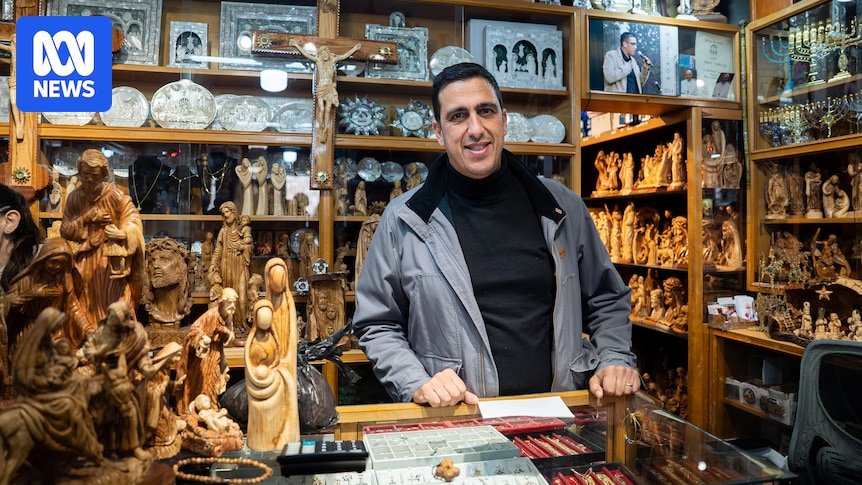
For the first time in two years, the city of Bethlehem has reignited its Christmas festivities, offering a glimmer of hope to its residents who have endured significant hardships. The return of these celebrations is particularly poignant for the Tabash family, who have operated a souvenir store in Bethlehem for nearly a century. Rony Tabash, the third generation to manage the business, reflects on the challenges faced due to the economic downturn exacerbated by the ongoing conflict in Gaza.
“Even my father, he always tells me, ‘Rony go open the shop,'” Tabash shared, highlighting the resilience required to keep their family business afloat. The economic impact has been severe, especially in a city like Bethlehem, where tourism is a lifeline for many. “It was really very difficult, because not just my shop … 80 per cent of the population in Bethlehem, they depend on tourism and pilgrims,” he added.
Economic Hardships and the Impact of Conflict
The war in Gaza has cast a long shadow over the West Bank, leading to a severe economic downturn. The restrictions imposed by Israeli security forces have further compounded these challenges, affecting daily life and the local economy. Bethlehem, a city deeply intertwined with the Christmas story, has felt these impacts acutely, particularly during the holiday season when it typically welcomes throngs of visitors.
Bethlehem’s mayor, Maher Canawati, emphasized the importance of this year’s festivities. “This year, after two years of silence, we decided to reignite Christmas, to reignite the spirit that everybody needs here in town, in order to give them hope so they can continue staying in Bethlehem and not leaving Bethlehem,” he stated. The mayor expressed optimism despite the city’s struggles, noting a significant loss in tourism revenue and a dramatic rise in unemployment and poverty rates.
“We had a loss of approximately $US1.8 million ($2.72 million) a day in the industry of tourism,” Canawati said. “The unemployment rate jumped from 14 to 65 per cent, poverty touched 60 per cent, [and] 4,000 people left [the city].”
Challenges of Access and Movement
Despite the festive atmosphere, challenges remain. Bethlehem is encircled by a wall built by Israel, ostensibly for security, which separates it from Jerusalem. This barrier complicates access to the city, with checkpoints often closed, forcing travelers to take lengthy detours. “All of these hardships are unfortunately normal for the Palestinians,” Canawati lamented, calling for the removal of checkpoints and the demolition of the separation wall.
The mayor urged the world to see beyond Bethlehem’s ancient relics and recognize its living community. “I think Bethlehem is not owned by certain people, and I think Bethlehem is international and Bethlehem is the capital of the Christian world,” he asserted. However, the local Christian population is dwindling, a trend historian Samir Qumsieh finds troubling.
“The Christian figures are dwindling,” Qumsieh noted. “Back in 1950, Christians made up 86 per cent of the population across Bethlehem, Beit Sahour, and Beit Jala. Now, the Christian population is less than 12 per cent.”
Hope for a Brighter Future
The Church of the Nativity, a focal point for Christmas celebrations, stands as a symbol of hope and resilience. While the number of visitors has declined in recent years, there is optimism that this trend will reverse. “We hope this year will be a year of good and blessing,” expressed Saliba Afteem Salameh of the local culinary institution Afteem.
As Bethlehem seeks to rebuild its tourism industry, the return of pilgrims and visitors is a positive sign. On the other side of Manger Square, Rony Tabash remains hopeful as he welcomes visitors into his shop, showcasing the intricate handiwork of local artisans. His interactions with tourists, conducted in multiple languages, reflect a deep-seated optimism for a future where Bethlehem can thrive once again.
The revival of Christmas festivities in Bethlehem is more than a return to tradition; it is a testament to the resilience of its people and their enduring hope for peace and prosperity.