

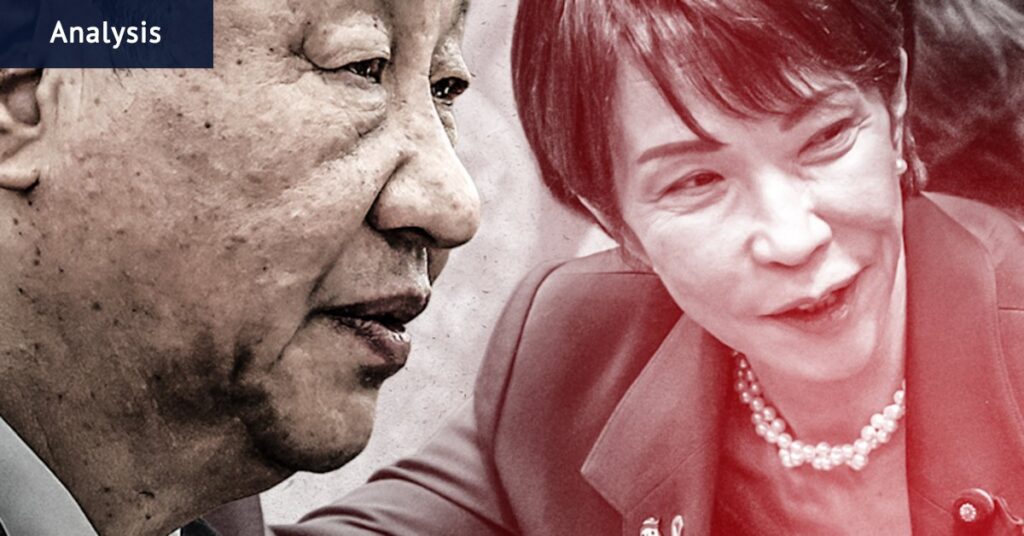
Singapore: Japan finds itself at the center of a geopolitical storm, facing a barrage of political and economic pressure from China. This follows Japanese Prime Minister Sanae Takaichi’s recent remarks in parliament regarding Japan’s potential involvement in a military crisis over Taiwan. The comments have provoked a fierce response from Beijing, which has long considered Taiwan a non-negotiable issue.
For over a month, Tokyo has been under intense scrutiny and pressure from China, which has sought to intimidate Japan’s new leader into retracting her stance. The situation underscores China’s determination to keep the global discourse on Taiwan firmly within its control.
China’s Red Line: Taiwan
Taiwan remains a crucial point of contention for China, which views the self-governed island as part of its territory. Takaichi’s remarks, which acknowledged the potential threat to Japan’s survival if China were to annex Taiwan, have been met with hostility from Beijing. This reaction is not so much about the novelty of her statement, but rather her refusal to sidestep the issue.
“Beijing’s problem wasn’t that Takaichi’s answer broke new ground – it didn’t,” says Wen-Ti Sung, a fellow at the Atlantic Council’s Global China Hub, based in Taiwan. “Beijing’s problem was that she didn’t choose to dodge the question. China is trying to silence and police this taboo around any discussion about Taiwan.”
This approach, reminiscent of the Chinese idiom “killing the chicken to scare the monkey,” aims to deter other nations from engaging in similar discussions.
International Reactions and Military Maneuvers
The international response has been cautious. While Takaichi has not retracted her comments, she has received limited high-level support. It was only after China escalated its military activities near Japan that countries like Australia and the United States expressed their concerns.
US strategic bombers recently flew alongside Japanese fighter jets, a clear message to Beijing following joint Chinese and Russian military drills near Japan. Meanwhile, Australia’s Defence Minister Richard Marles, during a visit to Tokyo, voiced concerns over China’s actions, aligning with Japan’s account of recent military encounters.
However, Marles avoided commenting on the economic measures China has taken against Japan, which include travel advisories, flight cancellations, and bans on Japanese imports and cultural exports.
Economic Coercion and Nationalism
China has leveraged its economic influence as a tool of coercion against Japan. Over the past month, Beijing has discouraged travel to Japan, canceled thousands of flights, and imposed bans on Japanese seafood and cultural exports. This economic pressure coincides with a surge in anti-Japanese sentiment within China, fueled by the commemoration of historical conflicts.
In putting Tokyo in its crosshairs, Beijing has tapped a deep vein of anti-Japan nationalism in China, which it has stoked all year as it has commemorated the 80th anniversary of the end of World War II.
This strategy not only redirects domestic frustration over China’s sluggish economy but also challenges the global perception of China as a stable superpower.
Domestic Implications for Japan
Domestically, the situation has bolstered Takaichi’s political standing, as her approval ratings have surged past 64%, a significant improvement over her predecessors. The nationalistic fervor stirred by China’s actions may support her agenda to revise Japan’s pacifist constitution and increase military spending.
“China the scary dragon, not China the huggable panda,” as Sung from the Atlantic Council puts it.
This development highlights the complex interplay of international diplomacy, economic leverage, and domestic politics, as Japan navigates its relationship with China and its role in the broader geopolitical landscape.
As the situation unfolds, the world watches closely, aware that the implications of this standoff extend far beyond the immediate region. The balance of power in East Asia remains delicate, with potential consequences for global stability and security.