


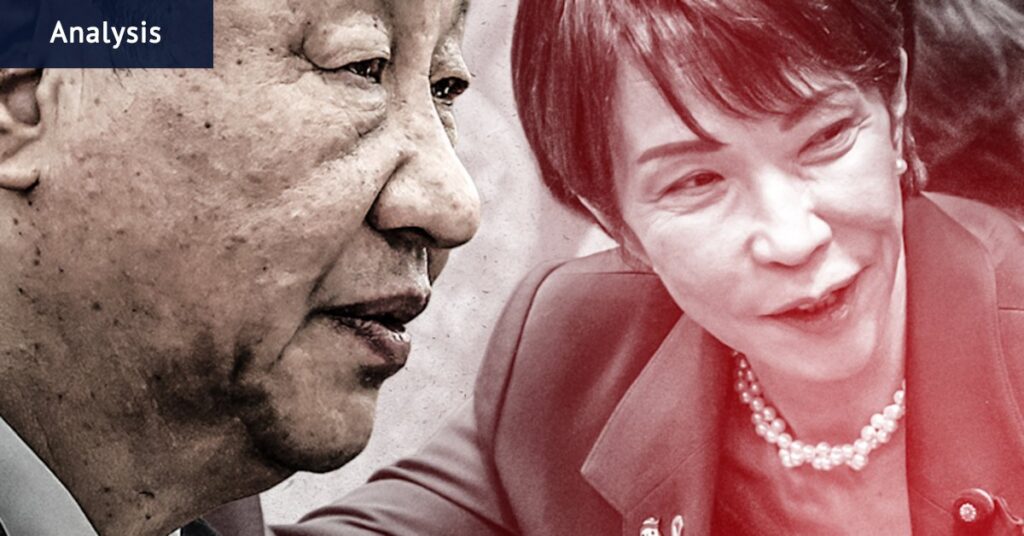
Singapore: Japan finds itself at the center of a geopolitical storm, facing a month-long campaign of political and economic coercion from Beijing. The trigger? Japanese Prime Minister Sanae Takaichi’s parliamentary response regarding Japan’s potential involvement in a military crisis over Taiwan.
Beijing’s reaction aims to intimidate Japan and its new Taiwan-friendly leader, while sending a clear message to the world: discussions on Taiwan’s status are non-negotiable. For China, Taiwan is a critical issue, viewed as a breakaway province that must eventually reunite with the mainland.
Japan’s Strategic Calculations
Takaichi’s comments, which Beijing deemed provocative, merely echoed what military strategists globally have contemplated: a Chinese move to annex Taiwan could pose a “survival-threatening situation” for Japan. This scenario could legally justify Japan’s military intervention alongside allies.
“Beijing’s problem wasn’t that Takaichi’s answer broke new ground – it didn’t,” says Wen-Ti Sung, a fellow at the Atlantic Council’s Global China Hub, based in Taiwan. “Beijing’s problem was that she didn’t choose to dodge the question. China is trying to silence and police this taboo around any discussion about Taiwan.”
This situation exemplifies Beijing’s strategy of “killing the chicken to scare the monkey,” a tactic designed to deter others from similar actions. While Takaichi hasn’t retracted her statement, she has received limited international support, highlighting the global hesitance to engage in Taiwan-related discourse.
International Reactions and Military Maneuvers
Beijing’s fury reached new heights with military displays over the Sea of Japan, prompting a measured response from allies. The United States and Australia have shown support, albeit cautiously. U.S. strategic bombers flew with Japanese fighter jets, a clear signal to Beijing following joint Chinese and Russian drills near Japan.
Japan accused Chinese jets of targeting its military planes with radar, a claim Beijing dismissed as false. During a press conference, Australian Defence Minister Richard Marles expressed “deep concern” over China’s actions, aligning with Japan’s account of events.
Marles, coincidentally in Tokyo during the radar incident, refrained from commenting on China’s economic pressures on Japan. Over the past month, China has restricted tourism, canceled flights, banned imports of Japanese seafood, and intensified military patrols, all while criticizing Takaichi through diplomatic channels.
Economic and Political Implications
The United States eventually condemned the radar incident, albeit belatedly, as reports surfaced of Japan’s dismay over its ally’s silence. Former Japanese ambassador to Australia, Shingo Yamagami, highlighted Japan’s previous support for Australia during its economic tensions with China, urging reciprocal solidarity.
China’s actions have tapped into deep-seated anti-Japan sentiment, amplified by commemorations of the 80th anniversary of the end of World War II. This nationalism may redirect domestic discontent over China’s sluggish economy, but it also risks tarnishing China’s international image as a stable superpower.
“China the scary dragon, not China the huggable panda,” as Sung from the Atlantic Council puts it.
Domestic Impact and Future Prospects
Domestically, Takaichi’s firm stance has bolstered her political standing, with approval ratings surging past 64 percent in November. This “rally around the flag” effect contrasts sharply with her predecessors’ lackluster support, potentially aiding her agenda to revise Japan’s pacifist constitution and increase military spending.
As tensions simmer, the world watches closely. The unfolding events may redefine regional power dynamics and influence global strategies concerning Taiwan’s future. For now, Japan navigates a delicate path, balancing national security interests with the complexities of international diplomacy.