




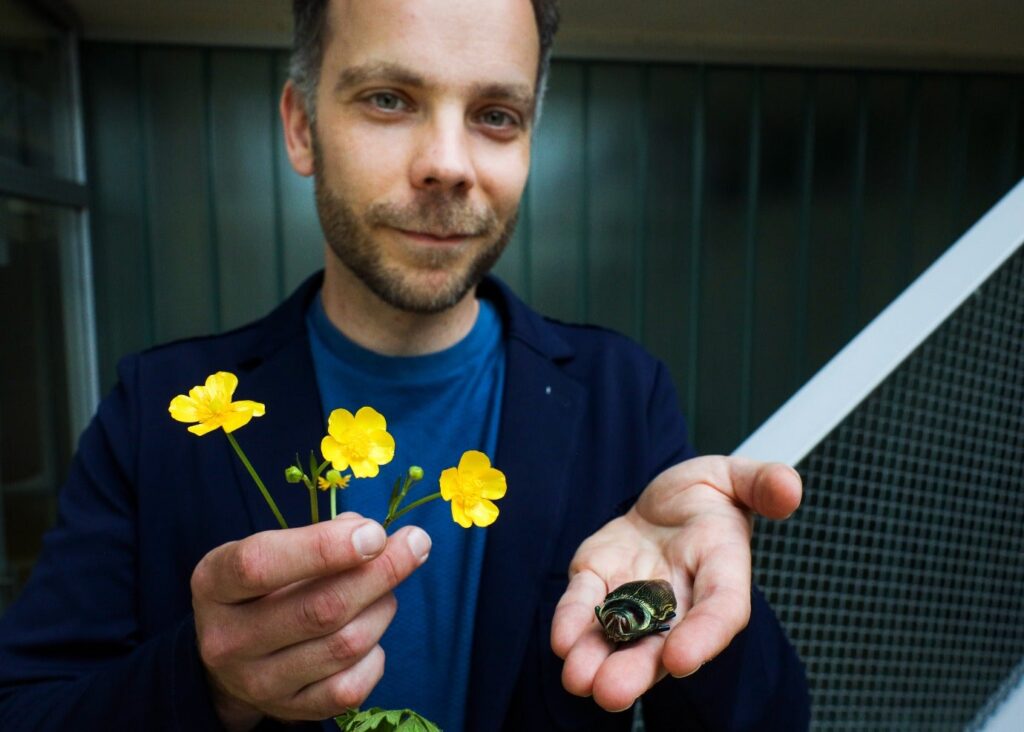
Nature’s most dazzling colors are surprisingly rare. As you stroll through a park or forest, the greens, yellows, and reds that greet your eyes are mostly matte. Occasionally, you might spot a buttercup petal or beetle shell that flashes like polished metal. This contrast piqued the curiosity of evolutionary biologist Casper van der Kooi, who sought to understand why glossy colors are uncommon and their significance for animals relying on color for survival. His investigation led him to bees, artificial flowers, and a simple question with a surprisingly profound answer.
Matte Signals and a Stable World
Imagine a daisy, a great tit’s feathers, or a small tree frog. Their colors remain steady as you move around them. Matte surfaces scatter light in various directions, ensuring the shade appears consistent from every angle and in most lighting conditions. According to Van der Kooi, “Many colors serve as signals, for example, to attract pollinators or a mate.” These signals are most effective when predictable in space and time. If a flower petal consistently appears the same shade of yellow, a bee can learn that this color signifies nectar and pollen.
Matte colors efficiently convey a simple, stable message: here is food, here is a partner, here is a warning. Evolution often favors such reliability.
When Nature Turns Up the Shine
However, the natural world isn’t limited to soft tones. Glossy buttercups, metallic beetle shells, and butterflies that flash bright blue in sunlight also exist. These shiny colors interact with light differently. Van der Kooi explains, “These shiny colors have a dynamic quality: how you perceive them depends on the angle of observation, the level of illumination, and the time of day.” Gloss is responsive to movement; a slight shift in position or sunlight can transform a petal from dull to dazzling.
To examine how shimmer affects bees, Van der Kooi and his team created artificial flowers with matte or glossy surfaces. They released bumblebees into large cages and observed their visitation patterns. From afar, shiny “flowers” stood out, their flashes of reflected light akin to a lighthouse beam or the flash of blue on an emergency vehicle. For a fast-moving bee searching for food, such bright cues can be powerful guides.
The Cost of Too Much Sparkle
The story changes as the bee approaches. At close range, gloss becomes a hindrance rather than a help. “At close range, their shininess will make them more difficult to see in detail,” Van der Kooi noted, comparing it to reading a glossy magazine in full sun, where glare obscures the text.
The same occurs for a bee nearing a glossy petal. Reflected light can wash out fine detail and color contrast, complicating the insect’s task of determining where to land or assessing the bloom’s richness. The signal becomes bright but fuzzy. “So, there is a trade-off, which explains why dynamic, shiny colors are rarer than static, matte ones,” he said. “It’s a visual trade-off.” Shiny petals help you stand out at a distance but complicate close work.
Why Most Flowers Stay Matte
This trade-off offers a fresh perspective on the flowers and animals around you. If a plant relies on repeat visits from bees or other pollinators, clear and consistent colors up close may outweigh attention-grabbing flashes from afar. Matte petals provide that reliability, signaling to bees, “when you get here, you will see exactly what you expect.” Over generations, such honest, stable signals can prevail over more dramatic but confusing shine.
Shiny signals may still have their place. In cluttered habitats, bright flashes could help insects locate flowers hidden among leaves. In other cases, dynamic shine might confuse predators or aid insects in recognizing each other. However, for most plants, evolution appears to favor the simple, matte message.
From Bee Vision to Human Design
Understanding how bees perceive glossy and matte surfaces extends beyond satisfying curiosity; it offers practical applications. “We could use this new knowledge to build better traps for pest insects and advise engineers on how to prevent bees from flying to solar panels instead of flowers,” Van der Kooi told The Brighter Side of News.
If shiny panels divert bees from crops, designers could alter the surface texture or coating to reduce misleading flashes. Meanwhile, farmers or public health workers might employ extra glossy traps to attract pest insects from afar, then use matte details or patterns to guide them upon arrival. The lesson is simple but powerful: shaping how a surface reflects light shapes how an animal experiences the world.
Seeing Nature With New Eyes
This research underscores that color involves more than pigment; it encompasses texture, angle, and the way light interacts with tiny structures. A buttercup’s shine, a beetle’s metallic shell, and a glossy magazine page all engage with the same physics.
For bees, these interactions have real consequences. A clear signal can mean a full stomach and a successful return to the hive, while a confusing glare can waste time and energy. Over millions of years, small differences in how petals reflect and scatter light have influenced which flowers populate your fields and gardens today.
The next time a shiny petal catches your eye, it carries a quiet story. It is not merely a pretty effect but a compromise between standing out and remaining readable, between a bright shout and a steady, soft voice.
This work provides a concrete guide for designing surfaces that insects see and respond to. By demonstrating that gloss aids detection at long range but hinders detail at close range, it offers engineers a method to optimize traps for pest insects, pollinator-friendly structures, and protective barriers.
Crop managers can utilize highly glossy patterns on traps to attract pests from afar, then incorporate matte elements to maintain insect focus once they arrive. Solar panel designers and urban planners can minimize unwanted bee visits by breaking up large shiny fields with matte textures or varying reflective properties.
For scientists, the study opens new avenues in visual ecology. Future research can explore how other pollinators respond to gloss, how different levels of shine influence behavior, and how petals evolve under changing light conditions in urban and agricultural environments.
Over time, this knowledge can support both biodiversity and agriculture, aiding in the design of landscapes that better serve people and the insects that sustain ecosystems.
Research findings are available online in the journal Science Advances.
Related Stories:
- Microscopic DNA ‘flower’ robots shapeshift for targeted medicine delivery
- Scientists create nutritious vegan-meat alternative from sunflowers
- Scientists discover the ancient link between bees and the evolution of colors in flowers
Like these kinds of feel-good stories? Get The Brighter Side of News’ newsletter.