


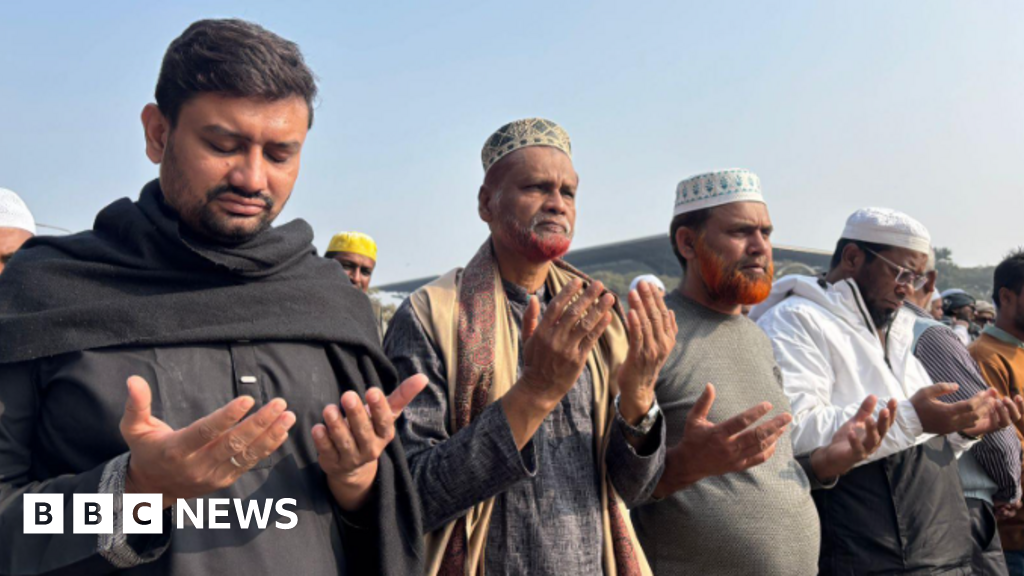
Hundreds of thousands of mourners gathered in Dhaka on Wednesday to bid farewell to Khaleda Zia, Bangladesh’s first female Prime Minister, who passed away at the age of 80 after a prolonged illness. The streets near the parliament house were filled with people holding flags adorned with her photographs, as a motorcade carrying her body made its way through the capital.
Flags flew at half-mast, and a heavy security presence underscored the significance of the moment. Setara Sultana, an activist from Zia’s Bangladesh Nationalist Party (BNP), expressed her sorrow, stating, “I have come this far just to say goodbye. I know I won’t be able to see her face, but at least I could see the [vehicle] carrying her for the last rites.”
Sharmina Siraj, a mother of two, described Zia as “an inspiration,” highlighting the impact of the stipends introduced by Zia to improve women’s education. “It is difficult to imagine women in leadership positions anytime soon,” she remarked.
A Farewell with International Attendance
The state funeral was attended by prominent figures, including India’s External Affairs Minister S Jaishankar, Pakistan’s National Assembly Speaker Sardar Ayaz Sadiq, and Bhutan’s Foreign Minister Lyonpo DN Dhungyel. Earlier in the day, Zia’s body was taken to her son Tarique Rahman’s house, where he was seen reciting the Quran beside his mother’s office.
Zia’s journey from a homemaker to the first female prime minister of Bangladesh was nothing short of extraordinary. Her political career was marked by resilience and determination, traits that endeared her to many Bangladeshis.
The Political Legacy of Khaleda Zia
Zia’s political career began in the aftermath of her husband, Ziaur Rahman’s assassination in 1981. She rose to prominence, leading the BNP in the country’s first elections in two decades. Her refusal to participate in a controversial election under military ruler General Hussain Muhammad Ershad in the 1980s earned her the reputation of an “uncompromising leader.”
For years, Zia and her political rival Sheikh Hasina were central figures in Bangladesh’s struggle for democracy. Despite arrests and political setbacks, Zia’s commitment to her principles never wavered. Her supporters admired her resilience, viewing her as a symbol of resistance against Hasina’s rule, which many perceived as increasingly autocratic.
Economist Dr. Debapriya Bhattacharya recalled Zia as “a political leader who appreciated ideas and valued informed decision-making,” leaving a lasting impression on those who worked with her.
Enduring Influence and Future Prospects
Despite health challenges in her later years, Zia’s political ambitions remained undeterred. The BNP had intended for her to run for parliament in February 2026, as the country prepares for its first elections since a popular revolution last year unseated Hasina.
According to the party’s candidate list, Zia was set to contest in three constituencies. Her son, Tarique Rahman, who recently returned to Bangladesh after 17 years in self-imposed exile, is expected to lead the party in the upcoming elections.
“The country mourns the loss of a guiding presence that shaped its democratic aspirations,” Rahman said, following his mother’s passing.
The turnout at Zia’s funeral, including many who did not support her party, is a testament to her enduring popularity among the masses. As Bangladesh looks to the future, Zia’s legacy of leadership and resilience will continue to inspire those who strive for democratic ideals.