




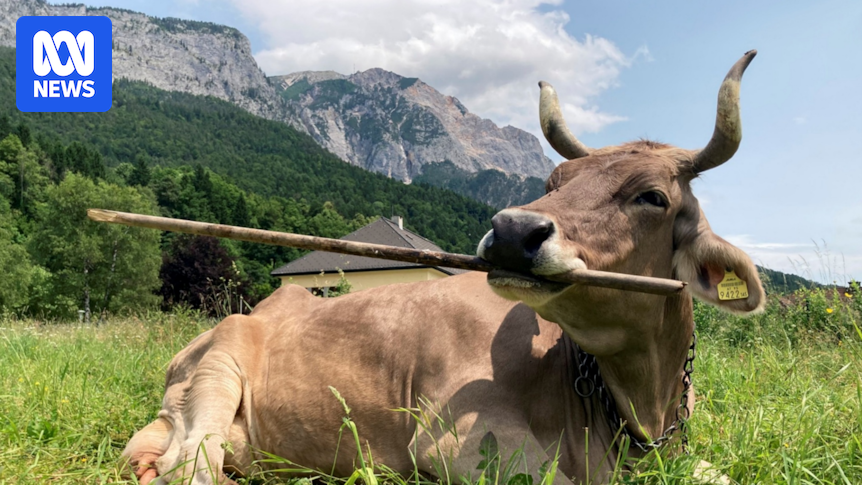
Hobby farmer Anthea Harrison expressed little surprise over recent scientific research revealing that cows possess the intelligence to use tools for self-care. Her remarks come in response to an Austrian study that documented a cow named Veronika employing a tool to scratch herself. Researchers suggest this finding could prompt farmers and scientists to reassess the everyday behaviors of livestock.
Ms. Harrison, who runs the Echo Farm tourist attraction near Mount Gambier in South Australia, has long observed the intelligence of her animals since taking over the property. “[Cattle] have an intelligence which I would say is equivalent to a pet dog,” she noted. Although she hasn’t witnessed her cattle using man-made tools, she describes them as resourceful, utilizing available resources in their environment. Her highland cross, Bonnie, even learned to open gates, necessitating reinforced enclosures.
Veronika the Tool-Using Cow
The study was conducted by cognitive biologists Antonio Osuna-Mascaró and Alice Auersperg from the University of Veterinary Medicine Vienna. Veronika, a 13-year-old Swiss brown cow, resides in a picturesque mountain village in Carinthia, Austria. The researchers’ interest was piqued when Veronika’s owner, Witgar Wiegele, sent them a video showcasing her tool use, leading them to investigate further.
Dr. Auersperg emphasized the need for scientific rigor, stating, “As a scientist, you have to be very careful, because we don’t just believe anecdotes.” The researchers aimed to determine if Veronika’s behavior was intentional and adaptable.
Researchers Surprised by Results
Upon visiting the village, the researchers anticipated a lengthy observation period. However, Veronika quickly demonstrated her abilities by picking up a brush with her tongue, using it effectively to scratch herself.
“She picked it up … using her tongue like it was a hand, pulling the tongue back in, fixing the stick horizontally in her mouth, turning her head and scratching her rear side,”
Dr. Auersperg recounted. The speed and proficiency of Veronika’s actions exceeded expectations, as she adeptly used different ends of the tool based on her needs.
Dr. Osuna-Mascaró noted, “After a while, we recognised a pattern and this was not the result of an error, this was a meaningful use of the handle end of the stick.” The researchers concluded that Veronika’s skills were not due to extraordinary intelligence but rather the enriched environment provided by her owner, which allowed her to develop such capabilities over time.
Call for More Research
Dr. Auersperg highlighted the lack of attention given to livestock behavior and cognition, pointing out that these animals are often studied solely for production purposes. “There is a bias in them only being studied for production … here is this animal that basically stands in any village that we live in and we have only observed [tool use] now,” she remarked.
Echoing this sentiment, Ms. Harrison added, “Farm animals are much smarter than they get credit for. Visitors to the farm are always surprised by what they find.” The study of Veronika may serve as a catalyst for further research into the cognitive abilities of livestock, potentially reshaping how these animals are perceived and managed.
Implications and Future Directions
This development follows a growing body of research into animal intelligence, challenging traditional views of livestock as merely utilitarian creatures. By recognizing the cognitive capabilities of animals like Veronika, scientists and farmers alike may begin to explore new methods of animal management that prioritize mental enrichment and welfare.
As the scientific community continues to uncover the complexities of animal behavior, the implications of such findings could extend beyond agriculture, influencing fields such as animal welfare policy and ethical farming practices. The discovery of tool use in cows may just be the beginning of a broader understanding of the intelligence that exists within our everyday livestock.
Looking ahead, researchers are likely to expand their studies to include a wider variety of species and environments, seeking to uncover the full extent of animal cognition and its potential applications in human society.