
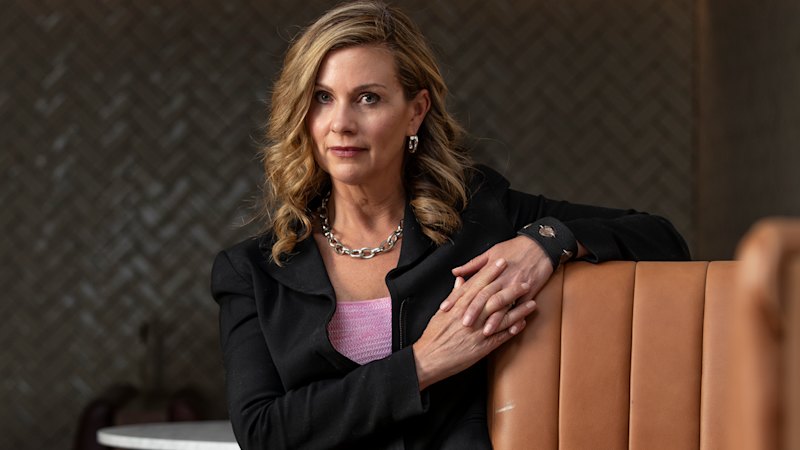
“This has been really, really hard for me and my team.” These are not the typical words of Julie Inman Grant, the eSafety Commissioner known for her unwavering resolve against tech giants and online adversaries. Yet, as Australia prepares to implement its pioneering social media ban, a shift is palpable.
Set to take effect on Wednesday, the ban mandates platforms like Facebook, Instagram, and TikTok to prevent under-16s from holding accounts or face hefty fines. Inman Grant, despite the mounting pressure, remains determined. “We’re now at this point where people want to tear it down and say it’s going to be a failure, and that I’m going to be a failure,” she says with a laugh, adding, “One of my favourite ones today is: ‘Maybe she’ll fail at this thing and they’ll send her back to the US.’ Oh, she can’t go back to the US. Jim Jordan will be waiting for her.”
The Challenges and Legal Battles
Currently, Inman Grant is entangled in a High Court challenge and has been summoned by US Congress Republicans, including Jim Jordan, who accuse her of a “zealotry for global take-downs.” Simultaneously, she is enforcing the new law on her own 13-year-old daughter, who believes the ban will disrupt her life.
The legal landscape is becoming increasingly complex. The Australian Financial Review reported that Reddit is preparing its own High Court challenge, arguing that the ban infringes on teenagers’ implied right to freedom of political communication. The $67 billion platform has enlisted constitutional law expert Perry Herzfeld, SC, and law firm Thomson Geer, known for challenging Inman Grant’s rulings on behalf of Elon Musk’s X.
“The only decision we’ve made is to comply with the law,” a Reddit spokesperson stated.
Inman Grant anticipated these challenges. “We know that some companies were briefing barristers,” she notes. “Yes, I am prepared for that.” The existing constitutional challenge, backed by the Digital Freedom Project, targets the legislation itself. “We’ll see what happens,” she says. “If the court makes a decision, we’ll abide by it. It may be that the Commonwealth wins. It may be that some changes need to be made to the policy. Who knows? I’m just going to move forward, given there hasn’t been any legal constraint placed on us.”
Implementation and Industry Response
The ban requires platforms to take “reasonable steps” to prevent under-16s from creating accounts, with fines up to $49.5 million for non-compliance. Meta has started deactivating accounts, while others are introducing age verification through facial scans, ID checks, and AI-powered behavioral analysis.
Even reluctant platforms are complying. Reddit, despite disagreeing with its designation as an age-restricted platform, is using identity verification service Persona. Elon Musk’s X is deploying its AI chatbot Grok for facial age estimation. “Interesting to see how efficacious that is,” Inman Grant comments. “And how spicy.”
She acknowledges the challenges ahead. “There are going to be teething issues. Some companies are going to do this better than others. Things aren’t going to be perfect.” However, she emphasizes the importance of patience, warning against expecting immediate transformation. “There will be a story every day about this kid in Perth getting around it with a sock puppet account. We’ve got to keep the longer game in mind.”
The Political and Social Landscape
Politically, the ban could be a significant win for the prime minister, who has addressed Australian school students and written to premiers and chief ministers, thanking them for their support. Recent polling indicates 67% of Australians support the ban, though only 35% believe platforms will enforce it effectively. Just 29% of parents plan to fully enforce it at home, with one in three telling government researchers they’re “likely” to help their children circumvent it.
Inman Grant remains focused on the broader implications. She cites internal Meta documents from US court discovery, revealing the company’s awareness of the harm their platforms cause to children. “I was shocked to see one document from Meta where they referred to tweens as having a ‘herd mentality’,” she says. “‘Go target them, get them on while they’re early, and then they’ll become adults someday.’”
“These aren’t just harmful and deceptive design features. There is a whole infrastructure and an ethos that is putting profits before child protections.”
Looking Forward
With a background of 22 years in the technology industry, Inman Grant is no stranger to the challenges of regulation. She joined Twitter in 2014, inspired by its potential to empower voices during the Arab Spring, but left two years later, disillusioned by its failure to protect vulnerable communities.
Now, as AI companies follow a similar trajectory, she warns of the need for regulation. “They’re behaving exactly the same way social media companies did 20 years ago: moving fast and breaking things, asking for forgiveness rather than permission.” Regulation of AI companions and chatbots is expected in March.
Her greatest concern? “A child out there who may not have supportive scaffolding, who may be vulnerable, who does feel very cut off.” Yet, she remains hopeful. Generation Alpha, children now aged five to seven, will grow up without the expectation of social media before 16, “around the same time they learn to drive.”
As the world watches, with countries like Europe, Malaysia, and New Zealand considering similar measures, Inman Grant is not celebrating the ban’s implementation. Instead, she is preparing to issue information notices to major platforms, demanding baseline data on under-16 accounts and the technologies used to enforce the ban.
When asked about her expectations for December 10, her response is candid, reflecting her commitment to the cause and the long-term vision she holds for a safer digital environment for children.