



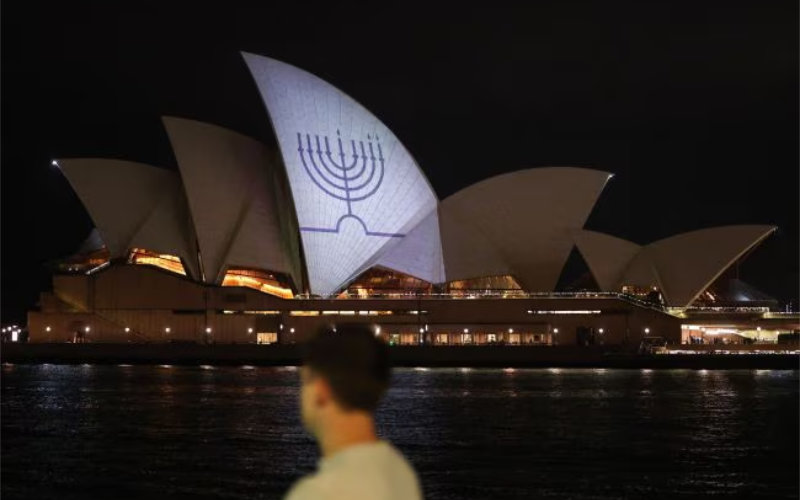
Australia’s empathy is not in question; rather, it is the selective nature of that empathy that has come under scrutiny. Nowhere is this more evident than in the manner in which the country’s political and media elite determine who is permitted to mourn. This was starkly illustrated on a recent Thursday night at the Sydney Opera House, where a solemn gathering of premiers, the opposition leader, and the prime minister took place. Cameras captured every moment as they offered condolences in a carefully orchestrated display of national grief.
This event was not an anomaly but the latest in a series of public displays of mourning that have unfolded over the past month. Vigils, ceremonies, gatherings at Bondi Beach, flags at half-mast, and illuminated monuments have dominated the national conversation, with media coverage extending to several pages daily. The catalyst for this outpouring was the tragic loss of fifteen lives, yet the scale and intensity of the response suggest a deeper, more complex dynamic at play.
The Hierarchy of Grief
At the heart of this phenomenon lies a rigid hierarchy of grief that dictates whose suffering is deemed sacred and whose is negotiable. While approximately ninety thousand Jewish Australians have received uninterrupted national mourning, the same cannot be said for the country’s Aboriginal population. Numbering between seven hundred and fifty thousand to eight hundred thousand, Aboriginal Australians are often denied the right to publicly mourn on January 26, a date marking the beginning of their dispossession.
For many Aboriginal Australians, January 26 is not a day of celebration but one of mourning, symbolizing invasion, mass death, and cultural destruction. Yet, when they call for a day of mourning instead of fireworks, they are frequently dismissed as divisive or un-Australian. Their grief is not recognized as genuine but is instead treated as a political irritant.
Media Amplification and Political Dynamics
This hostility is not spontaneous; it is cultivated and amplified by media outlets such as News Corp Australia, which have mastered the art of sanctifying certain types of pain while ridiculing others. Jewish mourning is framed as a moral obligation, while Aboriginal mourning is portrayed as an attack on the nation. This dichotomy raises critical questions about national priorities and values.
“Do we fly Aboriginal flags at half-mast on January 26? Do our leaders wear Aboriginal symbols to apologize for past injustices? The answer is no. Always no.”
Yet, Australia readily lowers its flags and alters national symbolism to express solidarity with foreign nations. This inconsistency becomes even more pronounced when moving from symbolism to the exercise of power.
Institutional Power and Double Standards
Aboriginal Australians are not a special interest group; they are the continent’s original custodians, having lived here for seventy to eighty thousand years. Their request for a Voice to Parliament, as outlined in the Uluru Statement from the Heart, was modest by democratic standards. It sought a permanent advisory body to provide input on laws affecting their lives, not a veto or supremacy, just a voice. Yet, this request was rejected decisively in a national referendum.
In stark contrast, without a public vote or referendum, the government appointed a special envoy for Jewish Australians, who now influences policy across various sectors, including education, immigration, and law. Institutions have quickly adapted, revising policies and amending laws, with political leaders following suit without hesitation.
“One community must survive a referendum to be heard, another receives institutional power by ministerial decree.”
The Unaddressed Question of Allegiance
Perhaps the most contentious issue is the question of allegiance. Many of those wrapped in national mourning openly identify first with Israel, asserting dual allegiance. Despite this, Australia performs national grief for a foreign nation while denying its own First Nations even a single day of mourning.
This disparity is not lost on Aboriginal Australians, who observe leaders adopting religious symbols for others while refusing even symbolic recognition for them. They witness extensive media coverage of certain tragedies while issues like deaths in custody receive minimal attention. Laws are swiftly enacted to combat one form of racism, while their own struggles are endlessly debated and diluted.
Conclusion: A Call for Honest Empathy
The current state of affairs is not one of national unity but of hierarchy and moral cowardice, masked as compassion. Until Australia applies the same standards of grief, symbolism, and institutional respect to Aboriginal Australians that it so readily grants to others, every speech about unity will ring hollow.
Most Australians, if they are honest with themselves, already recognize this truth. The challenge now is to confront it and strive for a more equitable and inclusive national narrative.