
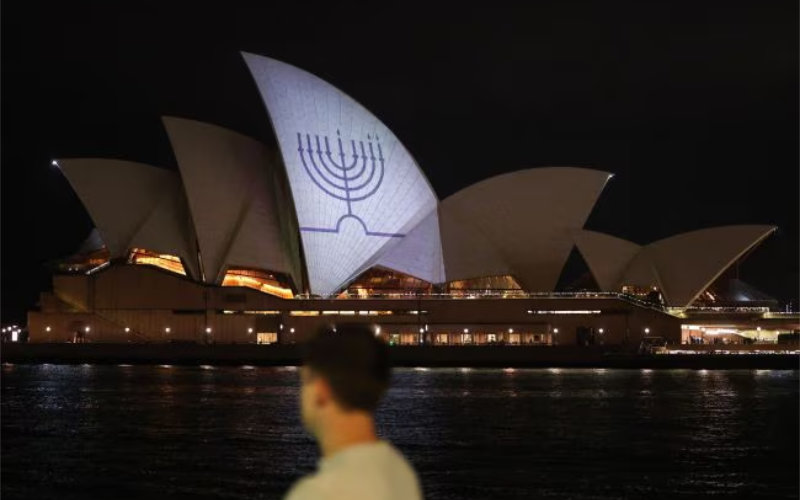
Australia is a country often praised for its empathy, yet recent events have highlighted a troubling pattern of selective mourning. This disparity is most evident in how the nation’s political and media elites choose who is allowed to grieve publicly. Thursday night at the Sydney Opera House, a scene unfolded that encapsulated this selective empathy. Political leaders, including premiers, the opposition leader, and the prime minister, gathered with solemn faces, donning kippahs, as cameras captured their every move. This was not an isolated moment but the latest act in a month-long national display of grief.
The occasion was marked by vigils, ceremonies, gatherings at Bondi Beach, flags lowered to half-mast, and monuments illuminated. The media coverage was relentless, with front pages dedicated to the tragedy for weeks on end. The deaths of fifteen individuals were undoubtedly tragic, but the scale and intensity of the response reveal a deeper, less noble truth: a rigid hierarchy of grief that dictates whose suffering is deemed sacred and whose is negotiable.
The Disparity in Mourning
While approximately ninety thousand Jewish Australians received uninterrupted national mourning, the story is starkly different for the country’s Aboriginal population. Numbering between 750,000 and 800,000, Aboriginal Australians are often denied the right to mourn publicly on January 26, a day that marks the beginning of their dispossession. For them, this date is not a celebration but a day of invasion, mass death, and cultural destruction. Yet, when they call for a day of mourning instead of fireworks, they are labeled as divisive and un-Australian.
This hostility is not spontaneous; it is cultivated and amplified by media outlets like News Corp Australia. Jewish mourning is framed as a moral obligation, while Aboriginal mourning is portrayed as an attack on the nation. The question arises: Do we fly Aboriginal flags at half-mast on January 26? Do our leaders wear Aboriginal symbols to apologize for past atrocities? The answer is a resounding no.
Symbolism and Power Dynamics
The hypocrisy becomes even more apparent when moving from symbolism to power dynamics. Aboriginal Australians, the continent’s custodians for 70,000 to 80,000 years, have long sought a Voice to Parliament—a modest request for a permanent advisory body to speak on laws affecting their lives. Yet, this request was rejected in a national referendum, leaving their voice optional and their history acknowledged only symbolically.
In stark contrast, without a vote or referendum, the government appointed a special envoy for Jewish Australians, who now influences policy across various sectors. This envoy shapes decisions on university policies, visa regulations, funding, and laws, with institutions complying swiftly and political leaders falling in line without hesitation. Protection for one community is automatic, while another must fight for recognition.
The Question of Dual Allegiance
Another uncomfortable truth is that many of those wrapped in national mourning openly identify first with Israel. This dual allegiance is not hidden but asserted, yet Australia lowers flags and performs national grief for a foreign nation while denying its First Nations people even a single day of mourning. Aboriginal Australians witness leaders donning religious symbols for others while refusing even symbolic recognition for them. They see extensive media coverage of one community’s grief while deaths in custody among their own barely make the news.
“Australia does not lack empathy. It lacks honesty.”
A Call for Honest Empathy
This is not unity; it is a hierarchy of grief, a moral cowardice masquerading as compassion. Until Australia applies the same standards of grief, symbolism, and institutional respect to Aboriginal Australians that it grants to others, every speech about unity will remain hollow. Most Australians, if they are honest, already recognize this disparity. The challenge lies in addressing it with the honesty and empathy that the nation prides itself on.